- October 31, 2026
- by Jazeeraadv
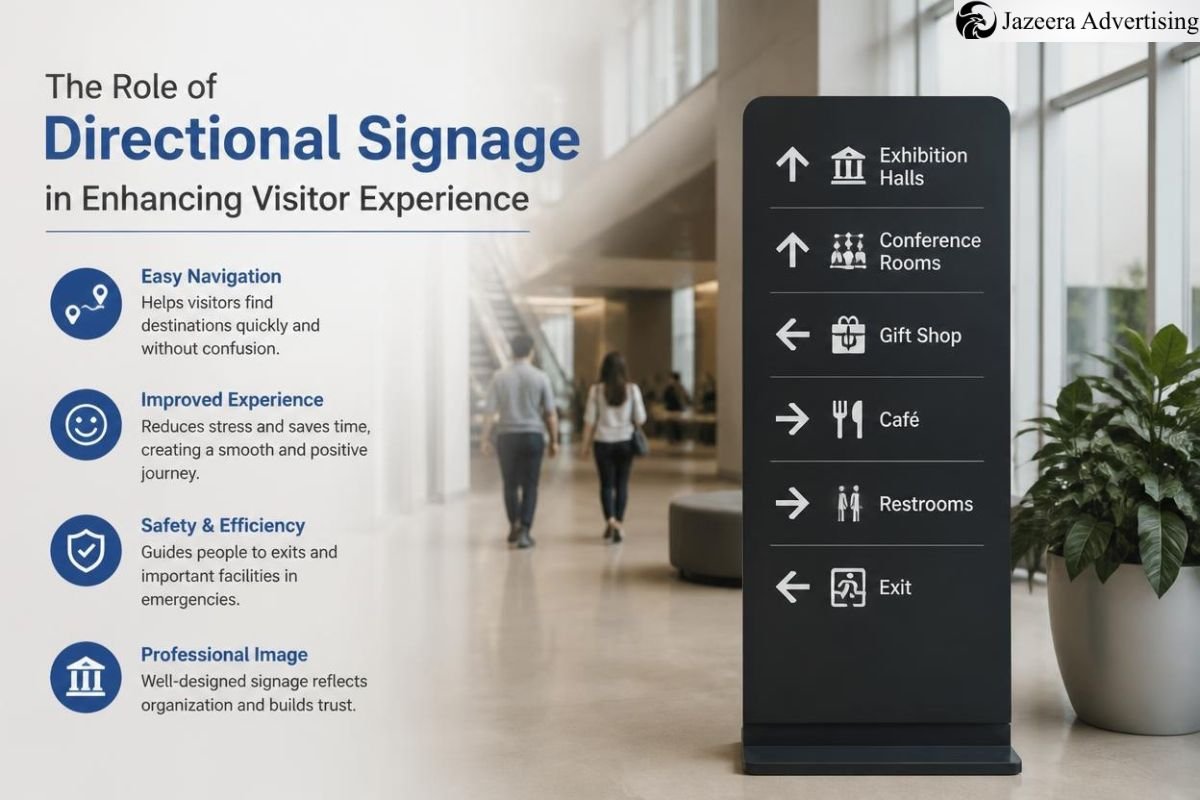
The Role of Directional Signage in Enhancing Visitor Experience
Table of Contents
- Key takeaways
- What is the role of directional signage?
- How does directional signage improve visitor experience?
- What types of directional signage work best?
- Where should directional signs be placed?
- What design principles make signs easy to read?
- How do you choose the best signage partner?
- What are the best practices for indoor directional signage?
- How do you maintain signs and measure results?
- What common mistakes should you avoid?
- Final thoughts
- Frequently asked questions
Directional signage is important in terms of visitor experience, giving information about the location, required distances for walking, and what to expect upon arrival. Good wayfinding decreases confusion and stress, creating a feeling of a well-organized building. This is especially important for hotels, malls, clinics, and offices, where carefully designed directional signs reduce the amount of disturbances faced by the personnel involved and contribute to the fulfillment of their functions.
This discussion explains how directional signage functions, how to place it properly, what its design should look like, and how to choose the right partner for finding good signage solutions.
Key takeaways
- The directional signs answer questions about directions to other places that people usually want to know more about.
- Signs at decision point for testing purposes are placed there; also tested by actual viewers’ eyesight.
- Legibility priority, contrast importance, and multilingual content are important to ensure accessibility of this application among various users.
- Select an experienced vendor of signs from Dubai to compare them against other companies for better results.
What is the role of directional signage?
Directional signage means any signage that directs people through a space, such as arrows, route maps, floor numbers, and destination labels. It is supposed to assist visitors in making decisions without seeking assistance. It gives information at the appropriate time, helps to move smoothly, decreases bottlenecks, and establishes an ordered atmosphere. New buildings, buildings not one’s own, are easy to navigate if they are well designed.
People tend to come into the office stressed, distracted, or in a rush. The sign design should be very clear and concise because few people read a long brochure before they look for the lift; that is, where do I go next? Without that answer, people wonder, ask staff again and again, and develop a negative impression of the staff within minutes.
Directional signage is also a brand touchpoint. Typos, colours, and materials convey a level of care with which a business functions. Jazeera Advertising does it like this with every project; they combine function with beauty in their external and internal signage, from facades to entrances and interior guidance.
How does directional signage improve visitor experience?
Wayfinding is effective without being too intrusive. If visitors can stumble upon the destination on their own, they don’t tend to pay much attention to the sign, and that’s exactly what you want to do. This is not just about navigation, but about comfort, efficiency, and inclusion.
How does clear wayfinding reduce visitor stress?
If there’s a lack of certainty, there’s anxiety, particularly in large venues like hospitals, airports, and shopping malls. The visitor is calmer and in better control when they know what lies ahead. Clear signs at each decision point eliminate any second-guessing of choices and retracing steps by people.
Clarity is not the only thing that matters: consistency does, too. Every floor and zone has arrows, icons, and colours that follow the same logic, meaning that visitors can learn the system in minutes and apply it to the entire building. If a sign with a distinct arrow type is used on each level, then individuals need to learn the rules again at each level.
Why does signage save staff time?
Unless a question is answered, the conversation always ends with a front desk employee. Directional signs with the right direction take care of the most frequent requests, allowing staff to focus on more personal aspects. There are typically three areas of improvement that businesses realize:
- Reduced repetition of queries at reception and information desks
- Reduced wait times for lifts, toilets and service counters.
- Quieter working during busy times like events, sales or peak clinic times
Furthermore, these gains build up over time. A receptionist that doesn’t repeat the same question every four hours can concentrate on welcoming visitors to the office, scheduling appointments, and addressing problems. In this way, signage acts as an unseen team member.
How does signage support accessibility?
Ramps and lifts are not the only ways of making things accessible. Signs are used to provide high contrast so that visitors who have low vision, cognitive differences, or limited mobility are able to see the sign from a reasonable distance, and that the sign is at a usable height. Tactile and Braille can be used also depending on the environment and local needs.
Accessibility is also affected by language. In a city as cosmopolitan as Dubai, signage that serves only one language group is likely to exclude many people. Using clear symbols together with a format of short sentences enables almost everyone to read easily, including visitors from afar and people who quickly skim the text in their own language.
What types of directional signage work best?
Signs must be different in various spaces. There is a lot more to the parking basement than there is to a boutique hotel lobby, and a good system typically incorporates multiple options. The table below is a comparison of the most popular options.
| Sign Type | Best Location | Main Advantage | Typical Use |
| Wall-mounted directional sign | Corridors and lobbies | Clean and space-saving | Room numbers and department names |
| Overhead or hanging sign | Large halls and car parks | Visible from a distance | Zone and level guidance |
| Floor graphics | Entrances and long walkways | Hard to miss | Route guidance and queue control |
| Projecting blade sign | Corridor intersections | Readable from both directions | Decision-point guidance |
| Totem or freestanding pillar | Plazas, campuses, and car parks | Strong vertical presence | Site maps and destination lists |
| Illuminated or LED sign | Night-time facades and entrances | High visibility in low light | Entry points and brand-led guidance |
A combination is best for most projects. The sleek reception signage feature in a lobby could be used for welcoming visitors, overhead signs in the car park, and projecting blades in the corridors at every junction. The most important decision is the type of sign to match the distance the sign will be from the viewer and the rate of movement.
Retail districts and hospitality districts may see high foot traffic at night and in the evening in Dubai, and illuminated signs should be given special attention and consideration. If the sign isn’t properly lit, it won’t be visible once the sun goes down. Lighting early, lighting right.
Moreover, there is a need for a system of safety information. There should be a special and applicable strategy for emergency exits, fire assembly points, and hazard warnings, which should be developed in conjunction with the directionality. Jazeera’s safety signage lines are designed for this purpose with many high-visibility options to assist workplace regulations.
Where should directional signs be placed?
The success or failure of a sign depends upon placement. Even the most well-designed sign is of little use if people are not aware of it, or if they come across it after having taken a wrong turn.
Which arrival points need signs first?
All trips begin at an entrance; therefore, arrival points should be the primary consideration. If visitors come from a car park, a street or a taxi drop-off, then they require immediate confirmation that they have arrived where they are expected. Welcome signage and directions to reception, lifts, or the main hall set the calm tone from the first step.
They can be overlooked, such as drop-off areas or car park entries. People driving into the site are already taking in a lot of information – speed, traffic, parking regulations, etc. Signage at the car entrance indicating parking and building entry helps alleviate hesitation and congestion at the entrance.
Where are the decision points?
A decision point is where a person must make a choice in their journey, whether it is a junction, lift lobby, or corridor split. These are the most critical areas for signage, as a missing sign at this time will lead people in the wrong direction. It’s a very simple principle: the sign should precede, not follow the decision.
A practical way to map these points is to walk the route yourself. For most buildings, the process below works well:
- Take the trail as you walk for the first time, beginning at the entrance
- Put a cross on each decision point
- Label each decision point with a sign, at an easy-to-view height and angle
- Test sightlines from normal viewing positions, such as when the area is full of people
- Check the system after the first hectic week, and make changes if necessary.
Therefore, the range of indoor signs for corridors and interior spaces developed by the Jazeera brand includes room-level and directional indications to smooth the transition from the entrance to the final destination. Signage placement inside the building should be uniform and as significant as the entrance design.
How should signs work with reception areas?
The reception area is often where guests have the greatest need for reassurance. A good reception area combines a welcome sign with directions to meeting rooms, waiting rooms, and lifts. A succinct message at the reception helps guests get moving quickly because it is easy to scan the directional information.
What design principles make signs easy to read?
Design is a place where a sign communicates or confuses. The best placement is not enough to save a sign that’s difficult to read, poorly lit, or has too much information. All of the following principles apply to most wayfinding projects.
Why does legibility matter most?
Directional signs always have legibility as their basis. The rule of thumb is that text should be approximately 10 ft in height for every 10 ft of distance to be considered. Legible fonts are more likely to be easily read from a distance, whereas decorative fonts are less legible.
Don’t include too many destinations on each sign – ideally no more than 3 or 4 destinations per sign. If a sign wants to list all the options, visitors take time to read it, and the line behind them is stopped waiting. Concise and focused messages maintain continuity of movement.
How should colour and contrast be used?
Colour can be used to make visitors aware of the different categories, for example, one colour for a restroom, another for an emergency exit, and a third for a meeting area. But colour should be an aid to the message and not a message in itself, since many people suffer from colour vision differences. The use of colour with text and symbols helps to make the system more inclusive.
You need to have a high contrast between the text and background. Typically, it’s best to have dark text on a light background or light text on a dark background. The matte finishes provide a smoother reflection under lighting conditions in bright areas, particularly near windows and glass doors.
Are icons and arrows enough on their own?
Icons and arrows can be very helpful, particularly in multilingual settings. A restroom icon or the lift icon can convey instantly across languages. However, not all icons are universally understood and work best when paired with short text labels.
Arrows should be drawn to show the direction of travel and should be uniform throughout a building. Varying the style or angle of arrows confuses, but a consistent arrow style and angle promotes confidence.
How does brand consistency fit into wayfinding?
Directional signage relates to marketing through brand consistency. When comparing branding and signage companies in Dubai, it’s vital that the partner can match the font, colours, logo rules, and material finishes for each sign, from the car park to the boardroom. Having a consistent look throughout the property makes it seem cohesive and professional, and bolsters brand recognition with every look-up.
Never allow the brand to become illegible. While graphics can be incorporated into a sign in large, prominent sizes, the directional information should still be the most prominent part of the sign. This is typically accomplished in the design by placing the logo in a dedicated header section and leaving the arrows and destinations prominent. The Jazeera article on corporate branding board designs is a great source of inspiration for brand boards in shared workspaces.
How do you choose the best signage partner?
Partnering with a direction sign provider is a long-term commitment since signs are in use for many years. When looking for the best signage company in Dubai, many lists come up with similar statements, which makes it advantageous to understand the difference between a reliable company and a straightforward vendor.
What should you look for in a provider?
A good provider isn’t merely a printer and installer. Find a contractor that inquires about visitor traffic, lighting, materials, and maintenance when making design suggestions. The following checklist includes the basics:
- A site survey before quoting for the design to fit the actual building
- Define material requirements such as weather resistance and finishes
- Success stories from projects in similar environments.
- Assistance in setting up a clear procedure for updates.
- Clear communication of timelines, responsibilities, and warranties
These points enable you to make an accurate comparison of providers. If the signs fade after 12 months, if they need to be repeatedly repaired, or if they are not compatible with the building design, then they have a lower value.
Why does local knowledge matter in Dubai?
Signage is truly challenged in Dubai’s climate. Inks and substrates can be dulled by intense sunlight, and the humidity and dust can cause damage to adhesives and electrical parts. A local handyman is familiar with materials that are suitable for these conditions, as well as materials that will age gracefully.
Language and culture are also a part of local knowledge. There are dozens of countries that people relocate from to Dubai, and many of these properties are going to be occupied by them, so bilingual Arabic and English signage is often essential. To ensure a design that does not become cluttered, a provider who is knowledgeable about the market can suggest layouts that will prevent both languages from taking center stage.
For example, Dubai signage specialist Jazeera Advertising has been working in the city for years and has developed its projects based on the situation in the area. For more information on Jazeera Advertising or for full information on signage services.
| Selection Factor | What to Check | Why It Matters |
| Site survey | Does the provider visit before quoting? | Ensures the design matches real traffic and layout |
| Materials | Are weather and UV ratings specified? | Protects signs from Dubai’s heat and sunlight |
| Language approach | Can they design bilingual layouts? | Serves residents, workers, and visitors clearly |
| Portfolio | Are there comparable completed projects? | Shows real-world performance, not just promises |
| Support | Is maintenance and updating covered? | Keeps signs accurate as spaces change |
What are the best practices for indoor directional signage?
There are specific challenges that are faced in indoor environments. People walk down corridors, down lifts, and up stairs, and often there are a lot of things that people don’t see, and there’s a lot of changing light on the way. A good indoor system is prepared to deal with these issues from the beginning.
When hiring an indoor signage company in Dubai, it is important to inquire about the performance of every product throughout the entire building, not just on the door. One partner who is thinking about the entire trip will create a more unified outcome than a partner who designs an individual sign.
How should lobbies and reception areas be signed?
The lobby establishes ground rules for the rest of the building. Signage should be used here to indicate the business name, invite people to reception, and indicate stairs and lifts. Limit the number of messages in each and put the most critical information at eye level.
Welcome signs or a brief description of the building’s floors are also good to be included in the reception zone signage. These little details make visitors feel welcome instead of lost. Reception signage designs can have a high-end appearance and provide directions to the most prominent places.
What works best in corridors and multi-floor buildings?
Signs should be consistent in the corridor. Each junction, lift, and door cluster should have a new sign, never allowing visitors to have to take big strides without any sign. Signs showing the project are very useful here, as they are visible from both directions when approaching an intersection.
Multi-level buildings should follow a clear system of levels when it comes to numbering. It is best to retain the same numbering system and colour scheme across all levels, and to display the floor number on the lift as well as on the stairs so that guests identify their level in no time.
Another thing worth mentioning is finishing touches. A name plaque or door sign showing the number and the purpose of the room allows guests to verify that they have reached their destination. In order to achieve a good effect with these details, laser engraving might be considered.
How do you maintain signs and measure results?
An installation of a directional sign system isn’t complete until it has been put up. Building changes and tenant movement are changing while visitors’ behavior evolves. The maintenance of a system ensures that it remains precise as well as efficient for an extended period.
How often should directional signs be updated?
Check out signs annually for updates like tenants moving in and out of premises, renovations to buildings, changes on storefronts, etc. Old signage is more likely to confuse, as people tend to follow it towards an incorrect destination rather than a new location where they need assistance. Maintain an easy-to-access log for signs’ locations, contents, and dates of installation so that it is easier to review them later on.
Additionally, cleaning is important. Weather conditions like dust may affect visibility, while dirtiness of the paper might decrease legibility as well. Check lighting frequently because an individual bad LED module may result in partially illegible signs.
How can you measure signage impact?
There is no need for complicated analytics to determine if your signs are effective. It simply takes observation and feedback:
- Monitor the number of requests for directions before and after installing signs
- Monitor whether guests are pausing and turning back at certain places
- Ask guests a simple question about how easy it was for them to find their destination
- Record the lengths of queues at busy points
This information enables you to decide what needs to be improved. If a lot of visitors pause at one corridor, it stands to reason that the sign at that junction needs to be either moved, enlarged, or changed.
What common mistakes should you avoid?
A lot of navigation issues are due to some common mistakes. Early recognition of these things is cost-effective for both those who have a signage business in Dubai and those managing their own signs.
- Signs at decision point placement for visitors; They should be visible prior to committing decisions by them.
- Stylish typefaces might look attractive up close, but they often fail from a distance or at a glance.
- Nighttime visibility is ignored; a signal that functions during daytime may vanish at night due to lack of lighting.
- Long-distance signs are overloaded, which slows people down and creates congestion at the sign location.
- Older room numbers and closed department names can be signs of forgetting about them, which damages trust rapidly.
Outdoor visibility requires attention and supervision. Many campaigns fail for the same reason, such as bad positioning or ambiguous messages. The article by Jazeera discusses these downfalls of failed campaigns more profoundly.
In the end, new technology can’t replace old good rules. Smart systems are becoming more and more common, however it still requires clear design, constant energy supply and simple content.
Final thoughts
The directional signs influence visitor perception of an interior space prior to any interaction with its occupants. If there is clarity of signage, consistency in placement and timing for visitor experience, employees have more free time to handle queries while maintaining an appearance that reflects business quality standards. Plan your entire trip instead of buying individual tickets for each stop along the way like this.
If you own an establishment such as a hotel, hospital, office, or storefront, then it begins with knowing where customers are going inside that place. Collaborate with an agency that conducts site assessments and selects long-lasting products for use under Dubai’s weather conditions and linguistic diversity. Selecting wisely from brands of signage services in Dubai will ensure that your signs are both attractive and functional. Through proper planning, your signage solution in Dubai will help people navigate easily over time.
Frequently asked questions
Removes guesswork, reduces stress levels and helps individuals to get from point A to B by themselves so that they can enjoy a comfortable environment at their own pace.
Put these on entrance doors, before any choice is made; next to elevators; and inside parking areas. View test sights at standard positions of observation.
The cost is dependent upon dimensions of material price lighting level installed at a certain height signs count. Request a site inspection so that I can get an estimate for this project.
Yes. Arabic-English language pairing for many of Dubai’s hotels is helpful to locals, employees, and visitors because it helps them navigate easily.
How Much Does Billboard Advertising Cost in 2026?
Emergency Exit Sign Requirements for Offices and Commercial Buildings