- November 10, 2026
- by Jazeeraadv
How Reflective Safety Signs Improve Visibility in Low-Light Conditions
Table of Contents
- Key takeaways
- What are reflective safety signs and how do they work?
- Why does low-light visibility matter for safety?
- How do reflective safety signs improve visibility at night?
- Reflective materials that perform best in low light
- Where should reflective safety signs be placed?
- How does Dubai’s climate affect reflective sign performance?
- What to look for in a reflective sign board?
- How to pick a reliable supplier?
- Maintenance tips for long-lasting reflective signs
- Common mistakes that reduce sign visibility
- Bottom line
- Frequently asked questions
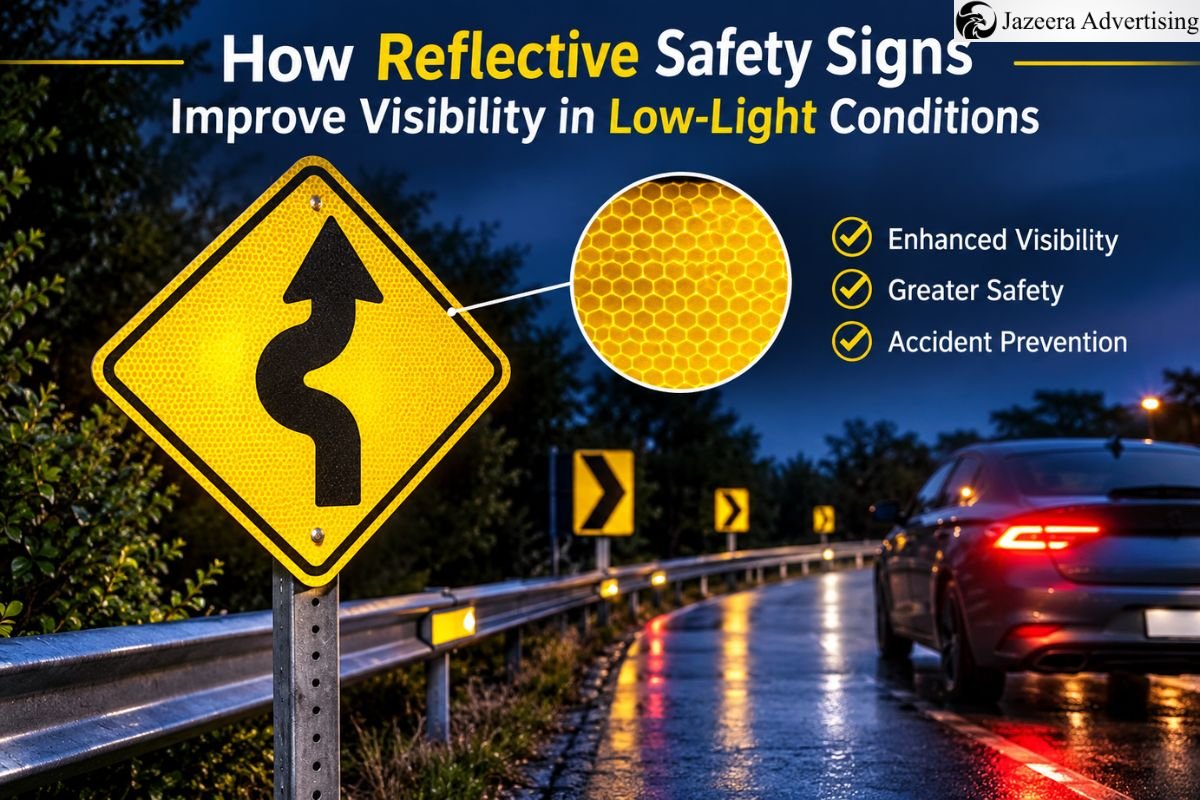
Reflective safety signs ensure more visibility under poor lighting because they send light back to its origin. Retro-reflective substances catch the light from headlamps, torches, and emergency lights and send it back to a person. That is the reason why a sign would vanish in a dark corridor or on a dirty site’s entrance and take back its meaning again.
When searching for the finest safety signs board in Dubai, reflective construction is the first aspect to look into. Daylight is only one of the points to keep in mind. Night shifts, thus, basement, parking, and dirty industrial areas require signs of it being dark already.
Key takeaways
- Reflective safety signs reflect light to the source; thus, they can be seen in darkness when the normal sign vanishes.
- The performance and longevity of a sign depend on the grade, substrate, and laminate quality.
- It’s just as crucial as the material itself to be placed at a correct height and angle.
- Signs should be constructed and maintained to withstand the elements of Dubai, such as high temperatures, high UV, and dust build-up.
What are reflective safety signs, and how do they work?
Common paint or printed vinyl disperses light in various directions, and therefore, most of it does not come back to the observer. Retroreflective materials work differently. They are made of tiny glass beads or microprisms that are incorporated in a clear resin. The light enters these materials, bends and reflects naturally in the glass, and follows the same path back.
In the case of a sign being viewed by a driver or worker, this means that whenever a headlight or torchlight is directed at it, it glows brightly. The effect is most noticeable when the light source is near the viewer’s sight. Consequently, a reflective sign appears bright in a vehicle but appears dull from a distance in the darkness. Such properties make it ideal for use on roads, factories, and warehouses.
Reflective Versus Non-Reflective Signs
Not all signs require reflective materials. In office buildings where the lighting is stable year-round, standard printed signs will also work well as expected. What is important, though, is the difference between the two in outdoor and industrial settings.
| Feature | Reflective Safety Sign | Standard Printed Sign |
| Performance in darkness | Brightens when hit by headlights or torches | Depends on ambient or built-in lighting |
| Visibility from a vehicle | High | Low to moderate |
| Typical use | Roads, car parks, construction, outdoor yards | Offices, reception areas, indoor corridors |
| Maintenance needs | Keep surface clean, check for abrasion | Keep surface clean, check for fading |
| Upfront cost | Higher | Lower |
Although reflective signs are more expensive at the start, they perform much better in areas where you can’t afford to lose something important.
Why does low-light visibility matter for safety?
A number of accidents on site and in facilities occur at dusk, during the night, or in poorly lit areas like doorways, tunnels, or stairwells. It takes time for your eyes to adjust to the light or dark when you transition from bright sunlight to shadowy space. In that limited amount of time, certain individuals may not be aware of the signs.
Additionally, in low light, the eye loses the ability to see details. Colours fade, text fades, edges lose contrast. If you can see it easily at noon, it might be difficult to see at 7 p.m. If you want to see our range of signs in action for greater workplace safety, take a look here: Browse our safety signage range.
Common low-light risk points
- Basement and underground car park entrances or exits
- Construction fencing and walkways
- Routes and loading bays for hydraulic or electric forklift trucks.
- Stairwells and between indoor and outdoor environments
- Unlit access roads, perimeter gates.
There must be signs at each of these places that may be easily understood even by someone tired, distracted, or walking quickly.
How do reflective safety signs improve visibility at night?
- Headlight and Torch Response
As an approaching vehicle approaches, its headlights will shine on the sign, which will reflect the light to the driver. The sign is clear and bright even without any power source. This is the same as a worker’s helmet torch, and reflective signs are useful in locations where lighting is sporadic.
- Colour, Contrast, and Shape
Reflective sheeting is available in standard safety colors such as red, yellow, green, white, and blue. Bigger contrast between background and symbol aids the brain to see the message quicker. Shape matters too. Triangles are typically used to alert, circles are typically used to forbid or require, and rectangles are typically used to give information. Using recognised shapes helps convey meaning to the person prior to reading the text.
- Reading Distance and Reaction Time
Being seen is not the only thing that matters about visibility. It’s the art of knowing what to do and when to do it. A reflective sign at the proper angle and height provides more time for people to slow down, alter their course, or wear protective gear. Larger lettering, simple words, and good contrast will keep a sign legible from farther away.
Reflective materials that perform best in low light
The type of material makes a big difference in night performance. Typically, sign suppliers have more than one grade of retroreflector; each one is appropriate for a specific type of viewing.
Retroreflective Grades Explained
- Engineering grade sheeting: Use for moderately lighted signs at night, which require less visibility and are less expensive.
- High Intensity Prismatic Sheet: These have a higher ability to reflect light and are ideal for signs that are viewed from a greater distance or at higher speeds.
- Diamond grade sheeting: The very best choice; this is usually used if maximum night visibility is required.
Furthermore, the grade should accommodate the actual viewing conditions and should not be the cheapest option. The requirements for a sign on a high-speed access road differ from a sign within a warehouse aisle.
Glass Beads Versus Micro-Prismatic Films
Glass bead sheeting has been in use for many years and works well at a broad viewing angle, but its brightness can suffer at close viewing angles. Micro-prismatic films are based on the principle of engineered prism structures which return light more efficiently, particularly at larger entrance angles. Both have a place. Inquire with your supplier what technology is appropriate for your site layout.
Substrate, Lamination, and Finish
Reflective sheeting is attached to a rigid substrate like aluminium composite, galvanised steel or rigid plastics. The reflective layer is protected with a protective laminate against the effects of abrasion, dust, and ultraviolet light. Because of the thinness or poor bonding, materials can warp or peel, and reflectivity is rapidly lost. Good suppliers communicate this well prior to production.
Where should reflective safety signs be placed?
Whether or not a sign is seen depends on placement. The best material will not work if it is not placed behind equipment or too low to trap a headlight.
- Construction Site Placement
At the fringe of the building site, construction site safety signage in Dubai begins. Reflective signs should be installed on entry gates, hoarding edges, and temporary walkways that can be seen from the road and inside the site. The hazard warning should not be limited to the entrance to the plant, but should be positioned where workers approach the plant for excavation, overhead work, and moving the plant. Planned sign positions during the site set-up phase will eliminate many of the gaps that occur during the start of work.
- Warehouses, Factories, and Loading Bays
Bright docks, dim aisles, and moving forklifts are elements of warehouse design. Route markings, pedestrian crossings, and emergency exits are good applications for reflective signs. Combine with an open plan diagram on the floor with the people’s permitted walking areas marked. The guide on emergency exit signs for warehouses and factories addresses the most frequently occurring issues when considering exit signage for these buildings.
- Car Parks, Basements, and Stairwells
One of the most difficult areas for signage is in a basement. The levels of light rapidly diminish after the entrance, and drivers might be turning sharply. Turning signs, ramp terminators, and pedestrian entrances are reflective to aid drivers and pedestrians in quickly reading the facility. Reflective edge markings and directional signs are also helpful in stairwells and will retain visibility in the event of a power outage.
How does Dubai’s climate affect reflective sign performance?
Any outdoor sign will be at a premium in Dubai. Over time, reflective materials are influenced by the elements of intense sunlight, high temperatures, fine dust, and humid coastal air.
- Colours may be affected by fading, or the protective laminate may weaken due to exposure to UV.
- In some cases, heat can melt adhesives, causing panels to expand or rise.
- Sand and dust settle on the surface, which decreases the light returned.
- Corrosion of untreated metal backings and fixings can be caused by humidity and salt air.
Signs constructed for a temperate climate might not work as effectively in the UAE. Verify if a product has been tested or specified for hot or dusty applications and ensure fixings are rated for outdoor use. Therefore, the materials used for construction site safety signs in Dubai should be strong, as they are in direct sun and dust for extended periods.
What to look for in a reflective sign board?
When selecting the best safety signage board in Dubai, examine the paint. The durability of the board depends on its construction.
- Material and Durability Checks
Inquire about the reflective grade and UV resistance of the laminate. Request samples or a written specification. A knowledgeable supplier will be able to clearly explain what type of sheeting is used, the thickness of the substrate, and the service life. Do not make statements that do not specify materials.
- Installation and Mounting Quality
Even a good sign will not be very successful if it is a poorly installed sign. Ask the supplier if they have any mounting hardware available that would be suitable for the surface; ensure the board is drilled or mounted so that water does not pool; and ensure the sign is mounted at an appropriate height and angle to the surface to facilitate traffic it serves.
- Compliance and Standards
The shape, colour and symbol shading should be in line with accepted standards. ISO 7010 is a standard that is broadly applied to safety sign graphics, and UAE Occupational Health and Safety rules establish general requirements for communication of hazards at work. These should be understood by your supplier and explained how their designs meet these requirements. When a project requires regulated approvals, please check with the applicable authority before ordering.
How to pick a reliable supplier?
When you select a supplier, you are impacting quality and ongoing support. A safety signage supplier in UAE ought to be capable of presenting you with their explanation of the materials they use, a site survey, and completed projects that are comparable in their surroundings.
Questions to ask before you order
- What reflective grade would you suggest for this distance and speed?
- Is UV and abrasion resistance provided by the laminate?
- Do you have a sample or a material specification sheet?
- What will be the fixing to be used, and what fixings will be provided?
- Do you provide a site visit for placement and visibility?
- What happens if the reflective layer fails prematurely?
Therefore, a supplier that provides clear answers to these questions is generally much more approachable after installation. Jazeera Advertising has a site survey form to use as a first step before choosing materials.
Maintenance tips for long-lasting reflective signs
While reflective signs require less maintenance than other sign options, dust, grease, and graffiti diminish the effectiveness of reflective signs quickly. Dust is heavy in Dubai, and the maintenance of construction site safety signage is particularly important.
- Regularly clean signs with mild soap and water. Do not use hard solvents, as this can harm the laminate.
- It is recommended that edges and corners be checked for lifting, cracks, and water penetration at least every few months.
- Signs with visible fading, peeling or dark patching have likely lost their reflectivity and should be replaced.
- Clear out vegetation or remove temporary equipment that hinders sign faces.
- Keep track of installation dates and schedule replacements ahead of time to avoid signs that are failing.
A regular inspection regime ensures your site is compliant and a sign is still in place when a worker requires it the most. It is common for businesses to find a supplier that knows the local environment to be able to recommend replacement cycles.
However, for those who are considering a larger program, looking at projects that have been implemented with signage would be a good way to gauge how materials have performed in actual projects.
Common mistakes that reduce sign visibility
Most of the visibility issues are due to avoidable mistakes and not inferior material. Be alert to these typical problems.
- Mounting too high or too low so headlights or torches are not reflected off the face.
- Construction of obstructions blocking signs with stored materials or temporary structures.
- Selecting a grade that is too simple for the traffic volume or viewing distance.
- Very small text that is not visible from the road from a moving car.
- Failure to maintain – dust can accumulate on the reflective layer.
- Ordering without a site survey, with placement based on guesswork.
Moreover, one of the easiest ways to prevent these mistakes is by using the best signage company in Dubai that will do site inspections before production. Planning for a few hours can save months of bad visibility.
Bottom line
Reflective safety signs are practical for night use and for use in dusty areas, or in areas where people have to move fast. They operate in a retroreflective mode, which means that they remain visible to light from a vehicle or a worker’s torch.
They do their job best when there is the right grade, careful planning of placement, and regular maintenance of signs. When ordering, consult with a qualified safety sign supplier in UAE to discuss the site and determine the appropriate materials and how each sign will function in the specific environment of the site.
Frequently asked questions
Reflective signs are made of tiny glass beads or microprisms that reflect headlight or torch beam directly back to the person viewing the sign. This allows the sign to be lit without the use of its own light source.
Reflective signs don’t require electricity. These are usually used in outdoor locations, and they are a great help in an emergency in the event of a power outage, since they use their own source of light, such as headlights, torches, or street lights.
The lifespan is determined by the grade of materials, the quality of lamination, and maintenance. Signs outside where there is intense UV and dust exposure should be routinely checked and replaced when they lose significant reflectivity due to fading or peeling.
Requirements vary based on the project, site regulations, and local laws. Reflective signs are used extensively on construction sites to make it easier to see at entrances, hoardings, and hazard areas. Ensure details are correct with the relevant authority.

How Much Does Billboard Advertising Cost in 2026?

Emergency Exit Sign Requirements for Offices and Commercial Buildings