- November 13, 2026
- by Jazeeraadv
Emergency Exit Sign Requirements for Offices and Commercial Buildings
Table of Contents
- Key takeaways
- What emergency exit signs are and why do they matter?
- What are the core emergency exit sign requirements?
- Where should emergency exit signs be placed?
- How do requirements differ by building type?
- How do you choose a compliant signage board?
- What mistakes should you avoid?
- How often should exit signs be inspected and maintained?
- Closing line
- Frequently asked questions
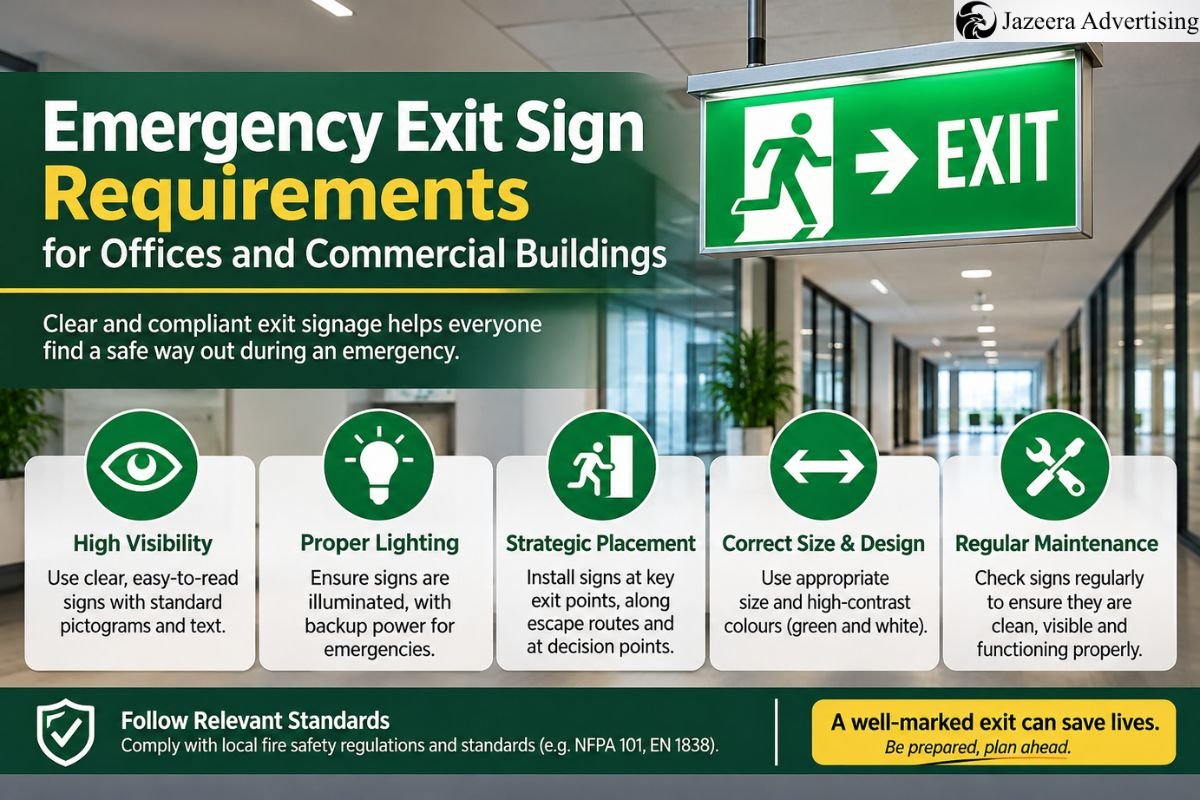
Emergency exit signs need to be readily visible, properly illuminated, and installed at every exit location; this helps people to find the safe way out during a fire or another emergency. In the case of offices and commercial premises in Dubai, these requirements generally adhere to the UAE Fire and Life Safety Code requirements and are regulated through the Dubai Civil Defence Authority. In short, exit signs must always be illuminated, always use the right running-man symbols on the right background, must be positioned at the right height above the door, and must be among the obstacles. Following these regulations allows one to secure people, be ready for inspections, and ensure compliance with the local legislation requirements.
Regardless of whether you take care of an office in Business Bay, a healthcare center in Al Barsha, or a commercial complex with many stories, the rules mentioned in this guide apply to you. The guide aims to inform you about the requirements covered, the location of signs, their variations based on the types of buildings, and how to select the right signage board to pass the required inspections. The guide provides some useful tips to ensure the proper functioning of the signs for years to come.
Key takeaways
- All exit signs should be lit, have the same symbol, and be located above all exits and at all changes in direction of travel.
- It is essential that you have backup power and regular battery testing, so incorporate these into your maintenance schedule from the outset.
- Signs for exits should be updated after any office fit-out, partition changes, or furniture reconfiguration, as office layouts evolve.
- Select boards that comply with the code, are durable, and have a supplier that will be able to assist with approval and maintenance.
What emergency exit signs are and why do they matter?
An emergency exit sign is an illuminated sign that indicates an emergency exit and guides people to it. A sign that can be read quickly could be the difference between an orderly evacuation and confusion in a smoke-filled corridor or in the event of a power outage. Most signs are symbolized by a white running figure on a green background, with symbolization conventions such as ISO 7010 widely used internationally.
Furthermore, the combination of lots of furniture, large open spaces, and a large number of occupants, many of whom may not be familiar with the office building of interest, means that offices present a special risk. Visitors, contractors, and new staff members often don’t know where the building is located and rely on signage for directions on how to get home.
Why do offices need clear exit guidance?
Corridors and meeting rooms are often partitioned, and rooms bend and split into multiple directions in offices. If not directed, individuals may approach a dead end or a service door that has been locked. A properly located exit signs takes that guesswork out of it and assists all to select the closest safe exit.
Exit signs matter in commercial spaces for several reasons:
- They direct the occupants quickly in the event of reduced visibility due to smoke or lack of light.
- They assist visitors and contractors when they are unfamiliar with the site.
- Help with confirming the locations of exits on arrival by emergency responders.
- They are documented as part of the fire safety inspection process.
Who must follow these requirements?
Owners, managers, and tenants all play a role. Owners typically operate fire systems on the building’s level, and tenants are responsible for fit-outs within leased units. Anyone making alterations to a floor plan should ensure that the signs remain compliant with the rules when the alterations are made.
What are the core emergency exit sign requirements?
Though requirements are different depending on the building type and on the code that is being reviewed, there are some common themes, such as illumination, symbols and colours, legibility, and power backup. These four areas can be used as a checklist during planning or auditing of a building.
Illumination and backup power
All exits are required to be illuminated when the building is in use. Many installations are powered by a mains lead and a battery backup, which will keep the sign illuminated during a power outage. Others are self-contained units that have built-in batteries. In the most common international codes, backup time is typically about 90 minutes, but please check with Dubai Civil Defence for your project.
The table below compares the common power options:
| Option | How It Works | Best Suited For | Key Consideration |
| Central battery | Lit from a building-wide battery system | Large commercial buildings | Needs regular system testing |
| Self-contained LED with battery | Each sign has its own battery | Offices, retail units, small floors | Individual battery checks required |
| Mains-powered with battery backup | Normal power, switching to battery during outages | Offices with stable power supply | Confirm backup duration |
| Photoluminescent | Glows after light exposure, no power needed | Supplementary guidance, stairways | Usually does not replace illuminated signs |
Symbols, colours, and wording
Exit signs should be a running-man symbol with an arrow if the exit is not directly overhead. The background is usually green and may be embellished with a symbol (usually white), and the word EXIT is often present as well. The correct symbol is important as it is understood immediately by visitors from many countries and will be checked by inspectors.
Good practice includes:
- Identifying and using standard green and white exit signage.
- Indicating routes where they are not apparent with arrows
- Avoiding long words and avoiding being too small in print.
- Using text that is not fancy and not having any other graphics or competing text.
The size of the letters and visibility distance
The distance from which a sign can be read depends on letter height and sign size. Larger signs are appropriate for wide corridors and high ceiling spaces, whereas smaller signs can fit into narrow spaces. Order with caution, as the viewing distance rules are frequently based on letter height.
Ensure that the sign is not dirty or covered. A sign that appears correct on paper may be blocked by plants, décor, hanging banners, and stacked boxes.
Where should emergency exit signs be placed?
The sign placement is as important as the sign itself. To ensure that any person in the building can see at least one means of escape from the area they are in, and a path is clearly visible from the point of origin to each means of escape.
Above every exit door
Each exit door must have a sign mounted on the wall or ceiling near the door. Signs placed too high or obstructed when the door is open serve no purpose. A sign or bracket projecting in a recessed area or alcove will ensure that the message can be seen.
Along corridors and changes of direction
Signs should be placed periodically in long corridors to ensure that the route is not out of sight. Signs should be placed at each junction, change of direction, or stairwell entrance, directing the direction of travel. A practical test is to walk the route at the usual running speed, and mark on the map where you cannot see the next exit sign any longer.
Typical placement zones include:
- Final and all secondary exit doors
- The place of junctions and branching in corridors
- Stairwell doors and landings
- Step changes, ramps, and steps are other terms used for changes in floor level.
- Furniture or other items that could be miswalked into dead ends or recessed alcoves
Mounting height and clearance
Signs are mounted at an appropriate height to be seen by people standing, but not blocked by ceiling lights, ducting, or objects hanging from the ceiling. Maintain code-prescribed distance around the sign to prevent being obscured by stored items, pipes, or ceiling tiles. Do not position to avoid glare from windows or downlights that will wash out the message.
How do requirements differ by building type?
Commercial buildings must also be properly planned for exits, but offices are not the only buildings where this is a concern. Requirements vary according to type of occupancy, building height, number of occupants, and the way in which the space is used. The table below summarizes some of the key differences.
| Building Type | Main Signage Concern | Typical Extra Measure |
| Offices | Open-plan layouts and moving partitions | Review signs after every fit-out and check sightlines past furniture |
| Retail and malls | High footfall and display fixtures | Keep signs clear of racks, banners, and promotional stands |
| Hotels | Guests unfamiliar with the layout | Add floor plans near lifts and stairs, with consistent sign style |
| Warehouses | Large spaces and stored goods | Mount higher, keep aisles clear, and use larger lettering |
| Clinics and hospitals | Occupants with mobility limits | Often subject to additional healthcare requirements |
- Offices and open-plan floors
A Dubai indoor signage company can assist with the planning of office signage that remains visible with changing layouts. Signs need to be placed high and away from storage items and screens for open-plan floors with movable desks, as these will create shifting obstacles. Meeting rooms and phone booths are not to be in the line of sight of an exit from the corridor.
The exit path may change whenever an occupant rearranges the layout of the floor. Exit signs and routes must also be depicted on fit-out drawings, and the new layout must be verified with fit-out drawings prior to occupancy.
- Retail, mixed-use, and multi-tenant buildings
Commercial areas and multipurpose buildings usually feature multiple types of business under a single roof. Each unit may have separate exits, with shared hallways connecting them. By ensuring coordination between the signage of landlords and their tenants, it is possible to reduce the chances of one party assuming that the other party has the respective sign.
How do you choose a compliant signage board?
Choosing the right board isn’t just about choosing an appropriate color. A good board should satisfy the code, should resist your building environment, and should be installed properly. When you’re doing the comparison, you’re searching for the best safety signage board in Dubai that is approved, has a long lifespan, and is easy to maintain.
What materials work best?
Materials impact durability, clarity, and expense. Clean faces and good light transmission for illuminated boards are achieved with acrylic and polycarbonate faces. If the area is high traffic or outdoors, where knocks and weather are an issue, aluminium or composite panels are suitable.
In the case of interior exit lights, it’s important to consider the type of lighting system and the overall aesthetic of the building. An indoor signage company in Dubai will be able to guide you in choosing the right mix of lights, face, and floor finish for your floor.
Key material considerations include:
- Acrylic or polycarbonate faces for clear and even illumination of messages.
- Single panel with aluminum or composite for impact resistance.
- Materials with an appropriate fire performance rating for the context.
- The provision of anti-glare finishes in corridors with good daylighting.
What to check before you buy?
When ordering, inquire if a product complies with the necessary standard, if there are test documents, and if the supplier can provide installation and inspection support. It is crucial for a safety signage supplier in UAE to describe why each sign complies with the code and give clear signage specs in terms of what method it is lit by and how long it will last if the power goes out. Jazeera Advertising’s signage and printing projects are available, and you can see examples of their work on the Jazeera Advertising website.
Questions to ask your supplier
Use these questions to compare quotations on an equal basis:
- Are the applicable UAE and international symbol standards adhered to by the sign?
- What form of lighting is provided and how many days is back-up?
- Do you have drawings or specifications to submit for approval?
- Do you provide installation services and a follow-on inspection?
- How will the sign be maintained, repaired, or replaced over time?
A reputable signage company in Dubai will have answers that are straightforward and won’t have any fuzzy language. Answers at this point will usually avoid any rework costs that will be incurred during an inspection.
What mistakes should you avoid?
Plans can go wrong on even the most well-thought-out projects. Most of the problems are of minor detail which is easy to overlook while designing and installing. Be aware of the following problems:
- Displaying signs too high, too low, or behind furniture and partitions.
- Use of unusual symbols or combinations of unrelated colours
- When a signage layout is changed, but not updated.
- Using only photoluminescent markings when illuminated signs are required
- Failure to take scheduled battery tests
- Constructing signs without approved drawings
One of the most prevalent underlying issues is battery failure. A properly functioning exit sign in the daylight can become inoperative during an outage due to a weak or disconnected battery. Include battery testing in your regular maintenance program so problems become apparent before they are discovered at an inspection or when you have an emergency.
Signage also ages. Lighting fittings may fail, faces can become scratched or discolored from sun exposure, and LEDs can become less bright over time. All maintenance and replacement procedures preserve the reading capacity of the message. With the best signage company in Dubai that provides maintenance support, these tasks can be easier to manage in various locations.
How often should exit signs be inspected and maintained?
The frequency of inspections is dependent on local requirements, the type of system installed, and the use of the building. Overall, facility staff typically conduct visual sign inspections on a weekly or monthly basis, test the facility’s illumination and backup systems at regularly scheduled intervals, and make sure there are records for inspection. The checks should include date, location, result, and person responsible.
| Task | Suggested Frequency | Usually Carried Out By |
| Visual check for damage, blockage, or dim lighting | Weekly or monthly | Facility staff or security |
| Functional test (simulated outage or test button) | Monthly or as the code requires | Facility team or contractor |
| Battery test and capacity check | Per manufacturer and code schedule | Specialist technician |
| Full system inspection and records review | Annually or as the authority requires | Competent inspector |
These frequencies are intended to give general guidance only. Please double-check the dates for your building with the approving authority and equipment manufacturer.
Use a simple log to help identify gaps. A long out-of-use sign is a serious risk, and documented checks demonstrate that the building is managed responsibly. A facility manager with good records will typically experience less stress during inspections and faster times.
Closing line
Emergency exit signs can be a simple yet vital element of building safety! If you know what is essential, can place signs strategically, and keep them up and in place, you are proactively keeping everyone using your building safe. Planning makes inspections easier and evacuation clear, whether you’re setting up a new office or upgrading an existing commercial building.
One of the elements in this planning is the selection of the most suitable safety signage board in Dubai. Ensure you are looking for compliance, quality materials, and a UAE safety signage supplier who is familiar with local approvals and provides support post-installation. When done right, your signage will be effective when you need it.
Frequently asked questions
Yes. All exit signs must be illuminated by means of battery-powered or mains-powered lights with batteries as a backup, or by lights that are self-contained.
Post signs above exit doors, away from ceiling fixtures. Check accurate heights with Dubai Civil Defence.
Typically not in areas where codes call for lighted signs. Typically, the photoluminescent markings are used only as an aid to guidance. Check with your approving authority.
Visually inspect weekly or monthly and test batteries and illumination according to local rules and manufacturers’ recommendations.

How Much Does Billboard Advertising Cost in 2026?
Emergency Exit Sign Requirements for Offices and Commercial Buildings