- August 10, 2026
- by Jazeeraadv
Smart Emergency Exit Signs: Latest Technologies in 2026
Table of Contents
- Key Takeaways
- Why does emergency exit signage still fail people?
- What changed in exit sign technology by 2026?
- Photoluminescent vs LED vs smart connected signs: differences explained
- Choosing the right signage supplier
- Installation placement rules most buildings get wrong
- Common mistakes facility managers make
- Maintenance and testing cycles
- Expert insights
- Bottom line
- Frequently asked questions
Key Takeaways
- The non-connection of modern exit signs to fire alarms and building management systems.
- Photoluminescent signs are still functioning excellently while LED systems are being utilized in modern office buildings.
- UAE Civil Defense approval depends on the placement, brightness, and reliability of the batteries.
- Supplier of safety signs in UAE takes care of compliance-related issues and prevents the rework from happening.
A building can pass every fire drill on paper and still fail the moment smoke fills a corridor. Usually that’s not because the exit signs are missing. It’s because nobody checked whether they’re actually visible under real emergency conditions: low light, smoke haze, people moving fast and not reading carefully. Exit signage has become a more technical part of building safety than most people assume, and 2026 brought changes worth knowing before your next fit-out or renovation.
This blog covers what’s genuinely new in emergency exit sign technology, where facility managers in Dubai tend to slip up, and what to look for when sourcing the best safety signage board in Dubai for a commercial or industrial site.
Why does emergency exit signage still fail people?
Exit signs look like a solved problem. A green box, a running figure, mounted above a door. But fire safety audits across the UAE keep flagging the same issues: signs mounted too high to see under smoke, battery backups nobody tested after installation, signage that hasn’t been touched since the building’s original handover.
However, the real issue is that exit signage gets treated as a one-time purchase instead of a system you have to keep maintaining. A sign that worked fine at commissioning five years ago can have a dead battery today, and nobody finds out until an actual power cut.
What changed in exit sign technology by 2026?
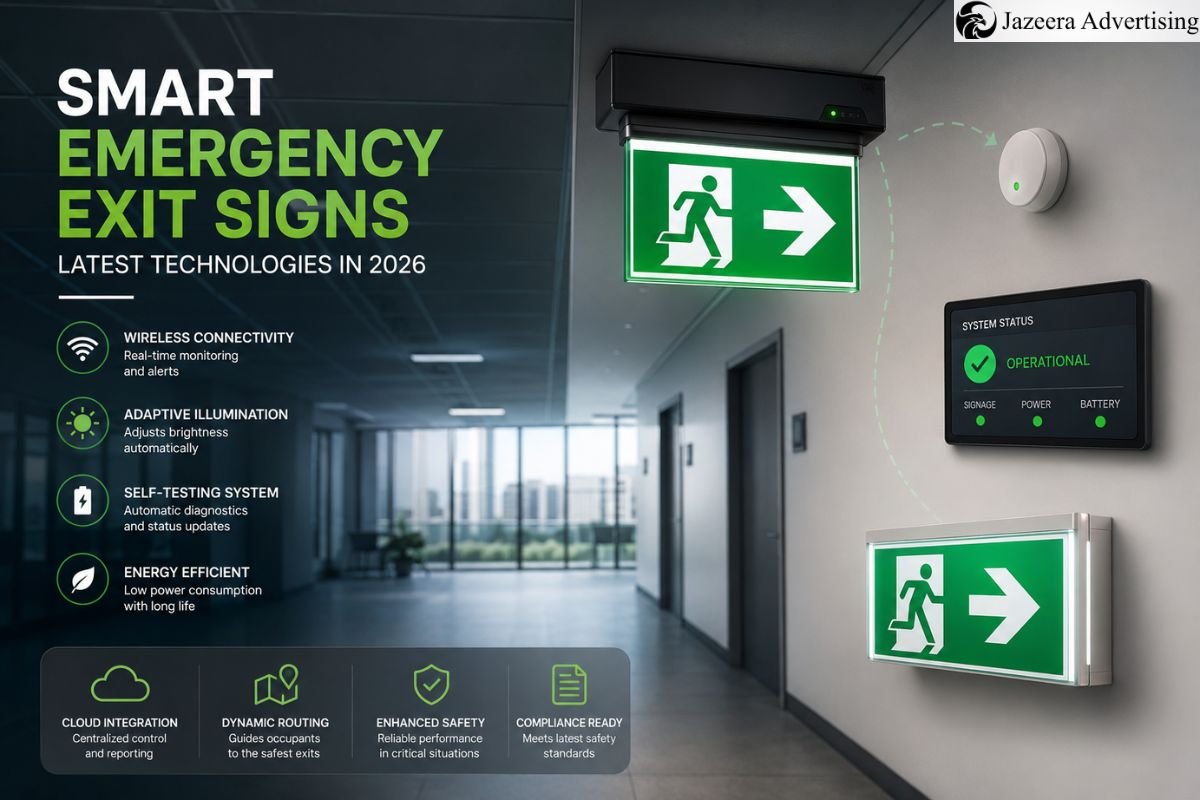
The bigger change isn’t the sign. It’s what’s wired behind it. Newer systems connect exit signage to the building’s central fire alarm panel, so a sign doesn’t just glow constantly. It can flash, redirect, or reroute based on where smoke or fire is detected. If one exit path gets blocked, a connected sign near that door can switch off or point toward another route.
A few things worth knowing:
- Addressable signage- Each sign has its own address on the fire panel, so building management can see which units are working and which need attention, without walking the floor.
- Dynamic direction indicators- LED arrows that change direction depending on which escape route is currently safe, instead of a fixed static arrow.
- Self-testing modules- Signs that run their own battery and LED diagnostics on a schedule and log faults automatically, rather than depending on someone remembering the quarterly check.
- Longer battery life at lower power draw- Some units now hold backup power for 3+ hours instead of the old 90-minute minimum, which matters in high-rise evacuations where getting everyone down the stairwell just takes longer.
None of this replaces basic photoluminescent signage as a fallback. It adds to it. Even the most advanced connected sign should still glow on its own if both power and battery fail. Safety signage suppliers in the UAE will be beneficial for you.
Photoluminescent vs LED vs smart connected signs: differences explained
People often ask which type they actually need. It depends on building size, occupancy, and how the fire system is already set up. Here’s how they compare.
| Feature | Photoluminescent | Standard LED | Smart Connected LED |
| Power source | Ambient light charge | Mains + battery backup | Mains + battery + network link |
| Works during total power loss | Yes, passively | Yes, on battery | Yes, on battery |
| Integrates with fire alarm panel | No | Rarely | Yes |
| Remote fault monitoring | No | No | Yes |
| Typical lifespan | 10–25 years | 5–10 years | 5–8 years (electronics-dependent) |
| Best suited for | Warehouses, basements, low-tech sites | Offices, retail, standard commercial | Malls, hospitals, high-rises, large campuses |
For a mid-size office in Dubai, standard LED with battery backup does the job and costs less. For hospitals, malls, or high-occupancy towers, addressable smart signage earns its higher price through faster fault detection and dynamic routing.
Choosing the right signage supplier
This is where projects usually go wrong, and it’s rarely the sign design. It’s the sourcing. UAE Civil Defense has specific rules for exit signage brightness, mounting height, and battery duration, and those rules don’t always match what’s printed on a generic overseas spec sheet.
Before signing off on a signage solutions Dubai provider, ask:
- Do they supply Civil Defense-approved signage with actual documentation, not just a verbal assurance?
- Can they show recent installations in similar buildings, retail, industrial, or residential towers?
- Do they offer post-installation testing and a maintenance contract, or just a one-time sale?
- Are the LED boards fabricated in-house, or resold from stock nobody can verify?
Therefore, Jazeera Advertising has handled signage fabrication and installation across retail, industrial, and commercial sites in Dubai. What separates a smooth job from a problem job usually comes down to whether the supplier understands the local fire code details, not just how to build a sign. The best LED Sign board makers in Dubai will offer the best one.
Installation placement rules most buildings get wrong
Placement matters as much as the sign itself.
- Mounting Height Inconsistency
Signs above door frames should sit at a consistent height throughout the building, usually between 2.0 and 2.5 meters from finished floor level, though this varies by local code. Mixed heights across floors confuse people moving fast under stress.
- Line-of-Sight Gaps
Long corridors need signage in the middle, not just one sign at each end. If someone can’t see the next sign from where they’re standing, that gap needs filling regardless of what the drawing says it should look like.
- Ignoring Low-Level Signage in Smoke-Prone Areas
Some jurisdictions now recommend low-level photoluminescent strips near the floor in corridors, since smoke rises and blocks ceiling-mounted signs first. It’s an easy thing to miss if the design only accounts for normal visibility.
Common mistakes facility managers make
- Treating signage as decoration- Exit signs get repainted, covered, or blocked by shelving because nobody flags them as safety-critical during a renovation.
- Skipping battery testing- A yearly glance isn’t enough. Battery backup duration needs to be tested under actual load.
- Buying on price alone- The cheapest LED board often lacks the certification paperwork Civil Defense inspectors want during an audit, and that turns into a costly delay later.
- No maintenance contract- A sign installed correctly in 2023 with no follow-up service is a liability by 2026.
Maintenance and testing cycles
Most UAE fire codes call for monthly visual inspection and an annual full-duration battery test for emergency lighting and exit signage. Addressable smart systems cut down on the manual work since faults get reported automatically, but they still need someone checking in person now and then. Sensors and software miss things a technician catches on a walk-through.
A testing rhythm that works for most commercial buildings:
- Monthly: visual check for damage, dirty LED lenses, or anything physically blocking the sign.
- Quarterly: battery discharge test on a sample of units, simulating a power failure.
- Annually: full building battery duration test and a Civil Defense compliance review.
Expert insights
The buildings that pass Civil Defense inspections without drama aren’t usually the ones with the most expensive signage. They’re the ones where someone actually owns the maintenance schedule. Signage technology has gotten smarter, but a smart sign with a dead battery is still a dark hallway during an emergency. The technology helps you catch problems faster. It doesn’t replace someone checking.
Moreover, one other pattern worth knowing: buildings that source their exit signage and their general branding or wayfinding signage from the same supplier tend to end up with more consistent mounting quality, because the fabricator understands the full signage layout of the building instead of treating it as one isolated compliance item.
Bottom line
Emergency exit signage in 2026 isn’t just about visibility anymore. It’s about connectivity, self-diagnosis, and how fast a fault gets caught. But the basics haven’t moved: correct placement, tested battery backup, and Civil Defense-approved materials are still what a compliant system is built on.
If you’re planning a fit-out, renovation, or compliance upgrade and need the best safety signage board in Dubai backed by proper documentation and installation support, Jazeera Advertising can walk you through options suited to your building type and occupancy level.
Frequently asked questions
Monthly visual checks and at least one annual full battery-duration test are standard under most UAE fire safety requirements, with quarterly checks recommended for higher-occupancy buildings.
Yes. It’s still code-compliant and often required as a backup layer even in buildings running LED or smart systems.
Most codes require at least 90 minutes, though many newer LED units now offer 3+ hours for taller or higher-occupancy buildings.
No. They run independently on battery power during an emergency. The network connection is only there for remote monitoring and fault alerts.
Approved signage comes with documentation from the supplier confirming certification, brightness rating, and battery specs matching Dubai Civil Defense requirements.
Often, yes, though it depends on whether the existing fire panel supports it. A supplier can confirm this during a site survey.
Untested or degraded batteries, followed by signs getting physically blocked or covered during renovations.
Usually between 2.0 and 2.5 meters from finished floor level, kept consistent across the building so evacuees aren’t second-guessing.
They’re increasingly recommended in corridors prone to smoke, since smoke blocks ceiling signage first while low-level strips stay visible longer.
A supplier experienced in both fabrication and Civil Defense documentation, like Jazeera Advertising, can handle assessment, installation, and ongoing testing support.
Digital Compliance Boards: Future of Industrial Safety
Safety Signage Cost Guide for Businesses