- August 5, 2026
- by Jazeeraadv
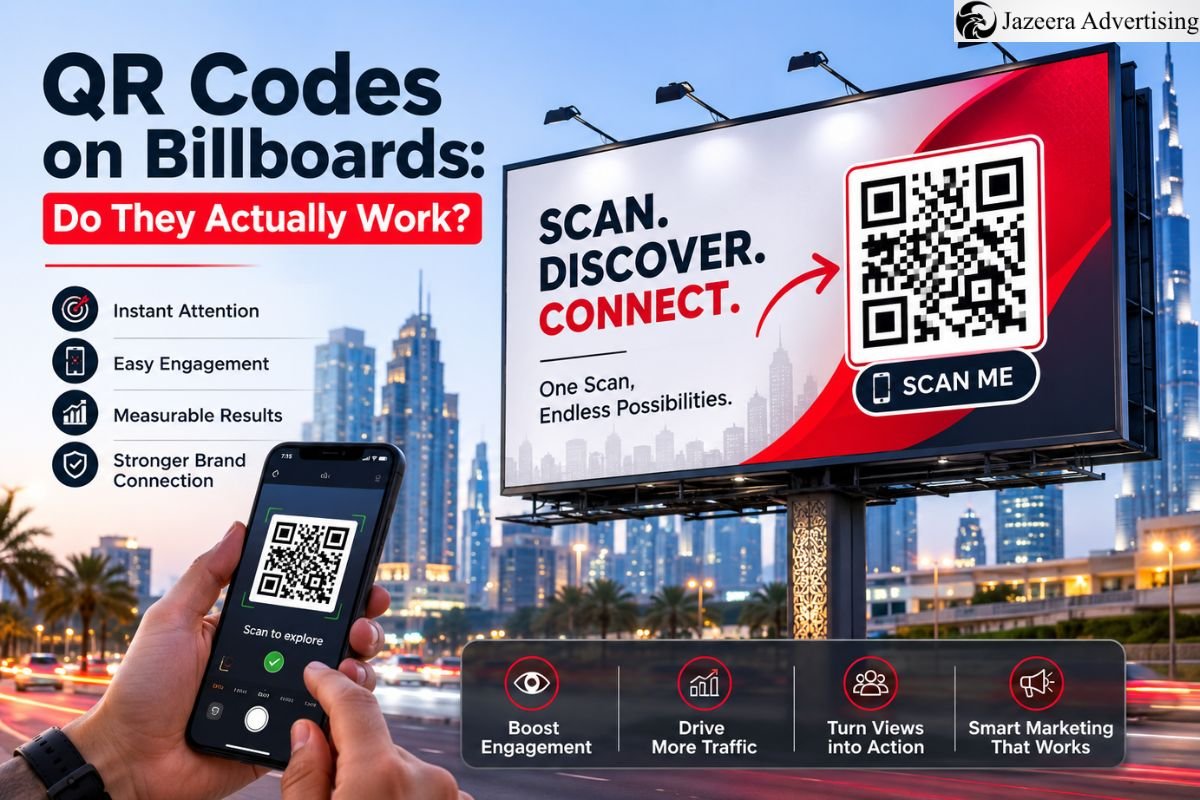
QR Codes on Billboards: Do They Actually Work?
Table of Contents
- Key takeaways
- How does QR code scanning behavior work outdoors?
- Where QR codes succeed on outdoor ads?
- Where QR codes fail on billboards?
- Design rules that improve scan rates
- Common mistakes brands make
- Choosing the right signage partner
- Expert insights from outdoor campaigns
- Final thoughts
- Frequently asked questions
Key takeaways
- The effective use of QR codes is guaranteed only if size, placement, and contrast hit the mark.
- QR codes positioned near traffic lights perform better than when placed alongside highways.
- A quality billboard print ensures the QR code stays sharp, high-contrast, and legible outside.
- Attractive incentives at the back of the QR code make people eager to scan it.
Yes, with conditions attached. A QR code on a billboard works when the person looking at it has time to stop, pull out their phone, and scan without stepping into traffic. Location matters more than design here. A code on a highway billboard doing 100 km/h traffic is close to useless; nobody’s scanning while driving. Codes located at the mall entrance, at the bus stop, or on building wraps near traffic lights occupy places where people remain for 15 to 20 seconds.
The pandemic caused QR codes to have a faster acceptance in the UAE compared to many other countries. QR codes became a part of all restaurant menus and retail payments, as well as event check-ins, in less than two years. That habit carried over into outdoor advertising. People aren’t confused by a QR code anymore. The real question isn’t whether they know what to do with it. It’s whether they have a reason to.
How does QR code scanning behavior work outdoors?
Scanning comes down to two decisions.
- First, the person notices the code.
- Second, they decide it’s worth the ten seconds it takes to scan. Either one can fail on its own.
Noticing depends on size and contrast. In order for a QR code to be scanned from an Android camera comfortably, it should occupy a size of around 10% of the area being printed, but this distance does not remain the same as the height of the billboard increases. The QR code should be printed the same size on both a rooftop billboard and a bus shelter advertising panel, but it will not work on the billboard as people will not be able to catch it in their frame.
However, the second decision, whether it’s worth scanning, comes down to the offer. “Learn more” isn’t a reason. “Get 20% off today” is. Outdoor ads get about three seconds of attention. If the value isn’t obvious in that window, the code gets ignored no matter how visible it is. Signage solutions Dubai are helpful in this situation.
Where QR codes succeed on outdoor ads?
Some formats consistently outperform others:
| Format | Why It Works |
| Bus shelters & transit stops | People are stationary for minutes, not seconds |
| Mall entrance signage | Foot traffic is slow, phones are already out |
| Retail storefront wraps | Shoppers are already in a buying mindset |
| Event & exhibition banners | High-intent audience, dwell time is built in |
| Building signage near pedestrian crossings | Natural pause points give scanning time |
Furthermore, static formats near foot traffic beat anything aimed at moving vehicles, and it’s one of the more consistent patterns in Dubai’s outdoor market. The medium ends up mattering almost as much as the message.
Where QR codes fail on billboards?
Highway and expressway billboards are the clearest failure case. Sheikh Zayed Road traffic isn’t stopping for anyone’s QR code, no matter how well it’s designed. In these placements, the code turns decorative rather than functional. Looks modern, does nothing.
A few other things trip campaigns up:
- Poor lighting at night- A code that reads fine in daylight can lose contrast fast under sodium streetlights or reflective glare.
- Weathered or faded flex prints- UV exposure in Dubai’s climate wears down ink faster than cooler regions ever see. A code that scanned fine at installation might not scan six months later.
- Codes placed too close to the ad’s visual center- If it’s fighting the main image or headline for attention, eyes skip right past it.
- No fallback for non-scanners- Older audiences, or anyone without data on hand, need a printed URL or phone number nearby. Skip that, and you’ve lost that segment outright.
Design rules that improve scan rates
A handful of principles hold up across formats.
- Size relative to viewing distance- Rule of thumb: the code’s total width in centimeters should sit around one-tenth of the expected scanning distance. A code meant to be scanned from 3 meters out needs to be at least 30cm wide.
- High contrast over decorative color- Black on white is still the most reliable combination there is. Brand colors can work if the contrast ratio holds up, but pastel-on-pastel codes fail scan tests more often than people expect.
- Quiet zone around the code- QR codes need blank margin space to scan reliably. Cram other graphics up against the edges and you’ll get scan failures even when the code itself looks fine.
- Print quality matters as much as the design file- This is where the actual printing process becomes the deciding factor. A properly calibrated billboards & flex printing ses in Dubai tests print resolution and material against outdoor conditions, sun, wind, and humidity before mass production starts, not after the billboard’s already up.
Common mistakes brands make
Most QR failures on billboards trace back to a short list of repeatable errors:
- Treating the QR code as an afterthought bolted on at the design stage instead of planning around it from the start
- Using highway billboards for QR campaigns when the format doesn’t support scanning behavior at all
- Skipping a pre-installation scan test under real lighting conditions
- Linking to a generic homepage instead of a landing page built for that specific ad
- Ignoring how flex prints degrade over time in high-UV, high-heat conditions
Moreover, that last one gets missed constantly. A code tested and approved indoors under studio lighting can behave completely differently once it’s outside for a few months.
Choosing the right signage partner
This is really where the outcome gets decided, long before the billboard ever goes up. Any design tool can generate a QR code in seconds. What it can’t tell you is whether that code will actually scan once it’s printed six meters wide and mounted four meters off the ground in direct sun.
That gap is what separates a decent print shop from the best outdoor signage company in Dubai with real experience in large-format work. A partner worth using asks about the location before finalizing code size, tests print samples under comparable lighting, and will tell you outright if a highway placement won’t support the campaign’s goals, even if that means pushing back on the brief.
When you’re evaluating signage solutions in Dubai for a QR-integrated campaign, a few practical questions tend to separate the print vendors from the actual partners: Do they ask exactly where the billboard will sit? Do they run scan tests before full production? Do they explain the material choice instead of just quoting a price?
Expert insights from outdoor campaigns
While some QR code campaigns succeed while others fail, the primary reason is offering a significant reward. A discount, freebie, or an offer that lasts a limited time is far more appealing than the plain “For more information scan here button.
Vertical displays such as building wrap designs or signs on the storefronts tend to attract more scans than horizontal billboards. People bump into these displays and stay there to look at them for a bit longer than in front of the horizontal display.
Just implementing a QR code is not enough for a modern look in an advertisement. In case the design is cluttered and the offer does not sound tempting enough, most people will even ignore the code. Simplified design along with an appealing offer is what can change the game.
Final thoughts
QR codes on billboards aren’t a gimmick, and they’re not a guarantee either. They work when the placement gives people time to scan, the design accounts for real viewing distance and lighting, and there’s an actual reason to pull out a phone. Get those three right and a billboard stops being a one-way message. It starts driving action you can actually track.
If you’re planning outdoor advertising that needs to hold up under Dubai’s sun, traffic, and foot patterns, working with an experienced billboards & flex printing service and the best signage company in Dubai from the concept stage, not just the print stage, is what separates a QR code that looks good from one that actually performs. Jazeera Advertising works with brands through that whole process, from placement strategy through final installation, so outdoor campaigns get built to be scanned, not just seen.
Frequently asked questions
Yes. Static, pedestrian-facing formats like transit stops and storefronts scan far better than highway billboards, where drivers don’t have time to stop and scan safely.
As a rule, code width should be about one-tenth of the expected scanning distance. A code meant to be scanned from 3 meters needs roughly 30cm of width to read clearly.
UV exposure and weathering fade flex prints over time, which cuts contrast until the code stops scanning, even if it worked fine at installation.
No. A dedicated landing page built for that campaign performs better and makes results easier to track than a generic homepage would.
Generally no. Vehicles moving at speed don’t give drivers a safe window to scan, which makes highway placements a poor fit.
Poor planning, usually. Treating the code as a last-minute add rather than designing size, placement, and contrast around it from day one.
Yes. High contrast, like black on white, scans more reliably than pastel or low-contrast combinations, especially from a distance.
An experienced outdoor signage company tests print samples under real lighting, recommends placements that actually work, and flags formats unlikely to scan before production starts.
Not really. If the location doesn’t give people time to scan, or there’s no offer worth acting on, the code just adds clutter.
A specific incentive paired with a placement where people naturally pause. That combination drives more scans than clever design alone.

Digital Compliance Boards: Future of Industrial Safety
Safety Signage Cost Guide for Businesses