- September 17, 2026
- by Jazeeraadv
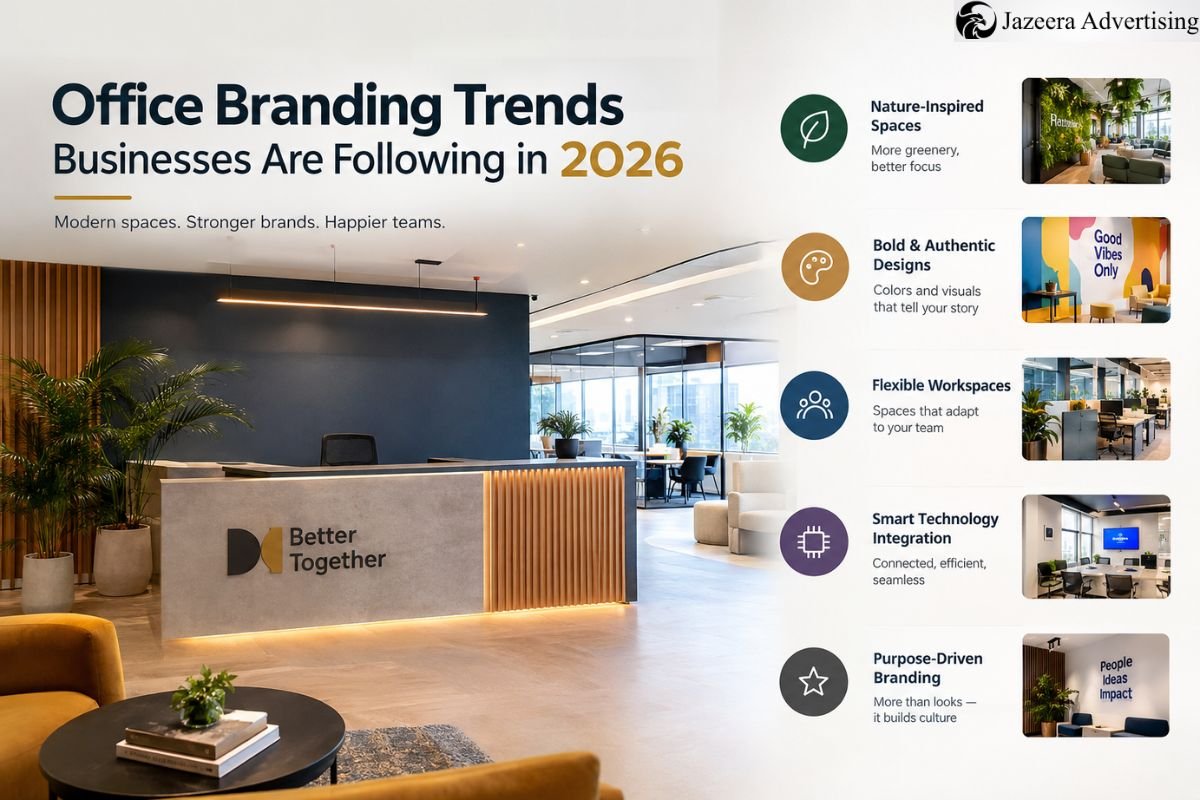
Office Branding Trends Businesses Are Following in 2026
Table of Contents
- Key takeaways
- Why office branding matters more in 2026?
- Trend 1: Branded wall graphics and feature walls
- Trend 2: Biophilic and sustainable branding materials
- Trend 3: Digital signage integration
- Trend 4: Minimalist logo placement
- Trend 5: Culture-driven meeting room naming and design
- Trend 6: Modular and reusable branding elements
- Office branding: DIY vs hiring a professional agency
- Cost factors to consider
- Common mistakes businesses make
- How to choose the right office branding company?
- Bottom line
- Frequently asked questions
In 2026, office branding in Dubai will have moved beyond logo walls to an immersive experience featuring sustainable materials, video displays, and design that reflects a company’s values rather than just its name. Clients ask for systems that can evolve without having to demolish the premises, so they can see more modular walls and changing display systems than static installations nowadays.
Additionally, physical branding will be accompanied by digital elements such as personalized welcome screens for clients and wall posters with QR codes. Nevertheless, the main point is that offices have transformed into client-centered institutions.
Key takeaways
- In most fit-outs in 2026, sustainable, low-maintenance materials are replacing materials used only for decoration.
- Digital signage in 2026 has become an important complement to physical branding.
- Modular systems are the winners, as frequent rebuilding of the walls becomes very costly for companies.
- Working with well-known branding agencies in Dubai definitely helps speed things up.
Why office branding matters more in 2026?
The competition for office space in Dubai has grown much tougher, not only for clients. But companies are competing for talent within the same commercial districts, too, and the office itself has become a part of that pitch. Even before a visiting client opens his mouth, a nicely arranged space tells him something. It also counts the folks who sit in that office five days a week.
However, it’s the nuance in the way a business is being branded that has changed this year. No one wants to enter their own reception and be in a salesperson’s ad for their own company. The preference is now to have the brand featured in the material selections, color, and layout, but without a car-sized logo in front of the reception desk.
Trend 1: Branded wall graphics and feature walls
Feature walls continue to be one of the most demanded office branding Dubai designs today, but what’s placed on them has evolved. Rather than a large logo, businesses are requesting graphics with texture, a mural that portrays part of the company’s history, or a wall with a timeline that highlights milestones. They have something to see and are not just a sign that they walk past once when they visit.
Here, the choice of materials is more significant than one would think. The one that is least expensive is vinyl wraps. Acrylic panels and metal-finish panels are more prominent in reception areas, as the added strength and sleek, sharp appearance are worth the investment.
Trend 2: Biophilic and sustainable branding materials
It used to be that sustainability was a part of the companies’ mission statement. The recycled wood finishes, low VOC paint, and living green walls as a backdrop for branding are now in the material spec sheet. It provides companies with a tangible response to a client or new employee’s questions as to what the company does for sustainability beyond just saying that it cares.
Moreover, designer color is also intentionally used to coordinate with brand colors, and the plants become part of the design rather than just an accessory.
Trend 3: Digital signage integration
It’s no longer just a sign that’s printed. Printed signage is not the only option. Digital displays at reception desks, meeting rooms and shared areas are becoming more prevalent, as they cycle through brand messaging, room schedules and even welcome a particular client by name. That’s better than reprinting a sign each time there is a change for a business that has multiple client meetings each week.
It also addresses a genuine issue in multilingual offices. Dubai’s client base is too varied to keep fixed signage in English, whether they’re on their way to the office or to the shopping mall. A screen does, however, do a far better job of switching languages than a fixed panel would.
Trend 4: Minimalist logo placement
A wordmark graved into a desk panel, a logo that’s been etched into a glass partition, a little emblem placed near a door, replacing the giant reception logo. It’s a trend that’s spreading to interior spaces, and it’s a space where the brand is not loud but rather quiet.
Trend 5: Culture-driven meeting room naming and design
It’s not only fun for the HR office to name rooms after company values, local landmarks, or company milestones; it’s actually a very useful branding tool. Not only does it provide staff with a common language (let’s grab the Marina room rather than conference room 3), but it provides clients with something to remember, and it turns a room that people book on autopilot into a small piece of the brand story.
Therefore, some Dubai offices make the effort to relate to the local area by using a local name or theme based on a landmark, for instance, to ensure that the branding remains local and not generic.
Trend 6: Modular and reusable branding elements
Instead of installing these for the long term, more businesses are moving away from permanent signage and towards modular panels, swap frame signage, and wall reconfiguration. It’s relevant for any company that rebrands periodically, shifts offices in the same building, or conducts seasonal campaigns. Since it’s a modular setup, there’s no need to tear down existing structures to update them, so it will save you both time and money and avoid the downtime of a full renovation.
Office branding: DIY vs hiring a professional agency
| Factor | DIY Approach | Professional Office Branding Agency in Dubai |
| Design consistency | Depends on in-house skill | Follows brand guidelines precisely |
| Material sourcing | Limited to retail options | Access to commercial-grade materials |
| Installation quality | Variable, DIY risk | Professional fitting and finishing |
| Timeline | Often delayed by internal resourcing | Structured project timelines |
| Long-term cost | Lower upfront, higher rework risk | Higher upfront, lower rework cost |
Furthermore, a small business with one feature wall or basic signage can probably handle it in-house. Once the project spans multiple rooms, includes digital signage, or covers a full identity rollout, a professional office branding company in Dubai tends to come out ahead financially, mostly because DIY jobs at that scale usually need reworking within a year.
Cost factors to consider
Office branding in Dubai doesn’t have a single price tag, but a few things consistently move the number:
- Material: vinyl and printed graphics come in cheaper than acrylic, metal, or illuminated signage.
- Scope: one reception wall costs a fraction of what a full-floor rollout costs.
- Digital elements: screens, mounts, and content management systems raise the upfront cost but usually cut down on what you’d spend updating physical signage later.
- Customization: fully bespoke fabricated pieces cost more than standard modular kits.
There’s no industry-wide rate card for this, since the building itself, material availability, and how complex the design gets all factor in. A site assessment before locking in a budget is the only way to get a number that actually holds up.
Common mistakes businesses make
- Picking decorative materials without checking how they hold up against Dubai’s dust and UV exposure, which wears down some finishes faster than people expect.
- Branding every single surface, which ends up making an office look cluttered instead of intentional.
- Leaving digital signage as an afterthought until after the physical branding is already installed, which forces an awkward retrofit later.
- Not setting aside a budget for future updates, so the branding looks dated within a year or two.
How to choose the right office branding company?
Look at their portfolio and check whether it’s actually office projects, not just retail displays or event signage repackaged as “commercial work.” Ask directly about material warranties, since Dubai’s climate treats certain finishes differently than cooler markets. It’s also worth finding a company that handles design, fabrication, and installation under one roof. Splitting those across separate vendors is where most delays and mismatched finishes come from.
Jazeera Advertising covers signage, printing, and interior branding work for commercial clients across Dubai, which is roughly the combination worth looking for when comparing an office branding agency in Dubai against a smaller vendor that only does one piece of the job.
Bottom line
Office branding in Dubai this year is less about a logo on the wall and more about the whole space feeling deliberate: sustainable materials, digital signage that actually gets used, and modular systems that don’t need to be torn out every time something changes. Anyone planning an update in 2026 should weigh flexibility and material durability just as heavily as how the branding looks on day one.
Jazeera Advertising is one option worth talking to if you’re comparing office branding companies in Dubai and want someone who can handle design, fabrication, and installation without passing you between three different vendors.
Frequently asked questions
It’s the visual and physical design of a workspace, signage, wall graphics, and color schemes that reflect a company’s identity throughout the office.
It depends heavily on material, scope, and whether digital signage is involved. A single feature wall costs far less than a full-floor rebrand.
If clients visit often or the team is multilingual, usually yes. For a small team with low foot traffic, printed signage alone is often enough.
Most businesses refresh every three to five years, though modular systems let you make smaller updates in between without a big cost.
Small, single-element projects are manageable in-house. Anything spanning multiple rooms or digital integration usually goes smoother with a professional handling it.
Materials built to resist UV exposure and dust, certain acrylics and treated metals, tend to outlast untreated finishes by a wide margin.
It does. Things like meeting room names and a consistent design language build a stronger sense of shared culture than people give them credit for.
Ask for office-specific project examples, get clarity on material warranties, and confirm whether they manage design, fabrication, and installation as one process.
Best Materials for Reception Letter Signage: Acrylic, Stainless Steel or Brass?
Office Branding Trends Businesses Are Following in 2026