- August 31, 2026
- by Jazeeraadv
How Often Should Safety Signage Be Replaced?
Table of Contents
- Key takeaways
- How often should safety signs be replaced?
- What shortens signage lifespan in Dubai’s climate?
- Requirements for construction site signage in the UAE
- Material comparison: which signage lasts the longest
- Choosing a reliable safety signage supplier
- Warning signs your signage needs replacing now
- Working with an outdoor signage company
- Common mistakes businesses make
- Expert insight: The real cost of waiting
- Bottom line
- Frequently asked questions
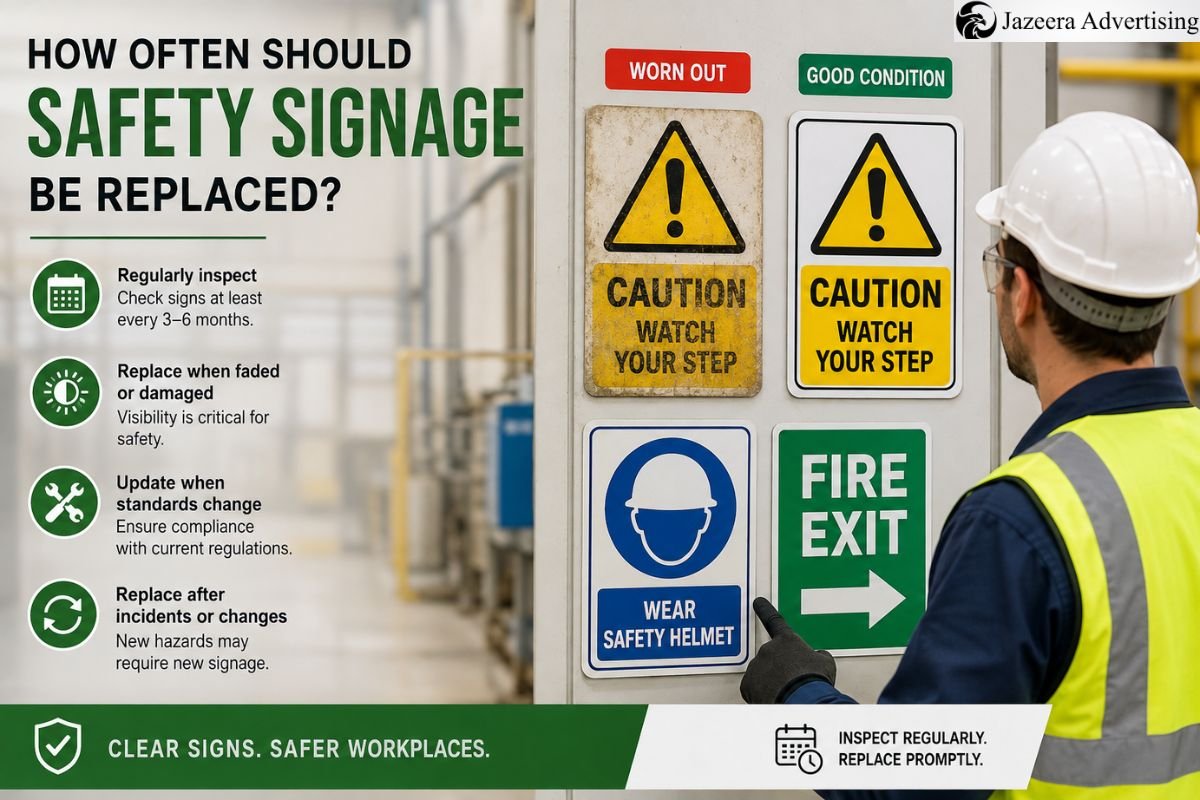
Most safety signage needs to be replaced around every 3 to 5 years, although in the UAE heat and UV exposure may reduce this lifespan. Manufacturer warranty data for reflective sheeting usually states 5 to 8 years for outdoor signage, but Gulf conditions, especially direct desert sun, tend to lessen this by 2 to 3 years. Signage should be replaced when one of the following occurs:
- The colours fade, or the information on the sign becomes unreadable from a distance
- The reflective coating loses its effectiveness
- The board cracks, bows, or peels
- The wording is outdated and does not comply with ISO 7010 or Civil Defence standards anymore
Those companies who want to buy the best safety signage board in Dubai should check their boards every 3 months instead of relying on the age of a sign.
Key takeaways
- Sign boards in outdoor conditions in Dubai are estimated to last between three and five years before their colors start to fade.
- Construction safety signs in Dubai should be bilingual and have ISO symbols.
- Materials such as enamel and aluminum, which are known for their longevity, will last longer than printed vinyl.
- Reputable suppliers provide quick turnaround time for new prints if there is a need to change the codes or layouts.
How often should safety signs be replaced?
UAE law does not prescribe a specific term for replacement, such as “replace anytime after every X years”. But there are universal standards for the performance of the signs: they should be visible, in proper color, and their condition should be sturdy. As soon as one of these criteria fails, it must be replaced regardless of how long it has been used.
Statistics serve as a good point of reference. Reflective material that is used in a lot of caution and warning signs has a typical lifetime of 5-12 years depending on its specific type. However, producers usually acknowledge the fact that signs that have been placed in high-stress environments lose much of their effectiveness even 2-3 years before they reach the prescribed limit. As for facilities in Dubai, this means that there is a window of 3-5 years for such signs as standard ones used on the outside and much shorter, 2-3 years, for the signs placed under direct sunshine.
Companies seeking a top-quality safety sign board in Dubai for their particular premises should refer to vendors for the advanced weathering statistics associated with the warranty of the product instead of just paying attention to the numerical data in the advertising materials. A guarantee of ten years without testing proves to be insignificant in July.
What shortens signage lifespan in Dubai’s climate?
UV radiation destroys pigments and adhesives on the molecular level. Colors do not lose quality simultaneously; they change gradually, thus enabling the signage to appear “good” until it is put next to a new one.
Additionally, heat cycling also increases wear. Signs exposed to the heat of 50°C during the day and cool down at night have to expand and contract all the time, and this stress factor impacts the adhesive layer, making it bubble or peel off much faster compared to a more stable climate.
Dust and sand wear effects are often neglected. Wind forces the dust to keep rubbing against the surface, making the coating gradually dull and thus making it difficult to read the text even before the color itself is gone.
Requirements for construction site signage in the UAE
Construction sites carry stricter and more specific signage rules than a typical office or retail unit, mostly because the population on site changes daily and includes visitors, subcontractors, and workers with different language backgrounds.
Under Dubai Municipality and UAE Fire and Life Safety Code guidance, sites are generally expected to maintain:
- Bilingual Arabic and English wording, with Arabic sized at least equal to the English text
- ISO 7010 standardized symbols and colors (red for prohibition, yellow for warning, blue for mandatory action)
- Clearly marked assembly points, fire equipment locations, and evacuation routes
- Hazard-specific signage for confined spaces, chemical storage, or work-at-height zones where relevant
Construction site safety signage in Dubai gets inspected as part of routine HSE audits by Dubai Municipality and contractor safety teams, and a faded or missing sign is a common finding in those reviews. Because site layouts shift as a project progresses, signage often needs updating well before it physically wears out, simply because the hazard it describes has moved.
Material comparison: which signage lasts the longest
Not all boards age the same way. Here’s a general comparison based on how these materials typically perform outdoors:
| Material | Typical Outdoor Lifespan | Best Suited For |
| Printed vinyl on foam board | 1–2 years | Temporary or indoor use |
| Powder-coated aluminum | 4–6 years | General warehouse and site signage |
| Reflective sheeting on aluminum | 5–8 years | Traffic, night visibility, roadwork |
| Porcelain enamel on steel | 15–20+ years | Permanent facility and fire safety signage |
For a facility deciding between options, the best safety signage board in Dubai usually comes down to where it’s mounted and how long it needs to last, not just upfront cost. A board that’s twice the price but lasts four times longer is the cheaper option over a five-year horizon.
Choosing a reliable safety signage supplier
Picking a supplier isn’t just about who quotes the lowest price per board. A few things separate a good safety signage supplier in UAE from one that has you reordering within two years.
Ask whether they manufacture locally or import finished boards, since local production usually means faster turnaround for reprints. Check if they can supply bilingual layouts that meet current ISO 7010 and Civil Defence formatting, not older templates. However, ask for references from sites with similar exposure conditions to yours too. A rooftop mechanical yard and an indoor storage facility wear signage very differently.
Therefore, a supplier who pushes back on unrealistic lifespan claims, instead of promising ten years on everything, is usually the one worth trusting.
Warning signs your signage needs replacing now
You don’t need a retroreflectometer to know a sign is failing. Watch for:
- Text or symbols that are hard to read from the required viewing distance
- Chalky, powdery surface residue (a sign UV has broken down the coating)
- Cracking, bubbling, or peeling at the edges
- Reflective panels that no longer catch headlights or torch light clearly
- Faded color that no longer matches ISO 7010 standard shades
If a sign fails any of these checks during a routine walk-through, replace it before the next audit, not after.
Working with an outdoor signage company
Exterior signage is a different discipline from indoor printing. It has to hold up through sand, coastal humidity, and months of direct sun, so whoever produces it needs to actually understand UV-stable inks, weatherproof substrates, and mounting hardware that won’t corrode.
A genuine best outdoor signage company in Dubai will talk through substrate options before budget even comes up, because the wrong material choice for your specific location is the single biggest reason signs fail early. They should also advise on mounting height and angle. South-facing boards take noticeably more UV punishment than shaded or north-facing ones.
Common mistakes businesses make
- Judging signage by age instead of condition- A three-year-old sign in a shaded, low-traffic area might still be perfectly legible, while a one-year-old sign in direct sun might already need replacing.
- Buying the cheapest option available- Printed vinyl on foam board works fine for a temporary notice, but it has no place marking a permanent fire exit or hazard zone.
- Skipping bilingual compliance- Some older signage still exists with English-only text, which doesn’t meet current UAE workplace safety expectations for a mixed-nationality workforce.
- Waiting for an audit to catch problems- Reactive replacement after a failed inspection ends up costing more, between fines, downtime, and rush production, than a planned quarterly check would.
Expert insight: The real cost of waiting
Run the math, and it’s not close. A quarterly visual check takes a facilities team maybe twenty minutes per site. A single sign that fails an audit costs more than that check ever would, once you factor in the fine risk and the rush order fee on top of rescheduling the inspection itself.
Facilities that treat the best safety signage board in Dubai as an ongoing maintenance line item, rather than a one-time purchase, consistently spend less over five years than those that wait until something visibly fails.
Bottom line
Safety signage isn’t a buy-it-once purchase, not in a climate that ages materials faster than most manufacturer warranties account for. A realistic replacement cycle, paired with quarterly visual checks, keeps a facility compliant and, more importantly, keeps people safe when a warning actually matters.
If your current signage is fading, cracking, or out of date with current codes, Jazeera Advertising can assess your site and recommend materials built for UAE conditions rather than generic imported stock.
Frequently asked questions
With standard outdoor signage exposure will last between 3 to 5 years in the UAE, even less with direct exposure to the sun depending on the material quality.
Yes. UAE guidelines require Arabic to be used, along with the English wording, in safety signage, with Arabic being at least as large.
Porcelain enamel on steel has the longest life, 15-20 years, but powder-coated aluminum is very cost-effective and durable for most locations.
In addition to replacement whenever fading, cracking, or loss of reflectivity has occurred, it is recommended that visual checks be carried out quarterly.
Yes. During Dubai Municipality and contractor HSE inspections, it is often discovered that the signage is not clear or is not kept up to date, and this can slow down or even stop the approval process, or lead to fines.
No. It is important more for low-light or night-time visibility (roadwork, perimeter signage on a property) than for all boards on a property.
The ISO 7010 standards are used: red = prohibition, fire equipment, yellow = warning, blue = compulsory action, and green = safe condition/exit.
Seek local manufacturing, ISO 7010 approved templates, true product life cycle advice, and testimonials from a similar environment of weather exposure.
Yes. Unshaded signs that face south receive significantly more exposure to the sun’s glare, and they usually need to be replaced earlier than signs with some shading or that face north.
Judging by age rather than actual condition to determine need for replacement which results in some replacement work being done prematurely, and signage being left in place when they are no longer legible in the majority of cases.
Construction Safety Signage Checklist Before Project Handover

Best Materials for Reception Letter Signage: Acrylic, Stainless Steel or Brass?