- September 5, 2026
- by Jazeeraadv
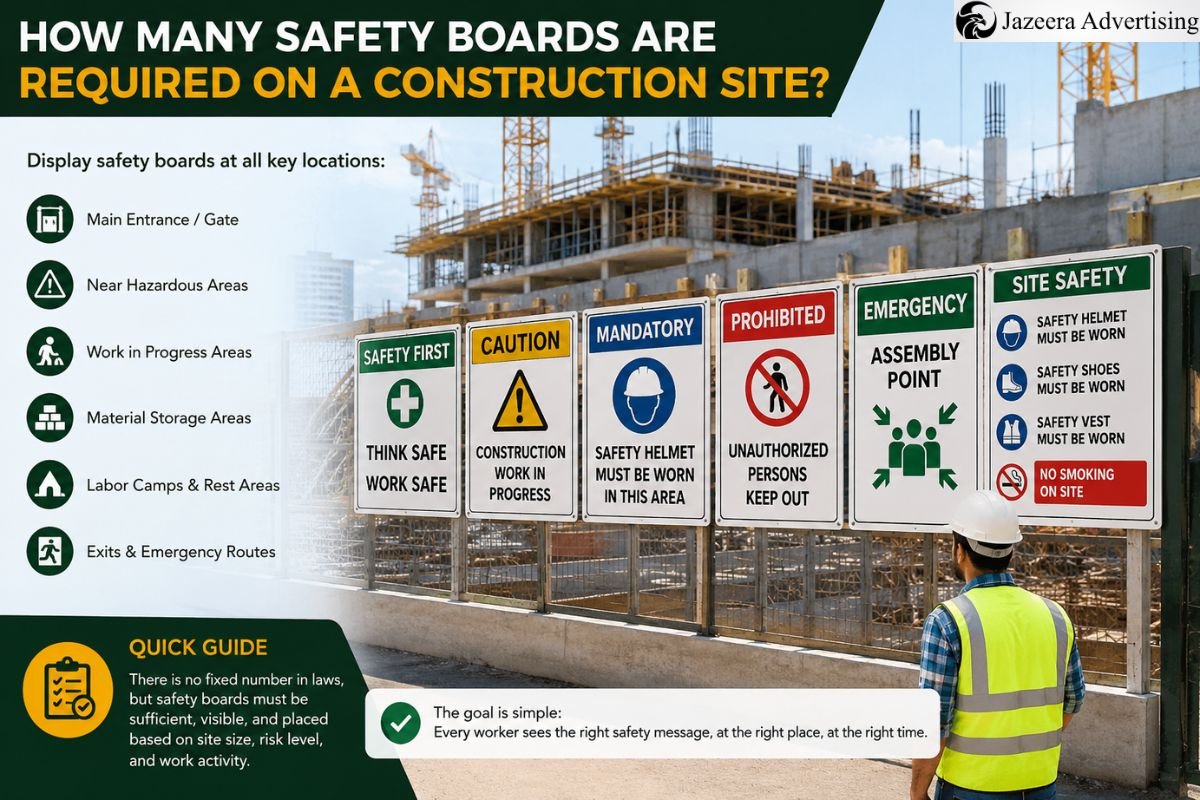
How Many Safety Boards Are Required on a Construction Site?
Table of Contents
- Key takeaways
- What actually determines the number of safety boards?
- Dubai’s legal framework for site signage
- Types of boards a compliant site needs
- Where to place them for real compliance?
- Common mistakes contractors make
- Choosing the right signage partner
- Keeping signage compliant long-term
- Bottom line
- Frequently asked questions
There isn’t one single fixed value. The Code of Construction Safety Practice by Dubai Municipality does not offer contractors an arbitrary number such as ’12 signs per project.’ Instead, what is required is for their surroundings to be marked at each entrance point, every danger area, each floor being worked on, and on the entire perimeter fence.
In reality, a mid-size jobsite in Dubai (for example, a building from 5 to 10 floors) will have around 20-40 signs, including greetings at the entrances, reminders for the use of personal protective equipment, hazard signs for particular floors, and emergency assembly point reminders. Bigger worksites with more contractors engaged or works being done in phases will have more boards in total. What really counts is whether all the hazards a worker or visitor would face will be marked before they get to them, not how many boards there are in total.
Key takeaways
- The type of safety boards necessary depends on the platform dimensions, dangers present, and entrances.
- The authorities in Dubai undertake inspections to ensure compliance with proper signage and PPE.
- There are obligatory signage boards, warning signs, banning signs, and emergency signs available.
- The leading suppliers in the UAE ensure there are no fines charged and expensive reprinted signage.
What actually determines the number of safety boards?
If you ask five different site managers how many boards their project requires, you’ll get five different answers – and all five of those answers might be correct. There is no formula used to determine the number. It is all about risk mapping. A single tower crane, one entrance, and three floors of construction require significantly fewer boards than does a mixed-use development with excavation, multiple subcontractors, and public foot traffic nearby.
The important thing to know is that each unique hazard requires its own sign, which must be placed in front of the hazard, not behind. Barrier signs are required to be placed on excavation edges. Warners are required for crane swing radii. Lockout or layout notices are required for areas where electrical work is being performed. When you’re doing construction site safety signage in Dubai, you should first perform a walkover of the site with a hazard checklist, and not a signage catalogue.
Moreover, the timeline of the project is a factor as well. The needs of a site in the foundation stage are different to those of a site doing façade work at height. One of the more frequent omissions I have seen in Signage Plans on inspection reports is that they are not being updated as the project evolves.
Dubai’s legal framework for site signage
The UAE Federal Labour Law places general duties on workers’ health and safety in a series of articles (Article 91 to Article 101), including an employer’s duty to ensure safe working conditions, including the requirement to communicate hazards as a visible hazard. Dubai Municipality takes this on board with its own Code of Construction Safety Practice, and enforcement is no fig leaf. In Dubai, there was a municipal safety campaign in which 35,000 engineers, supervisors, workers and contractors were visited on construction sites.
The same applies to the enforcement in Abu Dhabi. During one 3-day inspection sweep, municipal inspectors handed out 67 violations and 53 warnings, including some directly related to the lack of barriers, poor fencing and inadequate hazard controls, to contractors failing to meet basic safety requirements. In three days, the follow-on campaign identified 44 fines and 199 warnings, and once again uncovered entry points and non-existent temporary walls as common problems.
That’s the regulatory environment to be aware of: the authorities are not merely looking for signs. They’re verifying the signage is accurate to the risk level of the site and that it is in a language that workers can read. A safety signage supplier in UAE that is aware of this difference will create for compliance, not just for the inspection checklist.
Types of boards a compliant site needs
Not every board is made for the same purpose, and that’s where many sites get it wrong by putting them all together.
- Mandatory signs: signs giving instructions to be followed, such as ‘Hard Hats Required Beyond This Point’ or ‘PPE Mandatory’.
- Warning: Warn people of dangers, like an overhead crane in motion.
- Prohibition Signs: Indicate what you cannot do, such as unauthorized entry.
- Safety and Fire Signs: Identify meeting points, fire hoses, fire extinguishers, and first-aid kits.
- Information Panels: Provide information about the site, the contractor, and who to contact in an emergency.
A truly well-signed site respects the best safety signage board in Dubai and sees it as a readable signboard, which will offer pictograms in an ISO 7010 standard, so language is not an issue, and which will be able to withstand the heat of the Gulf without fading or warping within a year.
I have already had a site re-print an entire signage package after eight months, when they decided to use thin vinyl as opposed to a UV-stable board. This was a loss of money and time that no one wanted.
Where to place them for real compliance?
Most signage plans fail on placement, not design. A perfectly worded board buried behind a stack of rebar helps nobody.
Boards belong at:
| Location | Sign Type Needed |
| Main site entrance | PPE mandatory, site info, emergency contacts |
| Perimeter fencing (every 20–30m) | Warning of construction activity, no entry |
| Excavation edges | Fall hazard, barrier warning |
| Crane operating zones | Overhead load warning, swing radius |
| Electrical panels/live wiring | Danger high voltage, authorized personnel only |
| Scaffolding access points | Load limits, inspection tag status |
| Assembly points | Fire evacuation route, muster point marker |
The rule of thumb: if a worker or visitor can physically walk into a hazard without first passing a sign that warns them, the placement has failed regardless of how many boards the site has. Good construction site safety signage in Dubai comes down to sightlines: signs at eye level, unobstructed, and repeated at every approach angle to a hazard, not just one.
Common mistakes contractors make
A few patterns show up again and again on non-compliant sites:
- Signage installed once at project kickoff and never updated as the site’s hazards change.
- Boards in English only, on sites where the workforce reads Hindi, Urdu, or Tagalog.
- Faded or damaged boards left in place because replacing them “isn’t urgent.”
- Warning signs placed too close to the hazard itself, giving no reaction time.
- Treating signage as a box-ticking cost rather than an active safety tool.
Therefore, that first one is probably the costliest. A site’s risk profile in month one looks nothing like month eight, and a signage plan frozen in time stops protecting anyone.
Choosing the right signage partner
A lot of contractors prefer the least expensive sign supplier, but that could cost in the long run. Bad signs may result in fines, reprinting, or compliance issues. An experienced safety sign supplier in the UAE needs to evaluate your site and find potential sources of danger. They also need to know the requirements of the Dubai Municipality and recommend the best materials suitable for the weather conditions in the Gulf.
Before choosing a supplier, find out the following simple information. For instance, do the suppliers comply with the ISO 7010 pictograms standards? Can they produce multilingual boards in-house? What’s their turnaround time if a board gets damaged mid-project? The best signage company in Dubai’s answer to all three should be immediate, not “let me check.”
Keeping signage compliant long-term
Safety compliance does not conclude with signage installation, as it must be followed by ongoing maintenance. This is vital since UAE sunlight will fade or destroy poor-quality signage very quickly
A signage review every quarter makes it easy to catch faded, damaged or outdated signs at an early time and keep a simple log of each sign indicating where it is located, when it was installed, and when it is expected to be replaced.
When hazards change on the construction sites, signage must be changed as well; for example, excavation signs must be replaced as soon as cosmetic work starts.
Treating your best safety signage board in Dubai as an ongoing safety program will also make inspections easier and help avoid any last-minute troubles.
Bottom line
There’s no clean number that answers “how many safety boards does my site need,” and any supplier who quotes you one without seeing your site is guessing. What actually matters is hazard coverage: every entry point, every danger zone, every floor under active work, signed clearly and in the languages your workforce reads. Get that right, and the count takes care of itself.
If you’re planning or updating your site’s signage, Jazeera Advertising works directly with contractors across Dubai to map hazards and produce boards built for site conditions rather than showroom conditions, worth a conversation before your next inspection, not after. Contractors looking for a reliable best signage company in Dubai often start there simply because the boards are built to last a full project cycle, not just look good on day one.
Frequently asked questions
No fixed number exists in UAE law. Requirements are based on hazard coverage: every entry point, hazard zone, and floor under work needs signage, however many that adds up to.
Signs should use the languages your workforce actually reads, often a mix of English, Hindi, Urdu, and pictograms, since ISO 7010 symbols remove language barriers entirely.
Inspect quarterly. UV exposure fades vinyl and printed boards faster in the Gulf climate, so a board showing wear should be replaced immediately, not at the next scheduled cycle.
A warning sign flags a hazard (“Caution: Overhead Load”), while a prohibition sign bans an action (“No Unauthorized Entry”). Sites need both, placed differently.
Yes, proportionally. A smaller site has fewer hazards, so fewer boards, but the same categories, entrance, PPE, hazard, and emergency signage, still apply.
The main contractor typically owns this responsibility, though a safety signage supplier in UAE usually handles design, production, and installation under that contractor’s direction.
UV-stable aluminum composite or rigid PVC boards outlast standard printed vinyl by a wide margin under direct sun and heat exposure common on UAE sites.
Yes. Non-compliant sites can receive warnings first, with repeated violations leading to work stoppages until safety requirements, including signage, are met.
Absolutely. Excavation-phase hazards differ from façade-work hazards. A signage plan set once at kickoff and never revisited is one of the most common compliance gaps.
Readability from a distance, ISO 7010 pictogram use, weatherproof materials, and correct placement all matter; a best safety signage board in Dubai setup fails if any one of these is missing

Best Materials for Reception Letter Signage: Acrylic, Stainless Steel or Brass?

Office Branding Trends Businesses Are Following in 2026