- September 23, 2026
- by Jazeeraadv
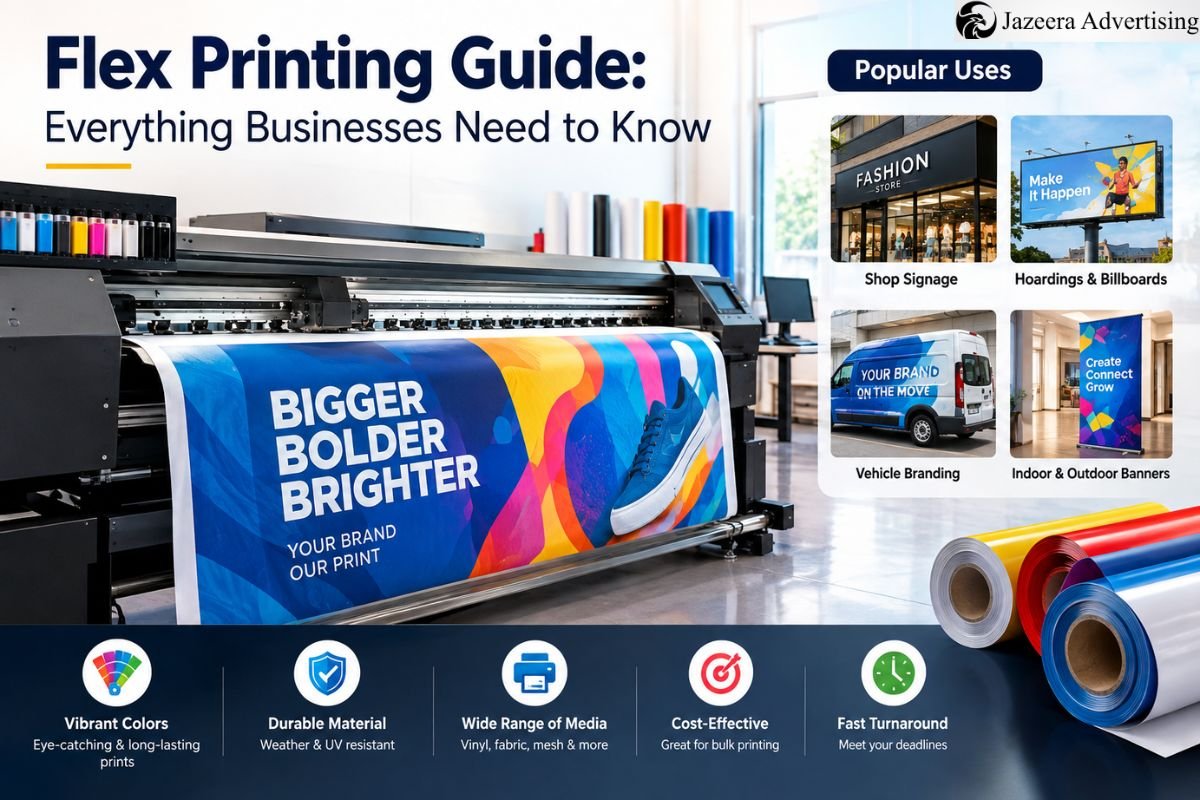
Flex Printing Guide: Everything Businesses Need to Know
Table of Contents
- Key takeaways
- What is flex printing?
- Flex material types and where each one fits
- Where do businesses use flex?
- Outdoor advertising permits in Dubai
- Preparing artwork that prints cleanly
- What drives the cost?
- Installation and upkeep in Dubai’s climate
- Mistakes that lead to reprints
- When flex isn’t the right choice?
- Choosing a printing and signage partner
- Bottom line
- Frequently asked questions
Flex printing refers to the process of printing the artwork on a sturdy PVC banner sheet by means of a large-format inkjet printer, and then completing the final product with hems and eyelets for mounting, hanging, or stretching purposes. Companies use it for hoardings, outdoor banners, lightbox covers, and backdrops. Its durability is ensured by the high-quality materials used for this process, and the price of a square meter of this kind of printing is lower than that of most other rigid types.
The outcome of your flex printing project depends on the materials the printing is done with, the artwork, and the permits for printing. When you are purchasing billboard printing and flex printing in Dubai, all of these must be addressed as they create a number of specific local features which are discussed below.
Key takeaways
- Flex refers to a digitally printed PVC banner available for hoardings, lightboxes, as well as shop fronts.
- Various types of flex, like frontlit, backlit, blockout, and mesh, are available for various purposes.
- Usually, outdoor adverts in Dubai need approvals from the concerned authorities.
- Preparing, finishing, and installing the artwork can influence the result itself as much as the printing process.
What is flex printing?
A flex banner is a reinforced core covered in PVC, with a smooth coated face that takes ink well. Frontlit sheets usually weigh 340 to 440 gsm. Heavier grades, around 510 gsm, exist for tougher jobs.
Printers run solvent, eco-solvent, UV, or latex inks. UV-cured inks are popular outdoors because they hold their colour better against the sun.
A typical job goes like this:
- The printer’s team checks your artwork at final size.
- The sheet is printed, then left to dry or cure.
- Edges get hemmed or welded, and eyelets go in about every 50 cm.
- Installers tie the banner off, tension it in a frame, or stretch it over a steel structure.
Flex material types and where each one fits
The choice comes down to two questions. Does light need to pass through the sheet, and how much wind will it face?
| Type | Best for | Watch out for |
| Frontlit | Hoardings, shopfronts, exhibitions | Catches wind; heavy on tall frames |
| Backlit | Lightboxes and illuminated signs | Needs even lighting behind it |
| Blockout | Double-sided hanging banners | Heavier than single-sided sheets |
| Mesh | Building wraps, windy sites, site fencing | Softer detail up close |
| PVC-free polyester | Indoor and eco-minded projects | Size limits vary by product |
Mesh has tiny perforations that let air through, which lowers the wind load. You give up some detail for that. Within about two metres, the print looks soft, and inside a metre you can see straight through it, so mesh is a poor privacy screen. From the street you’d hardly notice.
However, frontlit behaves like a sail. Hang a wide frontlit wall on an exposed site, and you’re inviting torn eyelets or a toppled frame.
Two quick examples. A workshop with a wide banner on an open roadside plot is better off with mesh. A restaurant with a lightbox on its facade needs backlit, so the artwork glows evenly at night.
Where do businesses use flex?
- Billboards and hoardings cover rooftop boards, unipoles, bridge banners and lamp post banners. Big faces are usually printed in sections and stretched over steel frames.
- Retailers use flex for promotional banners and for lightbox faces that stay readable after dark.
- Construction sites wrap scaffolding and perimeter hoardings in mesh.
- Events and exhibitions use it for stage backdrops, entrance arches and photo walls.
- Indoors, flex works best for temporary or seasonal setups. For office branding in Dubai, that means things like a launch backdrop or campaign graphics in reception. Permanent lobby logos usually look better in acrylic or metal.
Outdoor advertising permits in Dubai
Sort out approval before anything goes to print, because a finished banner that can’t legally go up is wasted money.
- Decree No. 6 of 2020 governs outdoor advertising in the emirate, and you can’t display ads without a permit.
- Approval comes from Dubai Municipality, the RTA, the economic department, or the free zone or development authority that manages the area, depending on the site.
- Restricted locations include residential building facades and balconies, historic and government buildings, traffic signs, trees, and places of worship.
- Fines go up to AED 15,000 and can multiply for repeat offences.
- When the permit expires, the holder has to take the ad down and restore the site.
Some free zones add their own rules, such as short promotional permit periods and permit numbers printed on the artwork. Content is expected to respect local cultural norms, and Arabic text has long been expected on outdoor ads.
Moreover, rules get revised, so check current requirements with the authority before you approve artwork. It also helps to ask anyone offering billboards & flex printing services in Dubai who files the application, since that changes your timeline.
Preparing artwork that prints cleanly
Flex is viewed from a distance, so it needs less resolution than most people expect. The catch is that resolution counts at final size.
- Common setups are full size at 72 to 100 dpi, or quarter size at 300 dpi. Past 150 dpi at full size, you add file weight and see no improvement.
- The classic failure is a 72 dpi web image stretched across a 10-foot banner.
- Send CMYK files with fonts outlined, and convert brand colours yourself. Left to the software, blues can drift toward purple.
- Keep logos and text about 50 mm inside the trim so eyelets don’t punch through them. Ask the printer for a template and their bleed requirement, often around 3 mm.
- Short messages and big type win. A phone number only helps if someone driving past can read it.
What drives the cost?
Flex is priced by area, so size drives the quote first. A 3 x 1 m shop banner covers 3 square metres. A 12 x 4 m facade covers 48 square metres, which is sixteen times the material, plus steel, crew, and lifting equipment.
Other things that move the price:
- Material grade, and whether the print is single- or double-sided
- Finishing, such as welded hems, pole pockets, or reinforced corners
- The frame or structure, if the site doesn’t already have one
- Access for installation, including work at height or off-hours work on busy roads
- Permit and site fees
- Design time and colour proofs
Installation and upkeep in Dubai’s climate
Tension matters more than most buyers realise. A slack banner flaps in the wind and tears at the eyelets, and frames with tensioned cords or aluminium extrusions keep the surface flat.
Sun is the other test here. Ask about UV-resistant inks and a protective laminate, since fading tends to show up before tearing does. On exposed sites, mesh copes with gusts better, and it’s worth checking fixings after strong wind.
Additionally, clean banners with mild soap, water, and a soft cloth. Harsh solvents and hard scrubbing can dull the surface.
Many branding and signage companies in Dubai bundle installation with printing, which helps because work at height needs trained crews and proper equipment. And replace a banner before its colours wash out. A faded sign looks neglected, whatever the business behind it is doing.
Mistakes that lead to reprints
- Using frontlit on a windy, exposed frame where mesh belongs
- Printing frontlit material for a lightbox that needs backlit
- Sending RGB files or low-resolution images
- Placing text too close to the edge
- Printing before the permit is approved
- Skipping a colour proof on a brand-critical shade
When flex isn’t the right choice?
Flex earns its place on large faces and campaigns with a fixed end date. Elsewhere it’s a weaker fit:
- For permanent identity signs, aluminium composite panels, acrylic letters or channel letters hold their finish longer and look more permanent.
- On glass, adhesive vinyl sits flush and looks cleaner than a hanging sheet.
- At touch height, rigid boards handle scuffs and knocks better than a stretched banner.
- If the message changes often, LED screens cost more upfront but save you reprinting.
Choosing a printing and signage partner
Anyone hunting for the best signage company in Dubai will see the label used freely, so use these checks instead:
- Do they print in-house or outsource, and will they share a material sample and proof?
- Do they handle permits and site approvals, or only production?
- Is installation done by their own crew, and how do they plan for wind load?
- Have they delivered work at your size and location type?
- Is the quote itemised into material, print, finishing, installation, and permit?
Therefore, compare at least three branding and signage companies in Dubai using the same brief, because quotes only line up when size, material and finish match. Jazeera Advertising, which works in signage and printing, is one firm you could include, and it’s reasonable to ask any of them for a site visit before quoting.
Bottom line
Before you brief a printer, settle where the banner will hang, how long it needs to stay up, and whether light has to pass through it. Those answers point you to the material, the finish, and the permit route.
Artwork at the right resolution and a properly tensioned installation cover most of what’s left. Send the size, location, and duration to a signage team such as Jazeera Advertising and ask for a proof and an itemised quote. That’s how billboards & flex printing services in Dubai go from a vague plan to a banner that holds up through summer.
Frequently asked questions
Vinyl is a thin, adhesive-backed piece of film that is applied to a surface such as glass or a panel. Flex is a heavy sheet which hangs over a frame or is stretched over it.
Yes, on blockout material. It has an opaque central layer to prevent the print from bleeding through from the back.
At full size, approximately 72 to 100 dpi, or at a quarter size, 300 dpi. Evaluate it in its actual size, not on your screen.
Depending on material, ink, sun exposure, wind, and tension. A fast-tensioned mesh can endure a slack frontlit on the same site. Check with your printer what will happen at your particular site.
Yes, in general, for outdoor advertising. The approving authority will vary depending on the location of the shop; consult your landlord, free zone, or signage contractor.
For temporary uses like launches, campaigns, and event days, yes. Acrylic or metal is a better choice of material for permanent reception logos as it is more finished and durable.
Review and compare quotes, request samples and proof, see similar work, and verify who is responsible for permits and installation. Jazeera Advertising or any other selected company will have to respond to these simply.
PVC flex is only available in a few locations. If sustainability is in the brief, inquire about take-back programs or PVC-free fabric options from your printer.
Digital Compliance Boards: Future of Industrial Safety
Safety Signage Cost Guide for Businesses