- September 15, 2026
- by Jazeeraadv
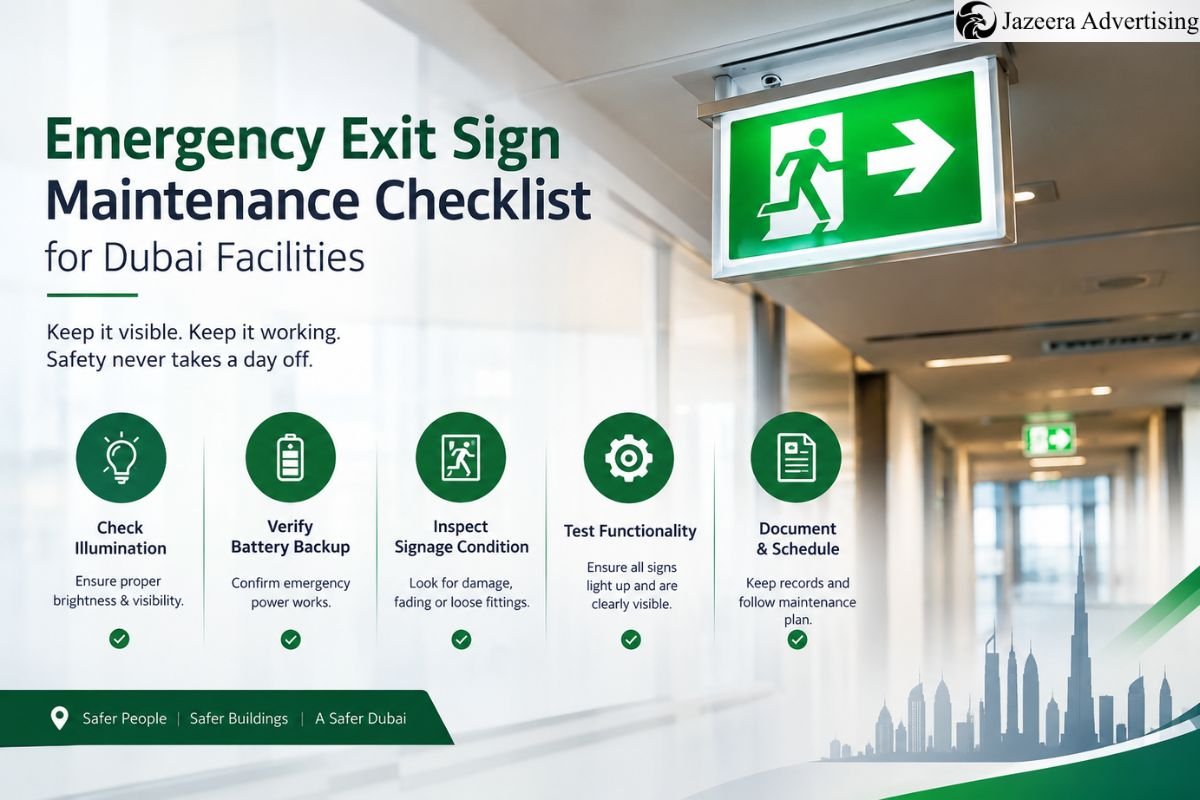
Emergency Exit Sign Maintenance Checklist for Dubai Facilities
Table of Contents
- Key takeaways
- Why exit sign maintenance gets overlooked?
- Daily and weekly visual checks
- Monthly testing procedures
- Annual and bi-annual compliance checks
- Common failure points nobody talks about
- Choosing the right signage partner
- Maintenance schedule at a glance
- Final verdict
- Frequently asked questions
Regular inspection of emergency exit signs is necessary for them to function properly. A faulty LED light, dead batteries, or accumulated supplies blocking exposure of a sign can turn a two-minute evacuation into a much longer, and even deadly, situation. This checklist outlines how to inspect the signs, their frequency of inspection, as well as the importance of working with a supplier of safety signs in Dubai that any facility manager has to consider.
The regulations that apply to buildings in the UAE, such as the rules issued by Dubai Civil Defence and Trakhees, consider exit signs to be mandatory. Yet, inspections are usually regarded as an annual event rather than a continuous process. This is the point where the problems can occur.
Key takeaways
- Visual inspections can be completed in under five minutes and identify most exit sign malfunctions before they escalate into a crisis situation.
- Battery backup systems require actual load tests instead of a look at the green light.
- Frequent audits by UAE Civil Defence highlight blocked or turned-off exit signs as a breach of regulations.
- Joining forces with a reputable safety signage provider in the UAE will help streamline compliance tracking and sourcing of replacements.
Why does exit sign maintenance get overlooked?
Exit signs are commonly placed high above the ground, which makes it difficult for individuals to notice these signs while doing their daily work. This may lead to facility team members walking past the exit signs every day and failing to see any potential sign problems such as a dim LED, a faulty sign, or an incorrect arrow direction after a building redecoration.
For example, an exit sign in a storage space can appear to be fine from afar but might actually be malfunctioning. Such problems can remain inconspicuous until a power outage happens and the sign stops working.
However, during Dubai Civil Defence inspections, stating that everything is alright with the signs is not enough; it is necessary to have formal records of maintenance, and all emergency exit signs have to work properly when needed.
Daily and weekly visual checks
These don’t need a technician. Whoever does daily walkthroughs- security, facilities staff, even a shift supervisor- can handle this.
Daily (or during routine walkthroughs):
- Confirm the sign is illuminated and visible from a normal walking distance
- Check that nothing is blocking the line of sight (stacked pallets, hanging décor, temporary partitions)
- Look for flickering, dimming, or uneven light distribution across the letters
Weekly:
- Wipe down the sign face; dust buildup in industrial or construction environments dulls visibility faster than most people expect
- Inspect mounting brackets for looseness, especially in high-traffic corridors where doors slam repeatedly
- Verify the sign still points toward the correct exit route if there’s been any recent layout change
This is also where a well-made best safety signage board in Dubai earns its keep. Cheaper boards with thin acrylic or low-grade LEDs degrade visibly within months in the UAE’s heat and dust conditions, while properly specified boards hold their brightness and structural integrity far longer.
Monthly testing procedures
This is where most facilities fall short, because it requires actually simulating a power failure, not just eyeballing the unit.
Steps for a proper monthly test:
- Activate the test button (most self-contained units have one) or trip the local circuit breaker feeding that zone
- Confirm the sign switches to battery power immediately and stays lit for at least 30 seconds without dimming
- Restore power and check the unit returns to normal (charging) mode automatically
- Log the result: date, unit location, pass/fail, and any observed anomaly like delayed switchover
Therefore, NFPA 101, which many UAE facility managers reference alongside local Civil Defence codes, recommends a 30-second functional test monthly and a full 90-minute discharge test annually. That distinction matters: a sign can pass a 30-second test and still fail during an actual extended outage if the battery is nearing end of life.
Annual and bi-annual compliance checks
Beyond routine testing, a more thorough review should happen at least once a year, ideally aligned with your fire safety audit cycle.
What this should cover:
- Full 90-minute battery discharge test to confirm backup duration meets code
- Physical inspection of wiring connections for corrosion, particularly relevant in coastal humidity or near industrial processes
- Verification against current floor plans, since renovations, new partitions, or relocated machinery can render existing sign placement non-compliant without anyone noticing
- Photometric check to confirm luminance still meets the minimum visibility standard from the required viewing distance
However, construction sites deserve a separate mention here. A construction site safety signage in Dubai setup changes constantly as the build progresses: exits shift, scaffolding blocks previous routes, and temporary signage often gets damaged or removed during works. What was compliant last month may not be compliant today, so these sites need checks tied to project phase milestones, not just a calendar date.
Common failure points nobody talks about
The obvious things are all in most maintenance guides. Here are the reasons that I have observed for failures in real UAE facilities, across various types of facilities:
- Heat-related LED degradation: Stairwells and corridors adjacent to the roof can become so hot in summer that the LED lifespan becomes significantly shorter than what is specified on the spec sheet, which is typically in a temperate climate.
- Nickel-cad battery memory effect for older batteries: In fact, these older types of batteries can quietly lose charge without you knowing, since you only run the 30-minute test and skip the full discharge, and a true multi-hour outage will be the first thing you notice.
- Signs that become obsolete after a fit-out: This is a regular occurrence in Dubai’s retail and office market, where tenants regularly refurbish properties. An indoor signage company in Dubai that knows how to do fit-outs will identify the mismatch before it becomes a complaint or fails inspection.
Moreover, dust entry is a problem in the industry. Fine dust can build up in the sign even before it reaches the level of damage to the circuitry underneath, due to the proximity to construction sites or sites with constant truck traffic.
Choosing the right signage partner
The only thing that makes a maintenance checklist effective is if the sign itself is designed to withstand the environment it’s installed in. This is where sourcing decisions are as important as the inspection schedule.
Over the years, Jazeera Advertising has seen enough generic, imported signage to know that when it enters the UAE’s reality- extreme heat, dust, and humidity fluctuations that most standard specifications were not designed for- it doesn’t seem to work out as well. Safety signage supplier in UAE provide the right solutions.
When evaluating a supplier, ask these practical questions:
- Are these made locally or imported, and how long is the typical replacement period?
- If your site has areas over covered but not enclosed, can they provide signage rated for both indoor and semi-outdoor exposure?
- Are they maintenance or the single time installers?
- Do the products meet the Dubai Civil Defence signage regulations for photoluminescent and illuminated signs?
Jazeera Advertising’s solution is to achieve compliance in manufacturing and have the type of support that gets the job done before the deadline of an inspection, between scheduled visits. That uniformity eliminates the need to keep track of compliance in multiple locations for facilities with multiple locations.
Professional Advertising would be a great board to compare with other safety signage boards in Dubai when considering the best safety signage board for your particular site conditions.
Maintenance schedule at a glance
| Frequency | Task | Who Should Do It |
| Daily | Visual check for illumination, obstruction | Facility staff/security |
| Weekly | Cleaning, bracket inspection, direction check | Facility staff |
| Monthly | 30-second battery switchover test, logging | Maintenance technician |
| Annually | 90-minute full discharge test, luminance check | Certified fire safety contractor |
| Post-renovation | Layout compliance review | Signage supplier/safety consultant |
Final verdict
Emergency exit sign maintenance isn’t complicated, but it does require consistency: daily glances, monthly functional tests, and an annual deep check that actually simulates a power failure rather than trusting the indicator light to tell the whole story. Skipping any of these steps is how facilities end up with signage that looks fine on a normal day and fails exactly when it matters most.
If your current signage is aging, poorly placed after a renovation, or you’re simply not confident it would survive a real discharge test, it’s worth getting a professional assessment rather than waiting for an audit to flag it. Jazeera Advertising can walk your site, check what’s already installed, and recommend where the best safety signage board in Dubai fits your specific layout and compliance needs.
Frequently asked questions
Monthly functional tests (30-second battery switchover) are standard practice, with a full 90-minute discharge test done annually to confirm the backup battery meets the required duration under actual outage conditions.
Quality LED exit signs typically last 7-10 years, but UAE heat can shorten this if units are installed near poor ventilation or direct sun exposure without adequate housing protection.
Yes. Construction site safety signage in Dubai must adapt as work progresses, since exits, scaffolding, and access routes change frequently and require more regular repositioning checks than fixed commercial layouts.
Daily and weekly visual checks can be done by facility staff. Monthly and annual functional testing, especially full discharge tests, are best handled by a certified fire safety contractor for accurate results.
Inspectors typically check illumination, correct directional placement, unobstructed visibility, battery backup function, and whether signage placement still matches current floor plans after any renovations.
Indicator lights only confirm the unit has power; they don’t verify battery capacity. A full discharge test is the only reliable way to catch a battery nearing end of life.
Relocate the obstruction immediately and reassess sign placement against the updated layout. An indoor signage company in Dubai can advise whether repositioning or additional units are needed for compliance.
No. Photoluminescent signs supplement illuminated signs in some codes but generally aren’t accepted as a sole solution for commercial and industrial facilities under UAE fire safety requirements.
Look for local manufacturing capability, proven compliance with Dubai Civil Defence standards, fast replacement turnaround, and ongoing maintenance support rather than one-time installation only.
Keep dated logs of every test: daily visual checks, monthly switchover tests, and annual discharge tests, including pass or fail status and any corrective action taken, since auditors will request this documentation.

Best Materials for Reception Letter Signage: Acrylic, Stainless Steel or Brass?

Office Branding Trends Businesses Are Following in 2026