- August 8, 2026
- by Jazeeraadv
Color Coding in Fire Safety Signs Explained
Table of Contents
- Key Takeaways
- Why does color coding exist in fire safety signs?
- Red signs and what they mean
- Yellow and amber signs explained
- Green signs for safe conditions
- Blue signs and mandatory actions
- Color coding on construction sites
- Common mistakes in sign selection
- How to choose the right signage solution
- Bottom line
- Frequently asked questions
Key Takeaways
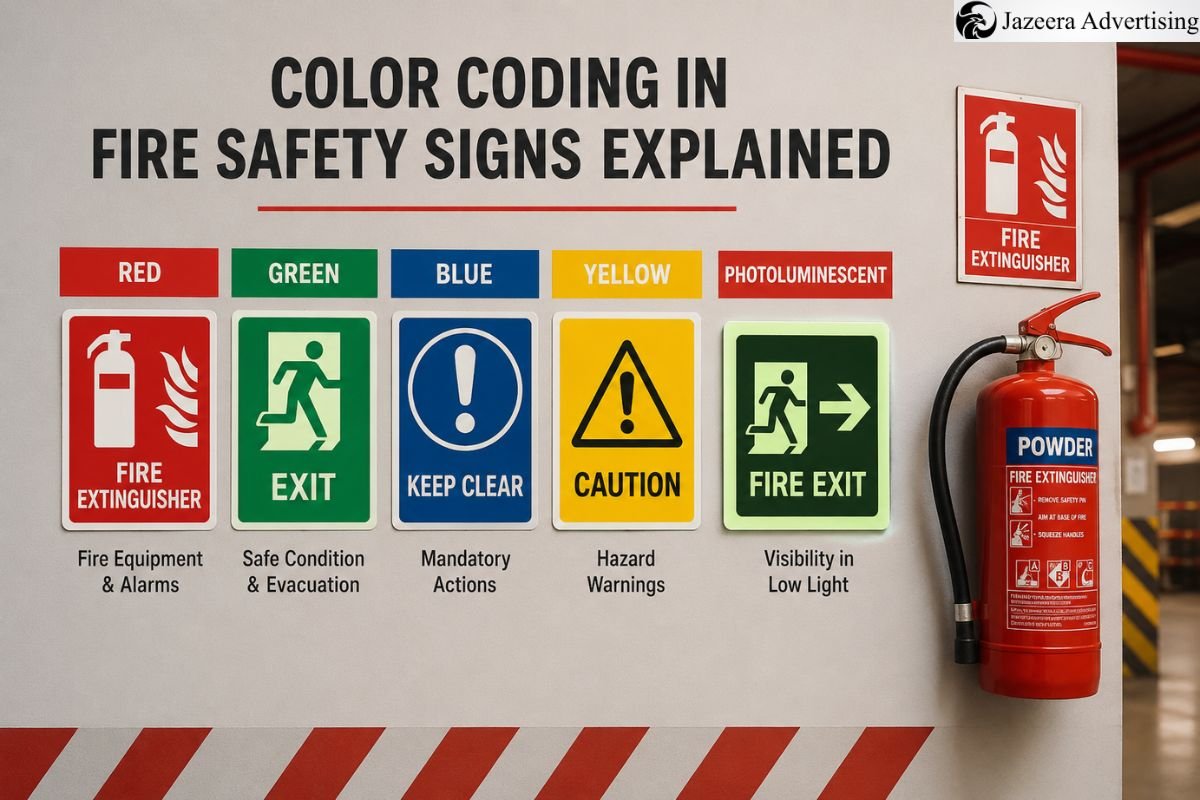
- The fire apparatus along with prohibitions have been indicated with the help of red marks while yellow warns users about possible hazards.
- Escape paths have been indicated by using green, and blue indicates the compulsory actions during emergencies.
- Safety signs in the construction sites of Dubai need to be made from strong materials that can tolerate the tough outdoor conditions.
- In the United Arab Emirates, the famous companies specializing in safety sign supply help to avoid expensive compliance problems from arising before the signs are installed.
Spend five minutes on a warehouse floor or a Dubai construction site and you’ll notice the same four or five colors on every sign, over and over. That’s deliberate. In an emergency people don’t stop to read paragraphs. They react to color before they process any text.
Most proprietors only consider these things at the moment an fire inspector points something out or when a worker inquires why the fire extinguisher sign is red instead of what the exit sign in the corridor is. It is discussed here in what each color implies, why the difference is significant to use in practice, and how to make sure it is done correctly from the start when you are setting up an office or a live site.
Why does color coding exist in fire safety signs?
The system isn’t arbitrary. It comes out of behavioral research on how people respond under stress. When someone is scared or moving fast, their ability to read and process text drops off a cliff. Color doesn’t have that problem. It registers almost instantly.
That’s the reasoning behind ISO 7010 and regional fire codes: fixed meanings tied to specific colors. Someone walking into a Dubai facility for the first time should be able to understand a fire sign from its color and shape alone, without reading a word of it.
Moreover, there’s also a business angle here. If something goes wrong and the signage doesn’t follow the correct color logic, that can complicate an insurance claim or a civil defense review. Choosing the right safety signage supplier in UAE from the beginning helps prevent costly corrections later.
Red signs and what they mean
The color red is associated with fire safety among many people, but it serves two different functions depending on the shape in which it appears.
- Fire equipment location- Red rectangular or square signs show the location of fire extinguishers, hose reels, fire alarm points, and fire blankets. It is a straightforward message – this is the equipment’s home and do not obstruct it.
- Prohibition- Red also appears on round signs with a diagonal stripe across it. A cigarette with the stripe means no smoking; the same goes for a flame in the red circle. The dual meaning trips people up sometimes, but the shape usually clears it up before the wording does, square for equipment, circle for prohibition.
I’ve walked into more than one client site where the red equipment sign was mounted too high, or hidden behind a stack of inventory. The color only does its job if it’s actually visible from where people are walking.
Yellow and amber signs explained
Yellow is the sign of warning: a danger, which requires attention but is not considered an urgent emergency. Additionally, there can be some dangers relating to wet surfaces, low ceilings, chemical storage, moving machinery.
Therefore, the well-established way to design them is to use the yellow triangle having a black border and a black pictogram. The shape of the triangle brings in a certain drive of urgency without borrowing red; the latter is reserved for more serious warnings. The yellow is the type of sign most often used in warehouses, as the areas of hazards change permanently due to the changes of the processes going on in the warehouse. For example, in a month, there can be a new road for forklifts, and in the next month, there will be an area for spills, and so on.
In one word, a yellow sign is a warning sign and can never be considered as a solution. I’ve seen facilities treat the sign as the solution and leave the actual hazard sitting there for months.
Green signs for safe conditions
Green marks safety and direction: exits, assembly points, first aid stations, escape routes.
Rectangular green signs with white pictograms, a figure running toward a door, an arrow pointing down a corridor, are meant to be followed in sequence during an evacuation. This is also where photoluminescent signage earns its keep. Power tends to fail during a fire, and glow-in-the-dark green exit signs are one of the few things that still work when the lights don’t.
However, a mistake I see more often than it should happen: green directional signs spaced too far apart down a corridor. If someone loses sight of one before the next comes into view, the evacuation path stops making sense to them even though it’s still physically there.
Blue signs and mandatory actions
Blue signs give instructions rather than warnings: wear a hard hat, use ear protection, wash your hands, use the handrail. Circular blue signs with white symbols are the standard, and the shape keeps them distinct from red’s prohibition circles and yellow’s hazard triangles.
On active construction sites, blue signage is often the one people stop noticing fastest, mostly because it goes up once at the gate and never again near the actual hazard. A hard hat sign at the entrance doesn’t do much good if the hazard is a hundred meters further in. Repeating the instruction near the hazard itself works better than posting it once and hoping people remember.
Color coding on construction sites
Construction site safety signage in Dubai deals with a different set of conditions than a fixed indoor facility. Layouts shift week to week. Equipment gets relocated. New hazards show up as a build moves through its phases.
| Factor | Indoor Facility | Construction Site |
| Sign material | Standard rigid PVC or acrylic | Weather-resistant aluminum or reflective composite |
| Sign lifespan need | Long-term, rarely moved | Short to medium-term, frequently relocated |
| Visibility requirement | Standard indoor lighting | Direct sunlight, dust, low-light early shifts |
| Update frequency | Occasional | Weekly or per project phase |
Dust, direct sun, and constant relocation mean site signage needs sturdier mounting and UV-resistant printing on top of the correct colors. A sign that fades within six months under Dubai’s summer sun isn’t doing its job anymore, no matter how correctly it was color coded to begin with.
Common mistakes in sign selection
A few problems come up again and again across sites and facilities:
- Generic printed paper instead of rigid boards, which fade, tear, or peel within weeks outdoors.
- Mixing color standards from different countries, which confuses a multinational crew that’s read different codes elsewhere.
- Signs mounted too high, too low, or tucked behind obstructions.
- Old signage left up after a layout change instead of being swapped for updated boards.
- Choosing on price alone instead of material durability, especially for anything going outside.
None of this is complicated to fix. It usually happens because signage gets treated as an afterthought instead of something planned alongside the rest of the safety setup.
How to choose the right signage solution
Three things matter more than anything else when sourcing signage: correct color and symbol compliance, material that suits the environment it’s going into, and a supplier who actually understands local regulatory expectations.
A signage solutions Dubai provider who knows UAE civil defense requirements will catch a compliance issue before it’s installed, not after an inspection fails, which is the difference generic online sign shops don’t offer.
If you’re weighing options for the best safety signage board in Dubai, a few things are worth checking:
- UV-stable, weatherproof material for outdoor or site use
- Photoluminescent options for exits and escape routes
- Pictogram sets that actually match ISO 7010
- Custom sizing for site-specific mounting
- A supplier who can handle bulk indoor signage and rugged site signage in one order
Jazeera Advertising works with clients across Dubai on this kind of signage, from color-coded fire safety boards through full construction site sign packages, building each set around both compliance and the physical conditions the signs will face on site.
Bottom line
Fire safety sign colors aren’t decoration. They’re a system built to communicate in seconds, under stress, without asking anyone to stop and read. Red covers equipment and prohibition, yellow warns of hazards, green guides people out, blue tells them what to do along the way. Get that system right and you’re protecting people first and staying compliant second, not the other way around.
If your current signage is faded, outdated, or just inconsistent, it’s worth reviewing now rather than waiting for an inspector to point it out.
Frequently asked questions
It marks fire equipment like extinguishers and hose reels, or shows prohibition on circular signs with a diagonal line, such as no smoking.
Green is the internationally recognized color for safety and escape routes. People tend to follow it instinctively during an evacuation, before they’ve read anything.
It warns of a hazard that needs caution, like a wet floor or moving machinery, without signaling an immediate emergency.
No. Blue circles tell people what action to take, like wearing protective gear, rather than warning them about a hazard.
Weather-resistant aluminum or reflective composite. Standard PVC doesn’t last as long under direct sun, dust, and constant site relocation.
With every major project phase, equipment, hazards, and layouts all shift as a build progresses.
Most places follow ISO 7010, though small regional differences exist, which is exactly why consistency matters on a multinational job site.
Treating it as a one-time purchase instead of something that gets reviewed and updated as the space and its risks change.
Look for civil defense compliance experience, weatherproof materials, and a supplier who can handle indoor and site orders without splitting the job.
UV-stable materials, correct ISO pictograms, photoluminescent exit options, and a supplier who knows the local compliance requirements firsthand.
Digital Compliance Boards: Future of Industrial Safety
Safety Signage Cost Guide for Businesses