- October 22, 2026
- by Jazeeraadv
Emergency Exit Signs for Warehouses and Factories
Table of Contents
- Key takeaways
- What makes an emergency exit sign effective?
- Why do warehouses and factories need special exit signage?
- How many exit signs does a warehouse need?
- Which materials and lighting technologies work best?
- How should you maintain exit signs over time?
- What mistakes should you avoid?
- How do you choose a reliable signage partner?
- How does construction site signage fit in?
- What makes a strong safety sign in Dubai?
- Closing line
- Frequently asked questions
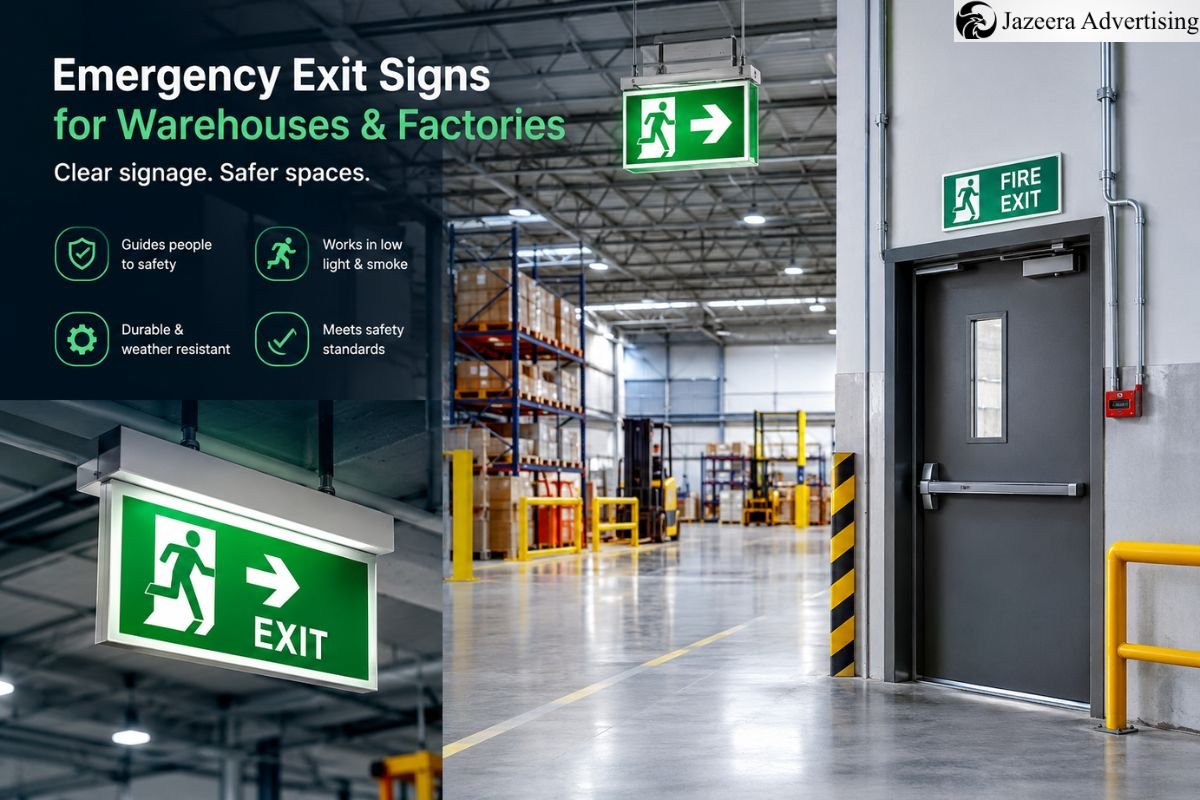
In a warehouse or factory, emergency exit signs are markings that light up and help workers find the closest safe exit during a fire, if the building experiences a power failure, or during any other emergency. In large industrial facilities, there is less time to evacuate compared to offices.
A doorway or an alarm may be concealed by loud equipment, tall racking, long aisles, and machinery. The right sign in the right place and lit properly will eliminate confusion and save minutes. This guide covers the meaning of these signs, placement, the important technologies, and how to maintain compliance.
Key takeaways
- Exits are to be illuminated so that they are visible from a distance and to direct an occupant to the nearest exit at each point in time the exits are changed.
- There should be signs at all exits, at direction changes and anywhere the view is obstructed by racking or equipment in the warehouse or factory.
- Use LED or edge-lit signs with battery backup for primary roads and photoluminescent signs as a secondary layer.
- Test signs every month and perform a full test every year, and collaborate with a reputable safety sign supplier in UAE to ensure your site is compliant.
What makes an emergency exit sign effective?
An effective emergency exit sign is a sign that can be easily read in any lighting conditions, including smoke. It must be lighted, must have the running man text or the exit text in high-contrast colors, and must clearly point to the closest exit route. How well it works during the actual emergency depends on size, mounting height, and viewing distance.
Visibility and lighting requirements
The key question is visibility. An inaccessible sign is not much use. Most safety standards require signs to be illuminated and clearly visible at a certain distance. In practice, that implies:
- Continuous illumination, even when the main power is off
- Clear and easily readable lettering at the appropriate viewing distance.
- An unobscured contrast ratio against the mounting surface.
Text, arrows, and color standards
Colors and symbols must be used in line with accepted safety practices so they are understood in the same manner by workers, visitors, and emergency personnel. Green and white are the usual colors used for exit signs; red is usually used for fire equipment locations. The arrows should always face the way of travel to the exit, and any directional sign should be used where a change of route occurs.
Why do warehouses and factories need special exit signage?
Industrial buildings are at risk in ways that would not be a problem for office buildings. Floors are frequently full of stacked goods, forklift trucks, and production lines. The working environment might provide less visibility, and alarms may be heard less clearly due to hearing protection worn by workers, and some areas may have dust, fumes, or poor lighting. One of the few safety tools that does not require the worker to make any effort is exit signage.
Common risk factors on the floor
There are a number of factors that make escaping more difficult in an industrial building. Every one makes it even more critical to have clear, well-placed signs:
- Too high ceilings and stacked pallets obstructing doorways
- The masking of audible warnings by noise from machinery.
- More than one zone or more than one level (mezzanine) with different ways of exiting.
- Shift rotation, where employees might not know an area they are rotating into.
However, signage plans should be reviewed when there is a change in the layout due to factors changing as production progresses and stock moves.
How many exit signs does a warehouse need?
The majority of warehouses require an exit sign at each exit door, each time an escape route turns a corner, and at regular intervals so that an exit sign will be visible from any point on the floor. The exact number is determined by local codes and the building’s occupancy. The best way to confirm the number is by a site assessment conducted by a qualified safety consultant.
Placement at doors and corridors
The first step in correct placement is to have a plan of escape routes. To place signs exactly as needed:
- Indicate on the map all the exit doors and the shortest possible route from each work area to the nearest exit.
- Mark each point where the route changes direction, such as a corner or a junction between aisles.
- Put a sign over each exit door, typically located at a height that ensures the sign is not covered by stacked merchandise.
- Walk it at night or without lights to be sure all signs are visible within the anticipated distance.
Spacing on large open floors
Extra thought should be given to large open floors. If the line of sight is obstructed by racking or equipment, one sign at the main door might not be sufficient. Other signs or direction markers may be used on columns, at the end of the racks, or on overhead beams. This ensures visibility of the escape route even if the floor is in use.
Which materials and lighting technologies work best?
The type of sign you choose will depend on your building, your budget and how much maintenance your team can handle. The table below compares the four most common options that are used in industrial sites.
| Type | Power Source | Brightness | Best Use | Maintenance Level |
| LED internally illuminated | Mains with battery backup | High | Main exits, large floors | Low, periodic battery checks |
| Photoluminescent | Charged by ambient light | Moderate, glows after light fades | Stairwells, backup routes | Low, no electrical wiring |
| Self-powered (battery unit) | Built-in battery | High | Areas without wiring access | Medium, battery replacement |
| Edge-lit acrylic | Mains with battery backup | Moderate to high | Clean, modern facilities | Low, periodic lamp checks |
Choosing between LED and photoluminescent signs
LED internally illuminated signage are typically the first signage to be installed in warehouses and factories because they will still light up during a power outage, as long as they are connected to a correct backup power system.
Therefore, photoluminescent signs are effective as a second line of defense, particularly in stairwells where the signs will continue to emit light for a short time after the power is turned off. Many facilities employ both types, in order to have multiple layers of protection along each route.
How should you maintain exit signs over time?
All exit signs must be in use. It could be dust, damage, failed bulbs, or drained batteries that make them harder to see, and no one will know. Most issues can be detected by a simple inspection process. Make sure to keep a record of each test, as this will be required by inspectors.
Monthly and annual checks
Signs are kept ready for use with a regular testing schedule. Most facilities will benefit from the following routine:
- Verify monthly that each sign is lit and, if not, that no panels are shattered or covered.
- Verify directional arrows once a month for directions to the correct way of exiting.
- Practice a full functional test once a year by turning off the main power and then testing to see that battery backup maintains the light on for the required test duration.
- For each test, replace failed batteries or bulbs as soon as possible and record the work.
What mistakes should you avoid?
There are many problems with the exit sign that are avoidable, either at the time of installation or during routine use. Knowing the most frequent errors will keep facilities safe and compliant.
Errors during installation
Installation errors are typically the least obvious since the sign appears to be correct from the entrance. Keep an eye out for the following problems:
- Mounting signs behind racking or stacked goods where they cannot be seen
- After a layout change, putting the arrows on the wrong side.
- A single sign used to sign two routes in two opposite directions
- Selecting unrated or decorative signs, which are not in accordance with local standards.
Errors in ongoing management
There are also problems that emerge with time. Shelving is often installed, and signs are blocked; signs are painted over when redecorating, and signs are not lit up after a battery failure. If staff are not familiar with the escape routes, they may not report these issues. Most of these failures are avoided by training workers on the layout and by incorporating sign checks into regular safety walks.
How do you choose a reliable signage partner?
As well as the correct product, it is crucial to select the right supplier. A good partner knows the industrial safety requirements, provides certified products, and can provide assistance in design and installation. While shopping for a safety signage supplier in UAE, don’t just consider the cost; confirm that the company can grasp your particular site as well.
What to ask before you buy?
Before signing an agreement, have a handful of direct questions to ask prospective suppliers:
- Are signs tested and certified to recognised safety standards?
- Perform a site survey for the number and placement of signs?
- What warranty/ replacement support do you offer?
- Are you able to provide samples which we can test on our floor?
Why does local experience matter?
It helps to have local experience. Suppliers who are aware of the best signage company in Dubai standards, as well as the local weather, will understand the effect heat, dust, and humidity have on sign materials and batteries. They are also aware of the expectations of local inspectors. Jazeera Advertising advises you to shop around for at least two or three suppliers, request a written proposal from each of them, and review their references with other industrial clients.
How does construction site signage fit in?
Most warehouses and factories are constructed or extended during production. Temporary construction obstructs escape routes, closes doors, and introduces new hazards. Signage during these times ensures worker and contractor safety. Construction sites that have good construction site safety signage in Dubai usually plan to avoid confusion that leads to injuries during renovations.
Temporary exit routes during expansion
If an existing exit is closed for construction purposes, a temporary exit needs to be signed clearly before construction work commences. Signs will be easily retrievable or changeable throughout the project. Teams should also conduct a shift-by-shift briefing of the new route to workers. This transition can be smooth and documented by ensuring proper construction site safety signage in Dubai.
What makes a strong safety sign in Dubai?
In Dubai, signs are put under a lot of stress due to the climate. Colors fade, panels warp, battery life is reduced due to the high temperatures, strong light, sand and humidity. For the best safety signage board in Dubai you should take care of materials and finishes that are designed for such conditions. All good signs are resistant to UV fading, maintain color and are reliable for storage in warmer locations.
Durability in Dubai’s climate
Check for UV stable materials, sealed electrical enclosures, and batteries with high ambient temperature ratings. Aluminum and polycarbonate panels tend to fare better than thin plastic in extreme environments. Request test information from suppliers about heat and UV resistance as a sign that performs well in an air-conditioned office might not work on a warehouse roof or loading bay. When it comes to safety signage boards, investing in a locally suitable design will save you money in the long-term.
Closing line
Simple yet important, emergency exit signs make a difference. They are used in a warehouse or factory, where there are busy, noisy and complex environments, and time is of the essence. When signs are most needed, careful planning, proper materials and regular testing combined with the right supplier ensures that they do their job.
Regularly update signage plans, particularly following layout changes, and consider it a living element of your safety program.
Frequently asked questions
Perform exit sign monthly visual test, and annual full functional test of exit signs. Record for inspection.
Yes. Exit signs must remain illuminated when the power goes out, usually by battery power for a minimum of 90 minutes.
Find the best signage company in Dubai with industrial experience, certified products and local signage installation references.
There is emergency lighting to light the path along the ground and exit signs to indicate the way to escape.
Emergency Exit Signs for Warehouses and Factories

Reception Signage Design Mistakes That Hurt Brand Perception