- September 19, 2026
- by Jazeeraadv
Best Materials for Reception Letter Signage: Acrylic, Stainless Steel or Brass?
Table of Contents
- Key takeaways
- What actually separates these three materials?
- Acrylic letters: when it’s the right call
- Stainless steel letters: built for what
- Brass letters: why premium brands still pick it
- Acrylic vs stainless steel vs brass: comparison table
- How does Dubai’s climate change the decision?
- What reception signage actually costs?
- Backlit or non-backlit- does it matter here?
- Where does metal engraving fit into the picture?
- Getting the material choice right
- Bottom line
- Frequently asked questions
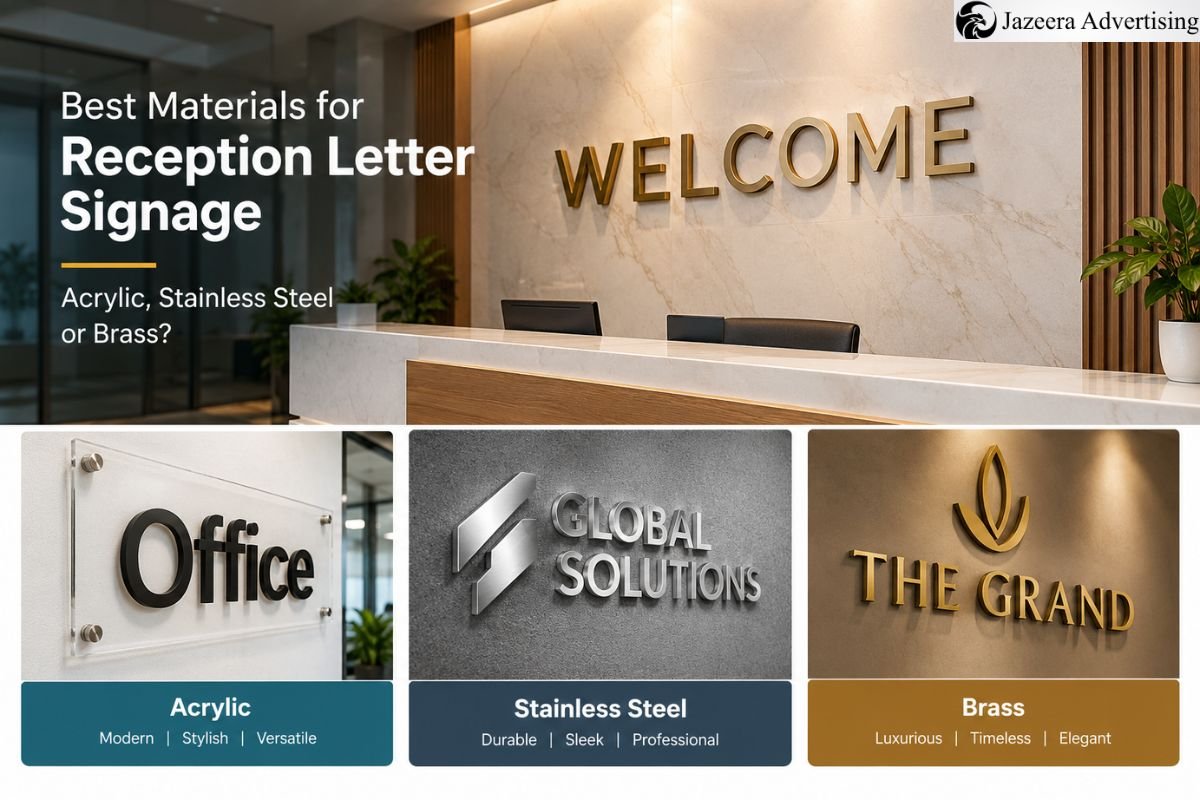
Acrylic, the least expensive and quickest to manufacture; stainless steel, which tends to last better under the weather conditions of Dubai; and brass, available for serious companies wishing their reception to look perfectly upscale, represent three materials that define the market.
There is no single “winner,” since one’s choice primarily depends on budget, the tone of their brand, as well as the amount of visitors and sun exposure in general. Rather than making the choice based on any serious matters, the majority of firms doing reception signage in Dubai base their decision on a single point: whether they want the sign to look prestigious from day one or remain quiet in use for ten years.
Key takeaways
- Acrylic is perfect for businesses and co-working spaces that need affordable yet attractive signage quickly.
- Stainless steel withstands the elements, requires little upkeep, and is very durable.
- Brass gives a traditional look to law firms and companies in the hospitality industry.
- Your decision will be based on the length of the lease, lighting, cleanliness, and frequency of contact.
What actually separates these three materials?
Before deciding on a material, it is necessary to be aware of the features you are comparing. This is not just a comparison of three different types of finishes. Even before letters are read, each of the finishes conveys different messages under Dubai’s sun.
Therefore, acrylic is made from molded or extruded plastic, then cut into shapes and installed on a wall with standoffs or glued flat against it. Stainless steel is made out of a metal sheet, cut with the help of a laser, and polished in a way that can make it glossy or brushed. Brass is denser and softer and gets a patina with time unless lacquered; it is usually used where a business wants to demonstrate a sense of permanence.
When choosing a finish, photos do not tell much about the selected materials. One must pay attention to whether the material will still look good three years after being used in a luxury air-conditioned area, constantly exposed to the sun and cleaned with a rag daily.
Acrylic letters: when it’s the right call
The unpopularity of Acrylic is supported by various reasons. It is lightweight, and it is almost impossible to engrave it in the same way as any metal material. But when it comes to starting a business, that speed is the main advantage of acrylic.
When should you use acrylic:
- For short-term leases and any business that will move in a few years
- For start-ups or co-working spaces that do not need a corporate look
- For reception areas with indirect or controlled lighting, protected from sunlight
- For companies that want to have a variety of colors – acrylic can be processed any way you like.
The downside is not longevity. Clear and white acrylic can turn yellow over time when subjected to UV light, particularly near west-oriented windows that are often encountered in Dubai office towers. It is also more susceptible to scratches than metal when placed in a location with a lot of passing people. However, this does not suggest that it is a poor choice; it simply means that acrylic signage in Dubai is best placed in areas where there is less traffic and sunlight.
Stainless steel letters: built for what
Stainless steel is the preferred material for most facility managers since it stops being a subject for discussion once it has been installed. It resists fading and corrosion in humid air, while its brushed or matte surface is much better at hiding fingerprints and dirt than a shiny surface.
It is perfect for businesses that want to seem strong rather than fashionable: engineering firms, logistics companies, banks, and government agencies. The letters are generally thicker than acrylic, making for a raised, three-dimensional shadow on the wall that looks luxurious even under simple lighting conditions.
The main disadvantage is its price and preparation time. Metal is more difficult to cut and finish than acrylic, and polished stainless steel can leave fingerprints if placed at hand level. Moreover, for reception signage in Dubai, where direct sunlight enters the office through the entire glass wall, stainless steel is the material that withstands time best.
Brass letters: why premium brands still pick it
Brass is still trendy, and that’s one reason why it has maintained its popularity in interior design. It has great photographic properties and weighs enough to make you feel it’s tough and therefore reliable. Brass acquires a lovely patina over time, which many people like more than the shine of the product when it comes from the factory.
Brass is favored by several brands, legal consulting companies, hotel chains, and similar firms because it does not give a modern vibe to the place. Additionally, that’s exactly the spirit that is required by a mature 40-year-old accounting firm, while for a young startup, the last thing it needs is to appear established.
Compared to acrylic and stainless steel, brass is more expensive because of the higher cost of the raw materials and the need to have the metal polished and lacquered. Brassed metal may also need re-lacquering now and then if the client decides that he wants to maintain the shiny aspect rather than let the metal become dull over time. For companies looking for office signage in Dubai, residents link longevity and trust; brass will be the preferred choice with the appropriate budget.
Acrylic vs stainless steel vs brass: comparison table
| Factor | Acrylic | Stainless Steel | Brass |
| Typical cost | Lowest | Mid-range | Highest |
| Lead time | Fastest (days) | Moderate (1–2 weeks) | Longest (2–3+ weeks) |
| UV/sun resistance | Fair, can yellow over time | Excellent | Excellent |
| Maintenance | Low, occasional dusting | Very low | Needs re-lacquering for shine |
| Best for | Startups, short leases | Corporate, industrial, high-traffic lobbies | Law firms, luxury, legacy brands |
| Visual impression | Clean, modern | Solid, professional | Premium, established |
How does Dubai’s climate change the decision?
This is the part a lot of first-time office fit-outs underestimate. A material that performs perfectly in a European or North American showroom doesn’t always hold up the same way here.
Dubai summers push external and glass-adjacent surfaces well past 45°C for months at a time, and UV intensity is significantly higher than in temperate climates. Reception areas behind large glass facades, which describe most Dubai office towers, take direct sun for hours a day depending on orientation.
That heat and UV load is exactly why so many businesses end up upgrading from acrylic to metal after their first lease renewal. The acrylic hasn’t failed. It’s just started to look tired next to a freshly finished space. Stainless steel and brass simply don’t have that problem. If your reception faces west or gets strong afternoon light, that alone is often reason enough to lean toward metal for office reception signage Dubai businesses plan to keep for more than three or four years.
What reception signage actually costs?
Pricing varies a lot based on size, letter height, mounting method, and whether the job includes illumination, but as a rough guide for a standard reception sign (company name plus logo, roughly 1-1.5 metres wide):
- Acrylic: generally the most affordable option, with the fastest turnaround
- Stainless steel: noticeably higher than acrylic, mainly due to cutting and finishing time
- Brass: the highest of the three, driven by material cost and hand-finishing labour
Backlighting, if you want it, adds to any of these regardless of material: it’s the wiring and diffusion layer, not the letters themselves, that drives that cost up. The honest advice here is to get a quote based on your actual logo and letter count rather than budgeting off averages, since a wordmark with fine detail costs more to cut cleanly than simple block letters.
Backlit or non-backlit- does it matter here?
For reception signage specifically, most brands skip backlighting. It’s more common on exterior signage or retail storefronts where visibility from a distance matters. A reception area usually already has ambient or downlighting, so a non-illuminated sign with a bit of shadow depth from raised letters looks cleaner than an LED-lit one competing with ceiling lights.
Furthermore, backlighting is worth considering if the reception is dim, if the sign sits behind a desk with low natural light, or if the brand wants a subtle glow effect for evening events and client visits after hours.
Where does metal engraving fit into the picture?
Not every reception sign is made of solid cut letters. Engraving is a technique utilized in the creation of some brass and stainless steel signs, where the name of the brand and sometimes also its tagline is engraved on the metal sheet, instead of using different letters of the alphabet.
This is particularly useful for those who are interested in high-quality logos that are very detailed and feature thin lines or a second sentence below the name of the brand. Moreover, this is the method of choice when it comes to making plaques, notice boards, and nameplates that are supposed to accompany the main company logo. As a rule, agents offering such metal engraving services in Dubai provide clients with surface engraving as well as deep engraving. In case the clients require more than just the name, it would be better to engrave it into brass or stainless steel, as it will be more efficient than cutting all the names or sentences from acrylic.
Getting the material choice right
It is not possible to have a single winner in the case of acrylic, stainless steel, and brass. How long one actually spends in this space is decided in practice by a short list of honest questions:
- How long are you in this space?
- What is the amount of sunlight that reaches that wall?
- How is the other part of the lobby?
- What impressions do you want the person to have upon walking in the first 5 seconds?
A team that has different people doing the design and fabrication in all three materials, but not just acrylic, will probably be more balanced because they are not keeping you from going toward their own preferred output. Jazeera Advertising isn’t a one-size-fits-all sort of company, creating acrylic, stainless steel, and brass reception and office signage when the space and budget are suitable, but not when they’re not.
Bottom line
There is a time and place for each of the three materials for reception letter signage – acrylic, stainless steel, or brass. Acrylic provides a professional and clean appearance in a quick and cost-effective manner. With stainless steel, you get something that will not complain about Dubai’s climate. Before they’ve even seated themselves, Brass informs visitors that the business has been around and is set to remain. None of these statements is wrong.
It is the right choice based on the duration you will be in the space and the message you want to send with your initial impression. When you are still considering the materials, Jazeera Advertising can come to walk through your lobby lighting, layout, and budget and recommend that you use a material that will not need to be changed in two years.
Frequently asked questions
If well finished, stainless steel and brass will last for many years without fading or warping in the Dubai sun and humidity.
No, it’s a great option for budget-friendly or temporary solutions, as long as it’s not placed directly in front of glass walls for extended periods of sunlight.
Yes, brass letters are usually attached to the wall with a hidden stud or standoffs, providing a neat and floating effect.
Very little. Dust or fingerprints can be removed as needed by occasional wiping to keep it looking sharp for years.
Depending on the size, acrylic can be available in days, and stainless steel or brass typically takes up to three weeks.
Not usually. Ambient lighting and raised letter depth are the most common signage approach for the reception, unless the lobby is quite dark.
Cut letters are pieces of dimensional lettering that are attached to a wall, while engraving creates text or designs by cutting into a solid metal plate.
Yes, noticeably. Acrylic is contemporary and easy to understand, stainless steel is sturdy and trustworthy, and brass is old fashioned and reliable.
Absolutely. Acrylic is the standard material a lot of businesses begin with, and they move to stainless steel or brass when it’s time for their next lease renewal or rebrand.
If you have any questions about what type of material you should choose, a fabricator with experience in acrylic, metal cutting, and engraving, like Jazeera Advertising, can give you the same.
Best Materials for Reception Letter Signage: Acrylic, Stainless Steel or Brass?
Office Branding Trends Businesses Are Following in 2026