- August 22, 2026
- by Jazeeraadv
Acrylic vs Glass Reception Panels: Pros, Cons and Cost Comparison
Table of Contents
- Key takeaways
- Why do reception panels matter more than people think?
- How do acrylic reception panels perform in real offices?
- How do glass reception panels perform in real offices?
- Cost comparison: what you’re actually paying for
- Durability and maintenance over time
- Which material suits which type of business?
- Common mistakes businesses make when choosing
- Expert recommendations
- Wrapping it up
- Frequently asked questions
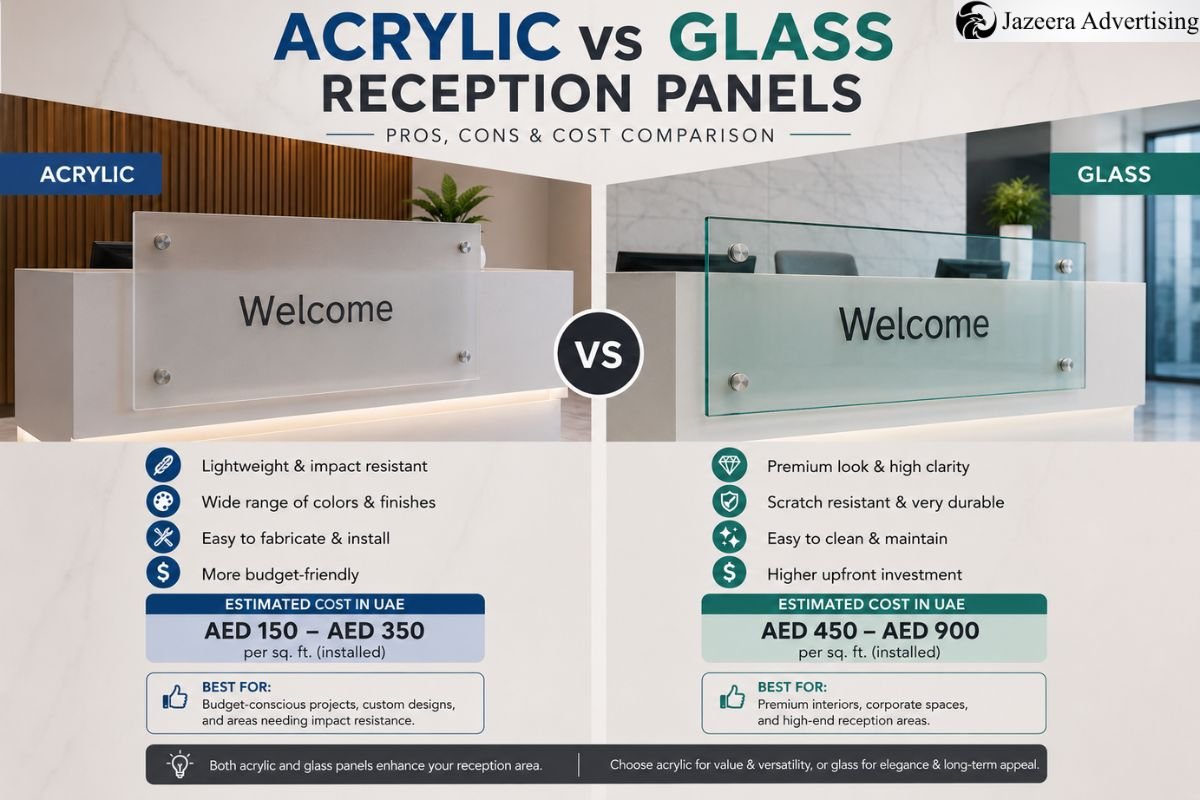
For most Dubai offices looking for an appealing modern style on a budget, acrylic reception panels are the superior option: cheaper, faster to install, and more resistant to damage due to contact. Glass is considered the best option when the company wants to maintain a high-status brand that requires an excellent presentation in time, because etched glass has a better resistance to UV and scratches over 8 to 10 years.
In terms of price, for instance, a typical acrylic reception sign of 6×4 ft costs AED 1,500-3,500 depending on printing or backlighting, whereas the similar glass sign could be about AED 4,000-8,000. If your company has a lot of visitors passing through reception or you’re under time constraints with renovations, you might want to stay with acrylic. Whereas you need it if it will stay behind a not-in-use reception desk.
Key takeaways
- The price of acrylic panels is usually 30-50% less than that of glass panels of similar size.
- Acrylic is more resistant to impact compared to glass, which makes it a safer material to be used at entrance doors in high foot traffic areas.
- Glass is better at providing clearer and scratch-resistant surfaces, thus satisfying high standard branding requirements.
- Frosted glass provides depth and texture that acrylic printed panels cannot deliver.
Why do reception panels matter more than people think?
After entering through the door, most people look straight at the reception panel, which creates an impression even before anyone at the reception says anything. Choosing wrong material for this purpose might result in damaged edges of low-quality acrylic or scratched glass, thus creating problems around one year after installation.
Moreover, when it comes to reception signage in Dubai, many businesses base their decisions on appearance only. This is a mistake since numerous factors, including panel thickness, method and the way of surface dealing with damage from bags, carts, and cleaning products will affect reception sign long after it has been installed.
How do acrylic reception panels perform in real offices?
Acrylic (cast or extruded PMMA) has become the material for modern office reception signage Dubai, especially in circumstances of limited budget or short deadlines. It is lightweight, which permits fewer structural concerns during installation on drywall or glass partitions, and allows direct UV-printed logos and texts since it works perfectly for this technology.
What surprises people is that acrylic is much stronger than glass. Some engineers say that acrylic is about 17 times more impact-resistant than the same thickness of glass, which is important in the reception area where people may hit a panel with their trolley or chair. The glass is likely to crack while the acrylic only gets a scuff mark.
However, in the case of Dubai, the absence of such properties doesn’t matter very much, as most reputable manufacturers use UV-stabilized acrylic, rather than cheap types of cast acrylic. Nonetheless, it is always reasonable to check what is included in the estimates.
Pros of acrylic reception panels
- Costs 30-50% less than glass for the same panel size
- Highly resistant to cracking and shattering on impact
- Lightweight, so mounting on drywall or partitions is straightforward
- Installs in 1-2 days in most cases
- Takes UV printing cleanly, so logos and colors stay sharp
- Easy and cheap to replace if a rebrand changes your logo or colors
Cons of acrylic reception panels
- Surface scratches more easily than glass
- Lower-grade extruded acrylic can yellow after a few years in direct sun
- Doesn’t replicate the depth and texture of physical glass etching
- Feels less premium for brands wanting a high-end, permanent look
How do glass reception panels perform in real offices?
Glass reception panels, particularly those with etched or sandblasted detailing, carry a different kind of presence. The depth you get from glass surface etching services in Dubai (frosted logos, layered text, subtle patterns) isn’t something printed acrylic replicates convincingly. Light passes through etched glass differently, and that’s part of why law firms, financial offices, and hospitality brands still lean toward it.
Tempered glass, which is standard for reception panels, holds up well against scratching and chemical cleaners. It won’t cloud or discolor over time the way lower-grade acrylic can. The tradeoff is impact resistance. Tempered glass is designed to break into small, less dangerous pieces under extreme force rather than crack cleanly, but it still breaks under enough force, and repair means full panel replacement, not a polish job.
Installation also takes longer. Glass panels need precise measurements, professional handling due to weight, and often a curing period for adhesive-mounted etching work. If your office has a hard deadline, that timeline matters.
Pros of glass reception panels
- Holds clarity and scratch resistance for years longer than acrylic
- Etching creates a depth and texture printed material can’t match
- Resists chemical cleaners and everyday wear without clouding
- Reads as more premium and permanent, favored by law firms and hotels
- Breaks into small, less dangerous pieces if it does shatter
Cons of glass reception panels
- Costs significantly more, often double the price of a comparable acrylic panel
- Installation takes 3-5 days due to weight and precision handling
- Any damage typically means full panel replacement, not a repair
- Heavier, so it needs stronger mounting and more careful transport
- Longer lead time if backlighting or complex etching is involved
Cost comparison: what you’re actually paying for
| Factor | Acrylic Panel | Glass Panel (Etched) |
| Material cost (per sq ft) | AED 80-150 | AED 200-400 |
| Standard 6×4 ft reception sign | AED 1,500-3,500 | AED 4,000-8,000 |
| Installation time | 1-2 days | 3-5 days |
| Backlighting compatibility | Excellent, even light diffusion | Good, but adds to cost |
| Repair on damage | Often just the panel, low cost | Usually full replacement |
These are typical ranges from Dubai signage fabricators and will shift based on thickness, printing complexity, and whether you’re adding LED backlighting. A backlit acrylic panel with a company logo can still land under AED 3,000 in most cases. The same effect in etched glass with internal lighting often pushes past AED 6,000.
Furthermore, the gap isn’t just material cost. Glass needs specialized cutting tools, more careful handling during transport, and skilled labor for etching. Acrylic signage in Dubai can be laser cut, printed, and mounted by a smaller crew in a fraction of the time.
Durability and maintenance over time
This is where the two materials really pull apart.
Acrylic holds up well against daily bumps but needs gentle cleaning. Standard glass cleaner with ammonia can cause micro-cracking on the surface over years, so most suppliers recommend a mild soap solution and a microfiber cloth instead. Done right, a quality acrylic panel looks close to new after five years.
Glass needs less babying day to day, it handles most cleaning products fine, but the scratches it does get are permanent and visible under certain light angles. I’ve seen ten-year-old etched glass panels in Dubai offices that still look sharp, and I’ve seen three-year-old ones with visible scuff marks near the bottom edge where cleaning staff dragged a mop bucket across them.
Neither material is maintenance-free. The real question is which type of wear your specific reception area is more likely to see.
Which material suits which type of business?
For a fast-growing startup fitting out a new office in a business bay tower, acrylic makes practical sense. It’s quick to install, affordable enough to update if the brand identity changes, and holds up fine against typical foot traffic.
For an established firm, a law office, a five-star hotel lobby, or a healthcare group aiming for a polished, permanent look, glass tends to justify its cost. The etching work reads as more considered, and clients notice the difference even if they can’t articulate why.
There’s a middle path some Dubai offices use: acrylic for interior wayfinding and directory signs, glass for the main reception wall where first impressions matter most. It splits the budget sensibly instead of treating the whole project as one material decision.
Common mistakes businesses make when choosing
A few patterns show up again and again in reception fit-out projects. Choosing based on the sample alone is a big one. A small acrylic or glass sample under showroom lighting looks nothing like a 6×4 ft panel under office fluorescents. Ask for a photo of a completed project in a similar space instead.
- Skipping the grade question. Not all acrylic is equal. Cast acrylic outperforms extruded acrylic in clarity and UV resistance, but suppliers don’t always volunteer which one they’re quoting unless asked directly.
- Underestimating install disruption. Glass installation with etching can take most of a week. If reception can’t be closed off during that time, factor it into the decision.
- Ignoring backlighting early. Deciding on LED backlighting after the panel is already fabricated usually means starting over, since it changes the mounting depth and sometimes the material thickness needed.
Expert recommendations
If budget and timeline are the driving factors, acrylic is the more sensible default for most small to mid-sized offices in Dubai. Ask specifically for UV-stabilized cast acrylic, not standard extruded sheet, and get backlighting quoted upfront if there’s any chance you’ll want it later.
If your brand identity depends on looking established and permanent, glass is worth the premium. Just get a firm timeline in writing before committing, since etching work has more variables that can push delivery dates.
Therefore, one thing I’d tell any business regardless of which material they pick: confirm the exact panel dimensions against your actual wall, not the architectural drawing. Drawings and finished walls in Dubai fit-outs don’t always match, and a panel cut to spec that doesn’t fit the space is a costly redo either way.
Wrapping it up
Acrylic and glass both do the job of reception signage well, they just do it differently. Acrylic wins on cost, speed, and resistance to everyday knocks. Glass wins on long-term polish and the kind of etched detail that photographs well in a lobby. Neither is objectively better. The right pick depends on your traffic, timeline, and how long you expect the panel to stay relevant to your brand.
If you’re weighing this decision for an upcoming fit-out, Jazeera Advertising can walk you through both options with actual samples from past reception projects, so you’re comparing real finishes instead of guessing from a catalog photo.
Frequently asked questions
Acrylic handles heat and humidity well when UV-stabilized. Glass is naturally heat resistant but can feel warmer to the touch under direct sun near windows.
5-7 years, if it’s a quality cast acrylic panel that’s been properly maintained, before fading or yellowing becomes noticeable.
Minor surface scratches can sometimes be polished out professionally. Deeper etching damage usually means replacing the panel entirely.
Yes, by roughly AED 500-1,500 depending on panel size and LED type. It’s worth it in dim lobbies where visibility is otherwise poor.
Acrylic, by far. A new printed panel can be fabricated and swapped in days. Glass etching requires a full new panel and a longer lead time.
A mild soap and water solution works best. Ammonia-based cleaners can cause micro-cracking on glass surfaces over repeated use.
Acrylic panels typically install in 1-2 days. Glass panels with etching usually take 3-5 days, including curing time for mounting adhesive.
No. Etching services in Dubai work on panels as small as directory signs and as large as full lobby walls, with pricing scaling to size and detail.
Acrylic, consistently, costs 30-50% less on average and doesn’t need the specialized installation crew glass etching requires.
UV printing on acrylic handles color and fine text well, but it can’t replicate the layered, translucent depth that physical etching creates on glass.

Emergency Exit Signs for Warehouses and Factories
Reception Signage Design Mistakes That Hurt Brand Perception