- August 26, 2026
- by Jazeeraadv
How to Choose the Best Reception Signage for Your Business Type
Table of Contents
- Key takeaways
- Why do first impressions start at reception?
- Choosing signage by business type
- Materials and design options compared
- Approvals and rules you need to know
- Mistakes businesses make with signage
- Tips from Dubai signage experts
- Wrapping it up
- Frequently asked questions
Three main factors to consider when creating signage in Dubai are the sector to which the sign caters, how quickly the building will approve the sign, and how busy the lobby is. For example, law firms would prefer a discreet sign, made of backlit acrylic or brushed metal, while creative agencies can afford to use more vibrant materials and colors. Medical clinics need signs that can be understood from afar; patients in clinics tend to hurry, so they will be unable to read a logo with small letters.
The budget for signage in Dubai can range from AED 1,500 for the basic flat cut logo to AED 15,000 and above for an illuminated logo made up of different materials. The final price will depend on many conditions, including the type of material used, the approvals required, and the placement of the sign.
Key takeaways
- The choice of signage materials according to the industry is important to create the right impression in terms of branding.
- Often, reception signs in Dubai may call for the landlord’s approval or the free zone stamp before production can be undertaken.
- Branding consistency can enhance trust and help customers gain confidence.
- Appropriate lighting can turn the standard reception signs into something exclusive and high-end.
Why do first impressions start at reception?
Most business owners consider signage as their last glance after furniture, paint, perhaps a plant in the corner. That order doesn’t really make sense. First impressions matter, and the reception wall is typically the first fixed environment that a visitor’s eyes encounter, prior to talking to any employee or viewing any product.
Therefore, within milliseconds, people make snap judgements about what they see that are often based primarily on appearance rather than reading or what they’re told. When the branding is missing from the lobby, a visitor asks himself for a split second, “OK, which floor am I on?” In Dubai, the key to creating a good office brand is to bridge the gap in advance.
But it’s not just about the appearance of the expensive beater either. When a dental clinic has worn-down signage that doesn’t match, it’s not that patients will be misled; it’s that they’ll have their doubts about the hygiene of the practice even if that’s not necessarily what is being discussed. When there’s no branding at the reception of a logistics office, a visitor to a company may doubt whether they have come to the right place. The sign has more meaning than most people realize, and most of them don’t realize that it’s doing that work.
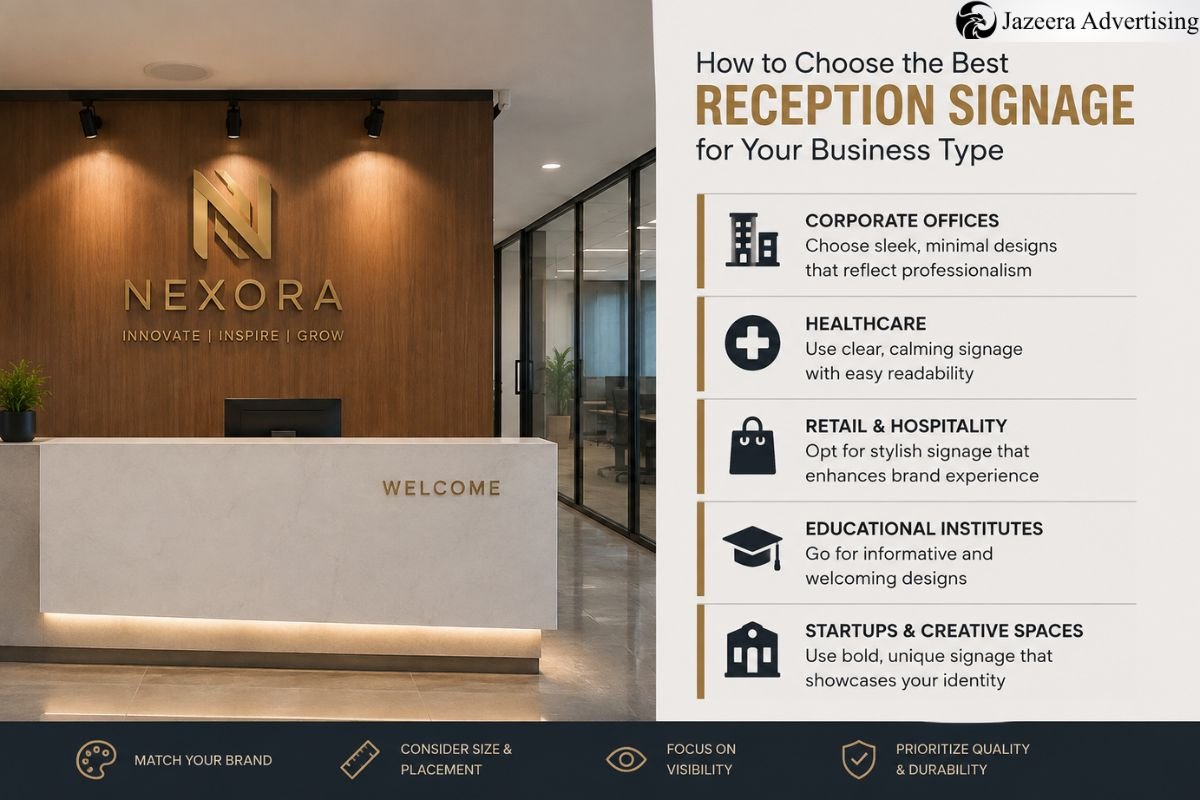
Choosing signage by business type
There are no definitive answers in this section. A mix of a fintech startup in DIFC and a manufacturing office in Al Quoz will simply not go together. There are some patterns that ring true across industries, however.
- Corporate and Professional Services
Brushed metal or matte acrylic letters, with a soft white or warm backlight, are popular choices for law firms, consultancies and finance offices. Colour is kept to a minimum – navy, gold or the main colour of the brand – not bolder. The focus is on stability, not flash
- Creative Agencies and Startups
Outside of the corporate realm, ideas for reception signage get a bit more creative. Raw wood, edge-lit acrylic, painted murals with the logo folded into the design, occasionally neon used sparingly. A creative agency’s reception is commonly a portfolio project.
- Healthcare and Clinics
Legibility is paramount. Visitors often have problems adapting to a new environment, like being tense or confused, and patience is not one of their virtues. Dark letters on a light background or the other way around gives the highest contrast in terms of reading speed. Additionally, typically, there will be a lot of closets contained on a single floor, and directional signage will need to be located near the main sign as well.
- Co-working and Shared Office Spaces
These require branding that is designed for dozens of sub-brands at a single location. Because the tenants are always changing, modular name boards, changeable letter systems, digital directories, that sort of thing. A sign that is always on the wall doesn’t make any sense if the people living there move in and out every few months.
- Retail-Facing Head Offices
In the case of direct access by clients or customers, such as showrooms, real estate offices, and car repair shops, the sign needs to serve a dual purpose as a wayfinding device, both in the parking lot and from the lobby.
Materials and design options compared
Let’s take a look at the ways that certain materials are commonly used for reception signage in Dubai businesses, and compare their costs, durability, and impact.
| Material | Typical Cost Range (AED) | Best For | Notes |
| Flat-cut acrylic letters | 1,500 – 4,000 | Startups, small offices | Clean, budget-friendly, no lighting |
| Backlit acrylic (halo/edge-lit) | 4,000 – 9,000 | Corporate, professional services | Premium look, needs electrical work |
| Brushed metal (stainless steel) | 5,000 – 12,000 | Law firms, finance, real estate | Long lifespan, resists tarnishing |
| Wood or wood-veneer | 3,000 – 8,000 | Creative agencies, hospitality | Warm feel, needs sealing in humid AC environments |
| Digital LED display | 8,000 – 20,000+ | Co-working spaces, retail HQs | Content changes without refabrication |
Prices shift with size, installation height, and whether the building requires scaffolding or after-hours work, which some Dubai towers insist on for lobby installations.
Approvals and rules you need to know
Most first-time business owners skip this step, and it tends to cost them time later. Exterior signage in Dubai almost always needs Dubai Municipality or DDA approval depending on the zone. Interior reception signage inside a leased office usually needs landlord or building management sign-off too, especially in towers with strict facade or lobby aesthetic rules. DIFC and a fair number of Business Bay towers are particular about this.
For office reception signage Dubai landlords expect you to submit a design mockup, confirm the sign won’t block fire exits or sprinkler clearance, and, in some buildings, use only their approved vendors for installation. Skip this and a sign can get fabricated, then rejected on install, which burns both the material cost and the week or two it took to make.
Therefore, if you’re in a free zone like DMCC or JAFZA, check with the free zone authority directly rather than assuming another building’s process applies. It usually doesn’t.
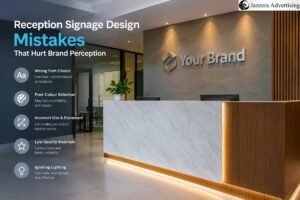
Mistakes businesses make with signage
A few things come up again and again with clients who arrive after a first attempt went sideways.
- Ordering before measuring the wall properly- A design that looks right on screen can look tiny or overwhelming on the actual lobby wall, especially with the ceiling height quirks common in older Dubai buildings.
- Ignoring the lighting in the room- A matte sign under harsh overhead lighting can wash out completely. The same design under warm ambient light reads like a different sign.
- Sizing letters for the design, not the viewing distance- If visitors see the sign from six metres away at the lift lobby, anything under 10cm tall tends to disappear.
- Skipping landlord approval to save a week- It rarely saves time. It just moves the delay to a worse point in the process.
- Copying a competitor’s look wholesale- Some reception signage ideas for offices get reused so often within one industry that they stop signalling anything at all.
Tips from Dubai signage experts
Get a physical material sample before committing to anything. Renders don’t show how brushed metal catches light differently across the day, or how acrylic goes slightly translucent under certain LEDs, and that gap between render and reality is where most disappointment comes from.
Think about maintenance early. Dubai’s dust and the humidity swings that come with constant AC use affect materials differently. Wood needs resealing more often than people expect. Metal needs occasional cleaning near the reception desk, where fingerprints build up faster than anyone anticipates.
Furthermore, a consistent brand colour scheme has been linked to recognition gains of up to 80% in controlled studies, which is reason enough to keep reception signage colours identical to whatever’s used on the website, business cards, and any vehicle branding the company runs. Mismatched tones between a website and a physical sign happen more than owners realise, usually because different vendors handled each piece separately with no shared colour reference between them.
Office branding in Dubai isn’t really one sign. It’s a system: reception, meeting room plates, directional signage, sometimes exterior signage too, all pulling from the same colour codes and typeface.
Wrapping it up
Reception signage seems like a small decision until you’re standing in a lobby that either says something about the business or says nothing at all. The right call depends less on what’s trending and more on who’s walking through the door and what they need to feel in the first ten seconds.
Planning reception signage in Dubai for a new office, or replacing something outdated, is the kind of project that goes smoothly or drags on for weeks depending almost entirely on whether approvals were handled early. Jazeera Advertising works across the material range covered here and manages the landlord and municipality paperwork as part of the process, which is usually the part that trips people up on office reception signage Dubai buildings are strict about.
Frequently asked questions
Costs range from AED 1,500 for basic flat-cut acrylic letters to AED 20,000+ for illuminated or digital displays. Size, material, and installation complexity are the main cost drivers.
Yes, in most cases. Landlord approval is standard for interior lobby signage, and exterior signage usually needs Dubai Municipality or free zone authority sign-off first.
Stainless steel and quality acrylic handle Dubai’s heat, dust, and AC-driven humidity swings better than untreated wood, which needs periodic resealing to avoid warping.
From design approval to installation, expect 2 to 4 weeks, depending on landlord approval speed and whether the material requires custom fabrication or electrical work.
Backlit signs suit dim or windowless lobbies and read as more premium. Unlit signage works fine in well-lit spaces and costs noticeably less.
Usually not ideal. Modular or changeable name systems work better since tenants rotate, and permanent engraving becomes an expensive problem when a company moves out.
As a general guide, letters should be at least 10 to 15cm tall if visitors typically view the sign from more than 5 metres away.
Yes, ideally exactly. Mismatched colours between physical signage and digital branding weaken recognition and can make a business look less established.
Yes. DIFC and several Business Bay towers have stricter facade and lobby aesthetic guidelines than standalone buildings, so check with building management before finalising a design.
Sometimes. Faceplate swaps or relit acrylic can refresh a sign’s look without replacing the underlying structure, which saves cost if the base material is still in good condition.

Emergency Exit Signs for Warehouses and Factories
Reception Signage Design Mistakes That Hurt Brand Perception