- October 12, 2026
- by Jazeeraadv
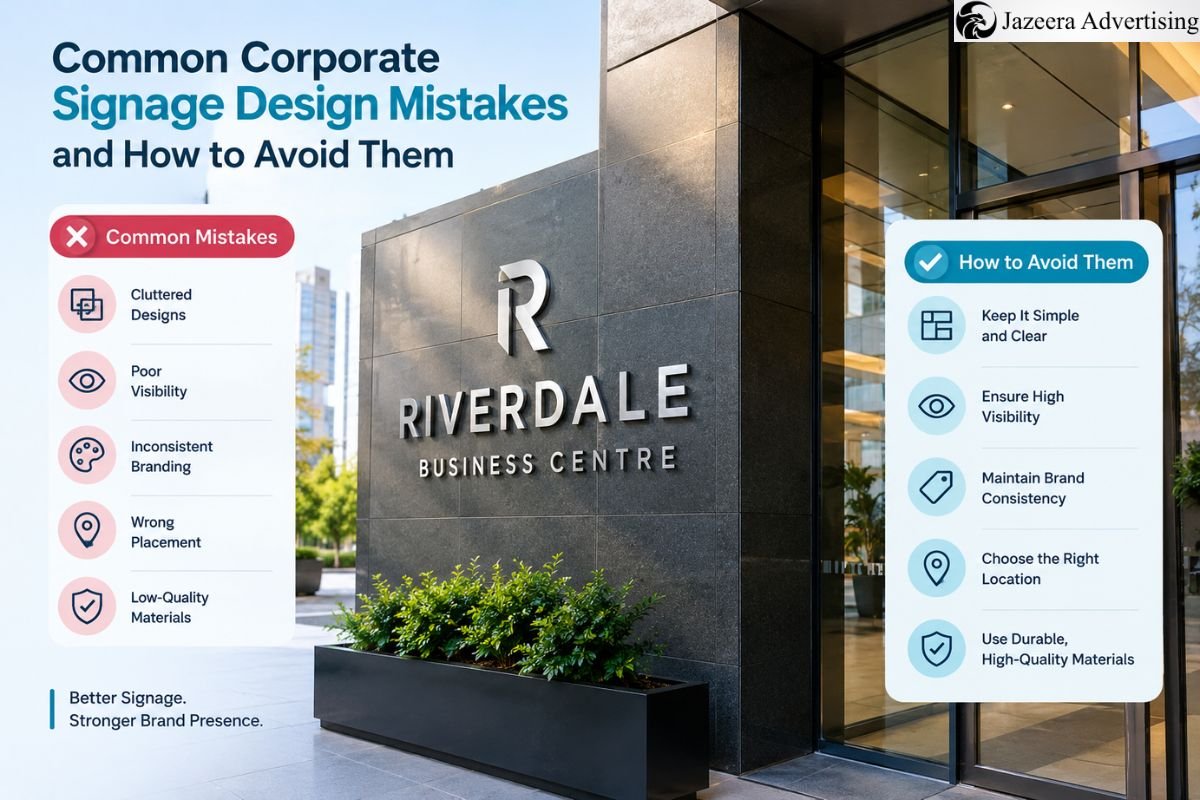
Common Corporate Signage Design Mistakes and How to Avoid Them
Table of Contents
- Key takeaways
- Why do small signage errors add up?
- Mistake 1: Choosing the wrong font
- Mistake 2: Getting the size wrong
- Mistake 3: Weak brand consistency
- Mistake 4: Poor placement
- Mistake 5: Using low-quality materials
- Mistake 6: Ignoring lighting
- Mistake 7: Overlooking visibility and local rules
- Common mistakes at a glance
- Choosing the right signage partner in Dubai
- Conclusion
- Frequently asked questions
There are seven mistakes that lead to the majority of corporate sign problems. These include the use of a bad font, wrong size, inconsistency with brand image, bad position, poor material quality, bad lighting, and not following visibility or local regulations. All of the above issues create an impression of unprofessionalism, confuse customers, and often lead to a replacement of a sign in a couple of years.
However, correcting the problems is easy. One needs to think about the audience who will read the sign, choose the materials capable of withstanding the heat and dust in Dubai, and check for approvals before launching the process.
Key takeaways
- Make sure signs from the entrance are easy for visitors to read.
- Maintain branding uniformity in street signage, lobby, and meeting spaces.
- Opt for signage materials that are long-lasting and resistant to Dubai’s heat, sun, and dust.
- Early contact regarding approval requirements can prevent costly redesign, delay, or removal.
Why do small signage errors add up?
The first impression that visitors have of an office is often a sign. It tells people who you are, where to go, and whether the company pays attention to detail in a few seconds. A single weak sign might not be that significant. That mismatching of font styles, a faded logo, and a poorly lit directory, however, say it loud and clear. Candidates and delivery drivers know that.
The majority of these errors are predictable. They are typically ones that have been rushed through the short process of site visiting, or have been chosen because they are the lowest price, but without consideration as to how they might appear after a couple of summers in the Gulf sun.
Mistake 1: Choosing the wrong font
A decorative script might work for a wedding invitation, but is difficult to read on the fascia sign or a door plate. People take a quick look at signs when they are walking. Fuzzy letters and misshapen letters at a distance can be a problem.
Why it hurts
Confused lettering causes people to pause and look for the information. That can mean missed meetings and deliveries getting confused in a busy building. The font that would make good sense on a laptop can be quite different when scaled up to 4 metres high.
How to fix it
- Print the main text in a clean sans-serif font, and allow for comfortable letter spacing.
- Limit the number of typefaces used on the sign to two, one for the company’s name and another for the text.
- Print a full-size mock-up and look at it from the point that people will be looking from.
- If you need signs in both Arabic and English, be sure that the fabricator does a good job on the Arabic, or have a fluent reader read it for you.
Mistake 2: Getting the size wrong
There are businesses that select sign sizes based on the appearance in the design file. The only thing that matters is the view from the street, the lift lobby, or the car park. Images that appear impressive on-screen are often reduced to a small image on a high wall.
Why it hurts
Undersized signs fall in seamlessly. Large signs may be too much or may violate building codes. Either way, the sign does not serve its purpose.
How to fix it
- Work out the viewing distance first. The lettering for a sign read from 10 metres will be much larger than that for a sign read from 1 metre.
- Before designing, measure the wall or fascia, and add margins to prevent the sign from appearing cramped.
- Let your signage supplier verify the height of your letters for the distance at which you will be viewing them.
- Ask for a drawing that includes the actual size of the walls, and not just a rendering.
Mistake 3: Weak brand consistency
If the signs are in different colours, logo versions, or tone, the company will appear disorganized. This is typically a gradual process, where departments place their own signs or install a new office where the brand template has not been provided.
Why it hurts
Weakened recognition is a result of inconsistent branding. If the same logo is used in the lobby and then again on the door to the meeting room, the visitor will be wondering if they are the same company. That is a loss of trust over time.
How to fix it
- Maintain a single file containing versions of the approved logo, colour codes, font names, and spacing rules, and make it available to all sign orderers.
- Ensure consistency of colour coding on all signs. It is best to match paint and vinyl by sample.
- At the beginning, brief your partner about these standards. Strong branding and signage companies in Dubai will ask for brand guidelines first and check final proofs against them.
- Make a plan for signs, not individual signs. Reception, directional, room, and safety signs should appear as if they are members of a family.
Mistake 4: Poor placement
Any sign that is poorly crafted, poorly placed, or poorly designed has limited value. Signs are placed too high, obscured behind an opening door, or in areas where people walk by without reading the sign, or covered by plants or furniture.
Why it hurts
The confusion at decision points such as the lift lobby, the junction in the corridor, and the reception desk is due to poor placement. Service staff are put to the test, and visitors find themselves asking for directions, leading to a disorganised space.
How to fix it
- Take a stroll through the space as if you were a visitor. Pay attention to where people stop, turn, or first see the company name.
- Place signs at working height (generally 1.5 to 1.7 metres to the middle of the sign if there are no other accessibility regulations).
- Make sure that the sign is not obstructed by doors, glass partitions or furniture.
- An indoor signage company in Dubai will conduct a site survey before coming up with a signage proposal. It is of particular importance in multi-floor offices, where wayfinding is more complex.
Mistake 5: Using low-quality materials
The materials may be inexpensive, but can turn out to be poor quality and fail within a short period of time. Dubai’s climate speeds up the process. Inks fade from strong sunlight, some boards are susceptible to moisture and humidity, and fine sand and dust can damage finishes and cause moving parts to become clogged.
Why it hurts
Worn, peeling, warped, or rusted signs give a business a derelict appearance. The cheapest may be the most expensive choice because of the cost and disruption of early replacement.
How to fix it
- Inquire about the ratings for each material, particularly UV resistance and outdoor use.
- For external applications, use powder-coated or anodised aluminium fixings, stainless steel fixings, or UV-stable vinyl or printed films.
- Acrylic, brushed metal, laminated panels and good quality vinyl signs are good choices for indoor signage depending on the environment.
- Request samples and examine them during daylight hours. Challenge the finish to see how it will perform at the point of installation – not just the showroom.
- Have any warranties written and understand what the warranty includes.
Mistake 6: Ignoring lighting
Lighting affects the appearance of a sign more than most owners will imagine. A sign in a faintly lit corridor is almost impossible to read. A sign painted in bright daylight can create such annoying glare that it is impossible to read. Backlit signs and illuminated signs need special attention, as bad LED selection can produce uneven illumination or hot spots.
Why it hurts
A poorly lit sign is difficult to read and appears lifeless. For signs in an office, where employees read the sign constantly, glare may cause eye strain. Incorrect installation can affect the lifespan of LED modules used in illuminated signs.
How to fix it
- Plan the lighting with the sign from the beginning, and not afterwards.
- Opt for LEDs that have a more uniform spread of light, and ensure the temperature of their colour will match your brand colours.
- Signs should not be in direct glare of Windows or ceiling spots. Regularly check your Sign(s) during the day.
- For backlit letters, ask about diffusers and heat management, especially for enclosed boxes in warm rooms.
- Ensure the electrical is up to code and that the sign can be serviced by technicians.
Mistake 7: Overlooking visibility and local rules
Some companies come up with a sign they like, only to find out that it cannot be installed in the existing space. Commercial signage in Dubai has certain demands. The type of sign may need approval, determined by its position, size, or whether it is being attached to the face of a building, to a shop front, or to a car.
Why it hurts
A sign that has not been approved might have to be taken down or redesigned, costing time and money and holding up the opening of a new store or moving into a new office. Signage obscuring fire exits or safety notices is a much more serious issue.
How to fix it
- Confirm requirements early with the relevant authority and your building management. Regulations can be different depending on the place and the type of sign – don’t take it for granted that they are the same as in another emirate or country.
- Make sure Emergency and Safety signs are left unobstructed and in plain sight. Do not conceal or obstruct Safety Signs or Emergency Signs with decorative elements.
- Send building policies and site photos to your signage partner early on before your design begins.
- Allow sufficient time for build approval within your project plan, so that the production build is not initiated until approval has been granted.
Common mistakes at a glance
| Mistake | Typical impact | Practical fix |
| Poor font selection | Hard to read from a distance | Use clean sans-serif fonts and test at full size |
| Incorrect sizing | Sign gets lost or overwhelms the wall | Plan size around viewing distance and wall measurements |
| Weak brand consistency | Brand looks disorganised and less trustworthy | Use one brand file and approved colour codes |
| Poor placement | Visitors miss key signs and get lost | Survey the space and place signs at eye level |
| Low-quality materials | Fading, peeling and early replacement | Choose UV-resistant, climate-suited materials |
| Inadequate lighting | Glare, dim signs or uneven brightness | Plan lighting with the sign and test at different times |
| Ignoring visibility and rules | Delays, redesigns or removal | Confirm approvals early and share site rules with the supplier |
Choosing the right signage partner in Dubai
A lot of these errors can be prevented if the right partner is selected in the beginning. If you’re looking for the best signage company in Dubai, don’t base your choice on price. Inquire about the approach of each company to the project. A good partner will ask you questions regarding your brand, your visitors, and your building before suggesting materials or designs.
These are some of the questions that might be helpful:
- Will you visit the site first before proposing?
- May I get an example of the materials and finishes that you are recommending?
- How do you ensure fonts, colours, and sizes are in line with our brand guidelines?
- Are you going to do the approvals, or should the approvals be done by us?
- What would be your guarantee, and what will it include?
- Is it possible to provide a scheme that will enable our office to operate during the installation?
Moreover, office branding in Dubai typically takes signage as a holistic part of an identity system that extends to the reception walls, meeting rooms, signs, and printed materials. That way, the signs maintain their office-styling appearance, rather than being tacked on.
Conclusion
Corporate signage is quiet, but visitors judge a business by it from the moment they arrive. Correctly selecting the font, size, branding, positioning, materials, lighting, and approvals guarantees a sign system that will last in Dubai’s conditions and look good on the company.
When you’re introducing a new office, refreshing a reception area, or designing a signage system, begin with a site visit, a clear brief, and a limited number of partners who can describe their approach in simple terms. It’s a good planning phase that helps save time and money later in the process and helps ensure that office branding in Dubai is done correctly, in that the signs become a part of the overall space.
Frequently asked questions
The most popular issue is poor readability. Several signs are not successful because of the font, size, or contrast at the distance at which the sign will be used. It’s typically caught by a full-size mock-up tested before production.
Begin by considering the viewing distance and wall space available. The larger the distance from which a person reads the text, the bigger the lettering should be. Have your supplier provide a scaled drawing of the sign you are going to install on your wall.
Depends on the type of sign, where it is located, and the rules of the building. Ensure compliance with the requirements of the relevant authority and with building management before production. One approval doesn’t necessarily mean another one.
Many materials, such as powder-coated or anodised aluminium, stainless steel fixings, and UV-stable printed films, are used, as they resist sunlight, heat, and dust more effectively than many of the standard options. Before you do, request samples and warranties.
No time limit. Involves the material, where and how the sun will reach the sign. Any fading, peeling, cracking or loose fixings indicate that an inspection, repair or replacement is required.
Matching colours across vinyl, paint, acrylic and metal is challenging due to the different ways that these materials respond to light. Request samples to be tested by your supplier under the light conditions you’ll find at the site of installation.
Common Corporate Signage Design Mistakes and How to Avoid Them

Best Locations to Install Safety Boards on Construction Sites