- October 9, 2026
- by Jazeeraadv
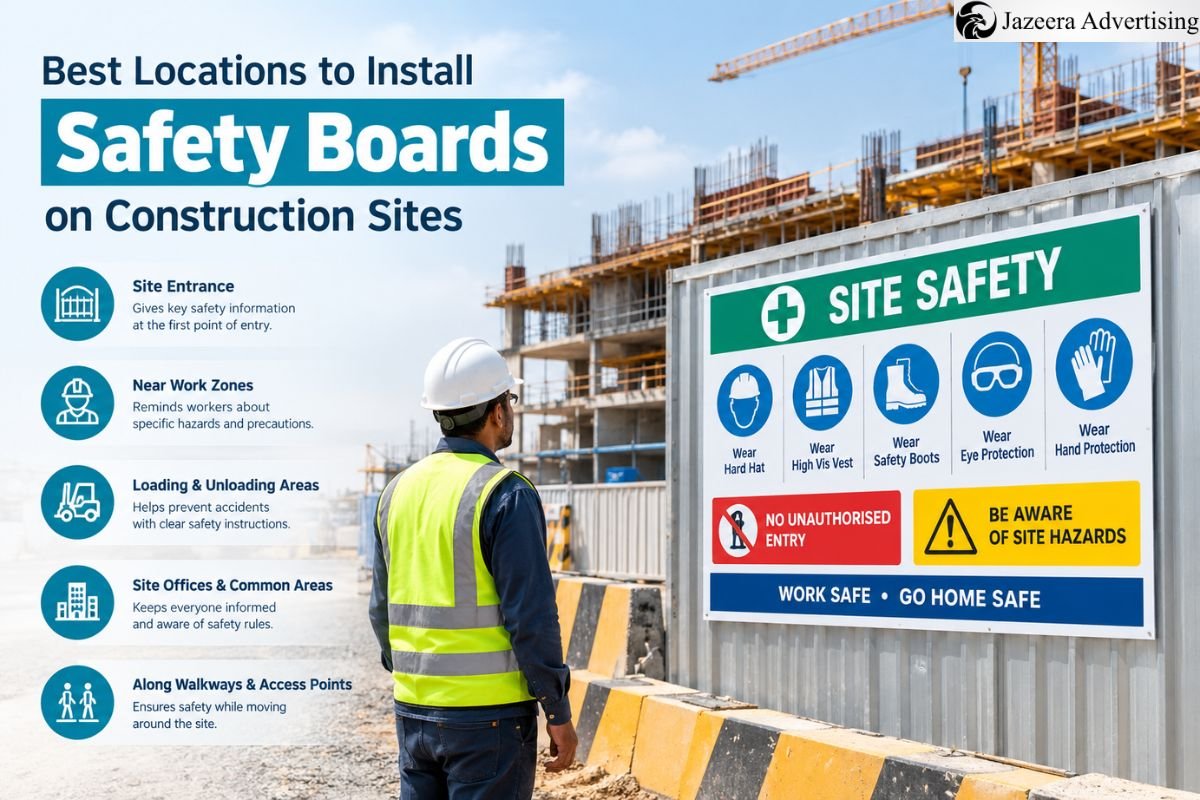
Best Locations to Install Safety Boards on Construction Sites
Table of Contents
- Key takeaways
- Why does sign location matter on site?
- Where to install safety boards?
- Quick reference: sign type and message by location
- Placement rules: visibility, height, lighting and upkeep
- Signs support other safety controls
- Common mistakes to avoid
- Wrapping up
- Frequently asked questions
The safety boards shall be installed d to indicate a hazard’s beginning or an area where a decision must be made: site gates, excavation, scaffold zones, electrical activity zones, storage areas, vehicle route, walkways, hazardous materials storage, assembly places, first aid and fire-fighting points, and restricted zones. Each board must be clearly seen, properly understood, and displayed before the approaching hazard.
Where the board is placed matters as much as what it says. A warning placed twenty meters back from the edge of a trench, or buried behind piles of stacked pallets, is just decoration. The interface of safety boards on such sites works when the right person sees the right message-at which point action can still be taken.
Key takeaways
- Place each board in front of the hazard to allow the person to avoid it.
- Match the sign type to the risk: danger, warning, mandatory, prohibition, or safe condition.
- Check visibility, height, lighting, and obstruction, then inspect boards on a routine basis.
- Signs support risk assessments, barriers, procedures and training. They never replace them.
Why does sign location matter on site?
Construction sites evolve from week to week. Hoarding shifts, trenches appear and disappear, cranes travel around the site. The workers know the patterns. It is visitors, delivery drivers, and passers-by who need guidance through signs and notices.
Moreover, there are only a few seconds to read a board while you walk or drive by. Effective placement of safety signs from a safety signage supplier in UAE, gives you those few seconds: near the hazard, facing the approach, free of clutter.
Where to install safety boards?
- Site entrances and exits
Everyone will see the main gate board. Site name, required PPE, visitor check-in, speed limit, and an emergency contact number. On departure, there should be a stop board or give way board facing the drivers leaving to join a public highway.
- Construction zones
Place warning and required boards at the entry to each work zone, not just the gate. Things like PPE requirements vary from one work area to another, like hearing protection close to power boxes or face shields in the vicinity of saws. A board at the work zone boundary explains what applies from there.
- Excavation areas
Attach “Danger: deep excavation” and “Keep out” notices to the barrier for every side from which the pit is approached, not on the ground. Use reflective surfaces, because pits are often accessed at sunrise and sunset.
- Scaffolding and work-at-height areas
Pin boards at the scaffold access point, and around the drop zone beneath it. Standard boards read, “wear hard hat”, “overhead work”, and “scaffold, inspected, do not use” or “scaffold, inspected, safe to use”. A status tag is in addition to the inspection record. It is not a substitute.
- Electrical work zones
Mount “Danger: high voltage” and “Authorised persons only” on the doors to the temporary distribution board. On the enclosure to the generator and the approach to an overhead line. When equipment is shut down for work, place a label “Isolated, do not switch on” where the isolation takes place.
- Material storage areas
Place load limits, stack heights, and “No smoking” signs at the store entrance and “Keep clear” signs where cranes or forklifts are used for offloading. The fire and ignition-source boards for a fuel, gas-cylinder store should be on the door, not just in the site office.
- Heavy machinery and vehicle routes
Signs should be positioned where they are relevant: at junctions, at blind corners, in crane swing zones, and at reversing locations. Speed limit, one-way arrow, give way, and “reversing vehicles” signs should be of a size visible at driving speed. Reflective faces assist during nighttime.
- Pedestrian walkways and crossings
Place a required walkway with boards and direction arrows. If crossing a vehicle route, the walkway should have a crossing sign on each side and a “Look both ways” sign at the edge. A busy site should use barriers and pavement markings with signs.
- Hazardous-material areas
Put hazard pictograms, type of substance, and a brief note on basic PPE at the store door and on the larger containers. Note, where applicable, “No naked flames” and indicate the location of safety data sheets and spill kits.
- Emergency assembly points
Use green safe-condition boards large enough to be seen from a distance around the site. Keep them clear of vehicle routes, excavations, and any potential falling hazards. Use arrows on escape routes and a site plan at the gate. If you have more than one assembly point, number them and take help from the best safety signage board in Dubai.
- First-aid and fire equipment areas
Mount a sign above equipment, high enough to be seen above stacking. Every first-aid box, eyewash station, and extinguisher requires a corresponding board, and the clearance in front has to be maintained. A sign pointing at an extinguisher buried behind plasterboard sheets helps nobody.
- Restricted-access zones
Provide “Authorised personnel only” and “No unauthorised entry” signs at all entrances to crane bases, hoists, plant rooms and live-electrical areas. Along perimeter fencing, position signs so that one will be visible to a member of the public approaching from any direction.
Quick reference: sign type and message by location
| Location | Sign type | What it should say |
| Entrances and exits | Mandatory, information, traffic | Site name, PPE, visitor check-in, speed limit, emergency contact |
| Construction zones | Warning, mandatory | Hazard present, zone-specific PPE, access limits |
| Excavations | Danger, prohibition | Deep excavation, keep out, edge hazard |
| Scaffolding and height | Warning, mandatory, status tag | Overhead work, hard hat, scaffold status |
| Electrical zones | Danger, prohibition | High voltage, authorised persons only, isolated |
| Material storage | Warning, prohibition | Load limit, no smoking, keep clear |
| Vehicle routes | Traffic, warning | Speed limit, give way, reversing, lifting zone |
| Walkways and crossings | Mandatory, direction | Use walkway, crossing point, look both ways |
| Hazardous materials | Hazard pictogram, prohibition | Substance hazard, no naked flames, PPE, spill action |
| Assembly points | Safe condition | Assembly point, escape direction |
| First aid and fire | Safe condition, fire equipment | Equipment location, keep clear |
| Restricted zones | Prohibition | Authorised personnel only, no entry |
Placement rules: visibility, height, lighting and upkeep
- Visibility and obstruction
Look at the board from the point where a worker or driver would stand when approaching the board. Signs can be found in hidden places such as scaffold netting, hoarding, parked plants and stored material. Do take a second look, as what you see is what you get; yesterday is not what you see today.
- Height and readability
Mount boards at approximately eye level (between 1.5 and 2 metres) unless it is specified otherwise in the project standard for people on foot. Drivers require bigger boards, positioned higher and further forward. Use a pictogram, keep the text short, ensure good colour contrast and write in languages that your workforce can read.
- Lighting
Early morning work during the day, evening work, or work in basements and stairwells are common at many sites. Install retroreflectors on vehicle and excavation signs and photoluminescent escape boards and signs in emergencies where power is out. Ensure that the lighting on the site does not create glare on a board.
Maintenance
- Do weekly inspection walkabouts, and record faded, bent, dirty, or loose walkabout boards.
- Replace damaged signs quickly. There’s a time and place for everything.
- Move or remove boards when the work or the hazard changes.
- Maintain an easy-to-read log to help identify missing signs at inspections.
Signs support other safety controls
The purpose of a board is to inform people of a hazard. It does not get rid of the hazard. OSHA’s construction standard indicates that danger signs identify immediate hazards and caution signs identify potential hazards or unsafe practices. HSE guidance in Great Britain is similarly practical – safety signs are for risks that have not been addressed by other controls.
Additionally, take an excavation. Edge protection, shoring, permit, and trained crew are the real controls. The sign gives reasons for the presence of the barrier. In the absence of these controls, the sign is simply a request.
The requirements vary in different countries; for clients and projects, it is important to check local regulations and the project safety plan with a competent adviser such as the best signage company in Dubai.
Common mistakes to avoid
- Avoiding any board at the hazard and only one at the gate.
- Stuffing too many signs into one posting so no one reads anything.
- Relying on ‘danger’ for all, reducing the strength of those signs that count.
- Installing hanging boards to hide hoarding, plant, or stored material.
- Letting outdated or uneven boards remain or be left up after the work is completed.
- Writing with long paragraphs in one language for a multilingual team.
- When selecting materials and finishes, ignoring night, rain and dust.
Wrapping up
Safety boards earn their place when they sit where decisions are made: the gate, the trench edge, the panel door, the crossing. Walk your site as if you are a first-time visitor, and identify where a stranger might fall off the path, and place a clear board there. Then recheck it whenever there is any change in the layout.
Therefore, Jazeera Advertising can assist with construction site safety signage in Dubai, constructed in the sizes, materials, and finishes you require to meet the specifications of your project.
Frequently asked questions
At the main gate and at each hazard point identified in your risk assessment. Begin with entrances/excavations, electrical equipment and vehicle routes, and install boards zone by zone as work progresses.
Pedestrian eye level is typically 1.5 to 2 metres. The larger, the higher, the boards on the cars. Please refer to your project standard, as requirements may differ.
No – Signs alert people but do not manage the hazard. The barriers, system of work, permits, and training do the protecting; boards back up.
OSHA’s construction standard says danger signs are for immediate hazards and caution signs are for potential hazards or unsafe practices. Some other systems may have different colours and wording; follow your local standard.
Most sites can be walked around on a weekly basis, and after any change of layout, storm, or major delivery. Replace faded, damaged, or blocked items immediately.
Yes. The more crowded posts are, the more people will touch them and then ignore them. Have only one message for each hazard and locate each of the boards with the hazard.
The languages in which your employees can read. Pictograms convey the majority of the message, with a short text added in the main site languages and, if necessary, any language in which the rules of the site are written.
Yes, if work or traffic is still going on after dark. Have reflective faces on vehicles and excavation signs, good lighting at gates and walkways, and photoluminescent boards on escape routes.
Best Locations to Install Safety Boards on Construction Sites

Reception Signage Cost Guide: Materials, Design and Installation Explained