- October 1, 2026
- by Jazeeraadv
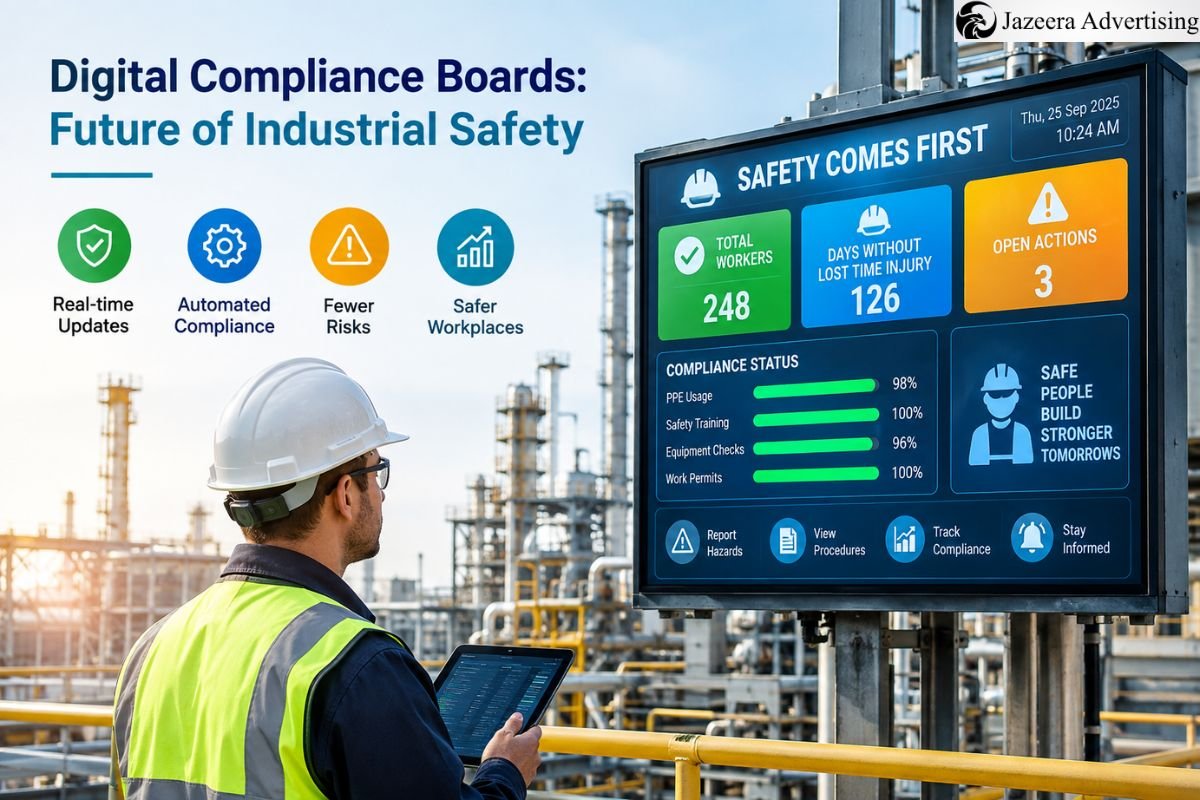
Digital Compliance Boards: Future of Industrial Safety
Table of Contents
- Key takeaways
- Why is traditional signage alone not enough anymore?
- What makes a board “digital” and “compliant” in Dubai?
- Regulatory backdrop: why this matters for UAE sites
- Where digital boards fit alongside standard signage?
- Types of digital compliance boards used on sites
- Where is this actually headed?
- Cost, power, and maintenance realities
- Common mistakes contractors make
- Choosing a signage supplier: what to actually check
- Bottom line
- Frequently asked questions
A digital compliance board is the electronic equipment placed on a construction or industrial site displaying the safety info from the site: permits in action, dangers, PPE requirements, headcount, alerts for weather conditions, etc. It is placed on the site with standard signs related to construction site safety in Dubai, but not replacing them, though presenting very easy tasks. It is crucial to carefully maintain the information displayed by the digital compliance board, as the risk on the site is changing every hour and cannot be shown on the printed board.
Key takeaways
- Digital compliance boards are able to offer updates in real time, whereas static boards are automatically out of date as soon as they leave the printer.
- The way compliance boards are operated on a daily basis depends on Dubai’s environment and the presence of a multilingual workforce.
- Future compliance boards could work with sensor and wearables data to detect risks sooner.
- Choosing a reputable supplier of safety signs in UAE ensures that your signs will be properly installed and maintained.
Why is traditional signage alone not enough anymore?
Walk onto most mid-size sites in Dubai, and the familiar mix is still there: red prohibition circles, yellow warning triangles, blue mandatory-action signs, green emergency markers. That’s not changing, and it shouldn’t. A fire exit sign doesn’t need power to work, which is exactly why it’s still required.
But printed boards have a limitation that doesn’t get talked about much. They describe a risk as fixed, even when it isn’t. A “high noise area” sign stays up whether or not the machine causing that noise is actually running that day. A “hard hat mandatory beyond this point” sign has no way of telling you today’s concrete pour moved the exclusion zone ten metres to the left. That gap, between what the sign says and what’s actually happening right now, is where a lot of near-misses start.
However, digital compliance boards exist because of that gap. They sit next to the certified physical sign and carry whatever part of the message keeps changing: today’s permit-to-work status, live crane lift zones, current headcount for evacuation counts, a heat-stress advisory during the worst weeks of a Dubai summer.
What makes a board “digital” and “compliant” in Dubai?
A digital board only counts as compliant if it still follows the visual rules regulators expect from any safety sign: the shapes, colours, and pictograms set out in Dubai Municipality’s technical guidelines for safety signs at work. Those guidelines apply to commercial, industrial, and construction-related sites across the emirate, screen or no screen.
In practice, that means:
- Prohibition messages still show up as the red circle-and-diagonal, not a generic red banner someone designed in an afternoon.
- Mandatory instructions (PPE, hand-washing, hard hat zones) keep the blue circular pictogram, because that’s what the eye recognises.
- Warning content stays inside the yellow triangle, even rendered on an LED or LCD screen.
- Emergency and first-aid information stays green, placed somewhere nothing blocks it.
Therefore, a screen scrolling text in a company font isn’t a compliance board. It’s a notice board wearing a costume. That distinction matters the moment an inspector walks the site, because construction site safety signage in Dubai gets judged against the standard pictogram system, not against how modern the hardware looks.
Regulatory backdrop: why this matters for UAE sites
Dubai Municipality has said plainly that non-compliant sites can be warned and, after repeat violations, shut down until things get fixed. Inspections look at PPE usage, whether signage is correct, and whether the safe systems of work written up on paper are actually visible once you’re standing on the ground.
There’s a heat angle here too, and it’s specific to this market. Dubai Municipality’s technical guidelines on heat stress, combined with the federally mandated midday work break running June through September, put real weight behind showing accurate, current safety information rather than a message that hasn’t been true since April.
Furthermore, for a contractor, that changes the calculation. A board still showing yesterday’s permit status, or a hazard zone that closed two days ago, can work against you during an inspection. It suggests nobody’s maintaining the safety system, not that the technology failed. Someone has to own updating it every shift, the same way someone owns swapping out a faded printed sign. A safety signage supplier in the UAE can be helpful.
Where digital boards fit alongside standard signage?
Think of it as layers, not a choice between one and the other:
| Layer | Best for | Power dependent? |
| Fixed printed signage | Exit routes, permanent hazards, fire equipment locations | No |
| Digital compliance board | Live permit status, today’s hazard zones, headcount, weather alerts | Yes |
| Mobile or tablet inductions | Worker-specific inductions, attendance, personal safety records | Yes, with backup |
The sites that handle this well keep fixed signage for anything a worker needs to see even through a power cut, and save the screen for whatever is genuinely time-sensitive. The ones that don’t tend to dump everything onto the display and let the printed signage fade into background noise, which is exactly backwards from a safety standpoint.
Types of digital compliance boards used on sites
A handful of formats keep showing up on UAE sites and industrial yards:
- LED safety scoreboards- Large outdoor displays showing days since the last incident, today’s PPE requirement, or a rotating safety message. Easy to read from a distance, which is really the point.
- Weatherproof LCD notice screens- Smaller units near site entrances, showing permit status, today’s crew, emergency contacts.
- QR-linked smart boards- A physical board with a QR code that opens a digital induction, hazard briefing, or attendance log on a worker’s phone. On a site where Hindi, Urdu, and English are all in use at once, this matters more than it sounds like it would, since the linked content can switch language on its own.
- Sensor-integrated boards- Wired into noise, vibration, or air-quality sensors, updating whatever’s on screen live.
Every one of these still needs a physical, certified sign nearby saying the same core thing without needing a battery to say it.
Where is this actually headed?
Here’s what actually separates a digital board from where this is going next. Right now, most digital boards on Dubai sites still work one direction: someone types in an update, the screen shows it. The next generation works the other way too, where the board becomes a place data lands automatically instead of a place someone posts it.
A few directions this is already moving in on larger projects internationally, and slowly making their way into GCC construction:
- Cameras feeding the board directly- Computer vision that catches missing PPE or someone drifting into a restricted zone can push that alert straight to the nearest screen, not just to a supervisor’s phone somewhere off-site.
- Wearables tied into the display network- Smart helmets and vests tracking heat exposure, falls, or proximity to machinery can trigger a localized warning on the board the moment a threshold gets crossed, instead of waiting for the next briefing.
- Flags for what’s coming, not just what’s happening- Rather than only showing “high noise area today,” these systems combine weather forecasts, crew schedules, and past incident history to mark a zone as elevated-risk before anyone’s even started work there.
- Boards wired into the rest of the site’s systems- Attendance tracking, equipment sensors, permit management- all feeding the same platform, instead of a screen that stands alone doing its own thing.
None of that replaces certified pictogram signage; nothing here changes that. What changes is what earns the word “digital” in the first place. A board that’s just a PDF converted to a screen isn’t really forward-looking, whatever the sales pitch says.
Moreover, one that updates itself off a sensor or a wearable, adjusting the hazard level it shows without a human typing it in, is the direction this is actually heading. Adoption on Dubai sites is still early, mostly limited to bigger infrastructure and industrial jobs for now, but it’s why “digital compliance board” is starting to mean something different from plain digital signage. Picking the best signage company in Dubai is a smart choice.
Cost, power, and maintenance realities
This is where the enthusiasm for smart signage runs into what a Dubai site is actually like in July. Outdoor electronics take a beating from the heat here. Screens need proper IP-rated enclosures and enough brightness to stay readable in direct sun, and both of those push the unit cost well past a standard printed board. Dust from any nearby earthworks doesn’t help either, and it shortens the life of anything not properly sealed.
Worth checking before installing:
- Confirm the display carries an IP65 rating or higher if it’s sitting fully exposed.
- Budget for a battery backup or generator tie-in. A blank safety screen during a power cut is worse than having no screen at all.
- Plan the content-update routine before the hardware arrives. A board is only as good as whoever’s actually updating it each shift.
- Check glare and readability at the real mounting angle, not off a spec sheet in an office.
None of this makes digital boards a bad call. It just means running them properly costs more than most sales pitches let on, and the ongoing cost usually outweighs what you paid upfront for the hardware.
Common mistakes contractors make
- Treating the digital board as a swap-in for certified pictogram signage rather than something that sits alongside it.
- Leaving old content on screen because nobody was actually assigned to refresh it. Ironically, a stale digital board can mislead people more than a stale printed one, since workers assume the screen is live.
- Mounting a screen where direct sun makes it unreadable for half the working day.
- Skipping multilingual content on a crew where Hindi, Urdu, and English are all in regular use.
- Buying the hardware first and figuring out the compliance content afterward, instead of starting from what Dubai Municipality’s signage guideline actually asks for.
Choosing a signage supplier: what to actually check
Picking the best signage company in Dubai for this isn’t really about who has the nicest-looking screen in their catalogue. Worth asking before you sign anything:
- Do they actually understand pictogram and colour-coding rules well enough to build compliant digital content, not just standard printed boards?
- Can they be weatherproof for outdoor UAE conditions, not just indoor office signage?
- Do they run a content-update service, or is that left to the client to manage?
- Have they done multilingual signage for mixed-nationality crews before, or would this be their first time?
Jazeera Advertising handles both traditional printed safety signage and digital display formats for Dubai sites, and that dual capability is worth checking for wherever you end up going. A supplier who only does one usually ends up outsourcing the other, and that’s where delays and extra cost tend to creep in.
Therefore, if you’re weighing up the best safety signage board in Dubai for a specific project, ask for real examples from similar-scale sites rather than trusting a catalogue photo. Outdoor readability and mounting quality vary more between suppliers than most people expect going in.
Bottom line
Digital compliance boards were never meant to replace the red, yellow, and blue signage that’s been standard on UAE sites for years. What they add is a layer of information that genuinely needs to stay current, not stuck at whatever it said this morning. Where this is heading next matters more than where it started: boards that respond to what a camera, a wearable, or a sensor picks up on site in real time, instead of only showing what someone typed in before their coffee got cold.
Get that combination right, with someone actually accountable for keeping it accurate shift to shift, and a digital board stops being an expensive notice screen. It starts being part of how the site actually manages risk.
Frequently asked questions
An electronic display showing live safety data, permit status, hazard zones, headcount, or alerts, updating in real time instead of staying fixed like printed signage.
No. Physical, pictogram-based signage is still the legal baseline. Digital boards are something many sites add on top for anything time-sensitive.
Not for critical warnings. Power outages, glare, screen failure- all of it makes fixed signage the safer permanent layer for exits, hazards, and mandatory PPE zones.
Boards pull data automatically from cameras, wearables, and sensors, flagging elevated-risk zones before something goes wrong, rather than only showing whatever someone typed in manually.
At minimum once per shift change, and immediately whenever permit status, hazard zones, or headcount shifts.
Yes. Without the standard red, yellow, blue, and green pictogram system, it’s a general notice screen, not genuine safety signage.
Heat and dust wear down the screen over time, plus glare making a poorly rated screen unreadable in daylight.
Some can. Worth confirming upfront, since splitting the work across two suppliers often leaves you with wording and compliance that don’t quite match
Digital Compliance Boards: Future of Industrial Safety
Safety Signage Cost Guide for Businesses