- September 29, 2026
- by Jazeeraadv
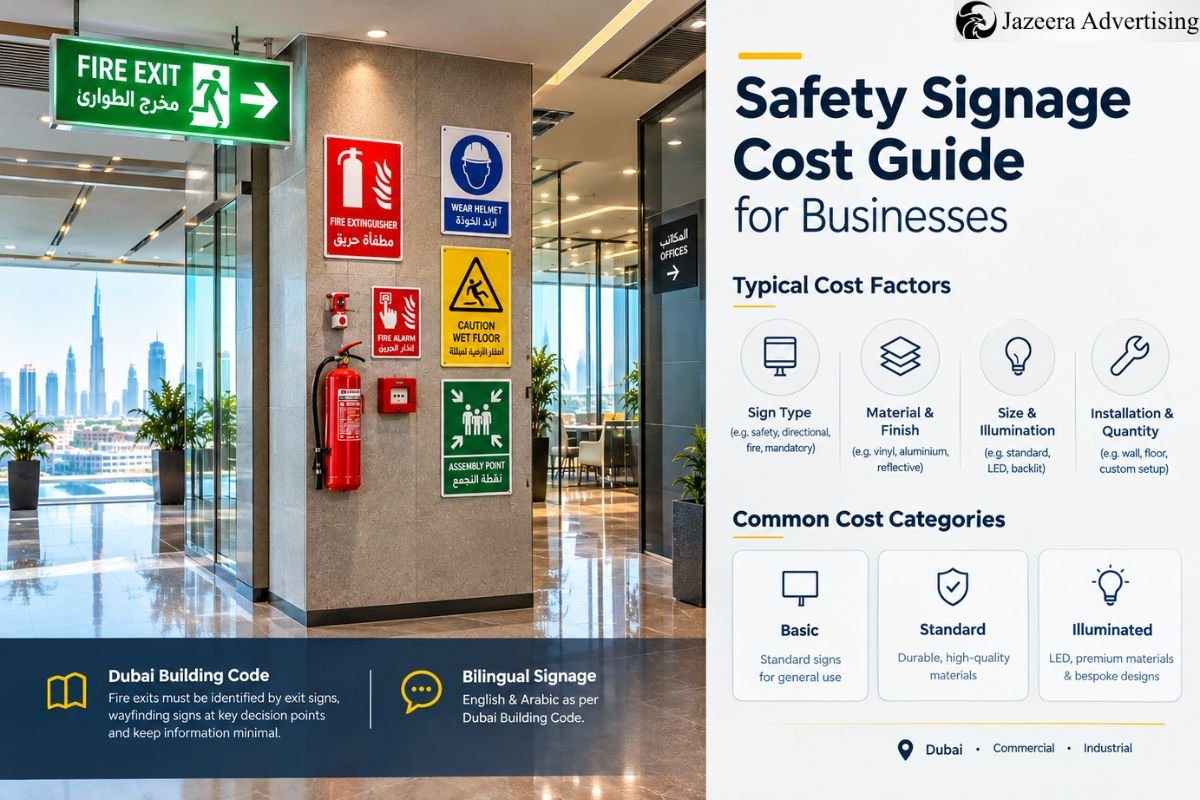
Safety Signage Cost Guide for Businesses
Table of Contents
- Key takeaways
- How much does safety signage cost in Dubai in 2026?
- What affects the price of safety signs?
- Which materials and sign types cost what?
- What should different businesses budget?
- What compliance costs should you expect?
- How can you cut costs without cutting safety?
- How do you compare suppliers fairly?
- Final thoughts
- Frequently asked questions
In 2026, the price of most common safety signs will range from AED 5 to AED 300 per sign, depending on printing quality, size, and material. Custom-made aluminium signs, lit exit signs, and signs for large construction sites can cost AED 800-AED 2,500 or more; a complete set of signs for a small office or warehouse usually costs a few hundred dirhams to several thousand dirhams, with the installation costs included.
It is important to treat all amounts in this guide as approximate costs and confirm whether a quote includes 5 % VAT in advance of comparing different quotes.
Key takeaways
- Most conventional safety signs have a price range between AED 5 and 300 per sign. Customized boards, exit signs, and entrance boards have a higher price tag.
- Apart from size, materials and location affect pricing. In most cases, cheap vinyl used outdoors could take away a lot more from your budget.
- Often, the first quotes do not take into consideration installation, artworks, and approvals; be sure to request a breakdown of these items.
- Bilingual signals with ISO 7010 designs are the best option for businesses in Dubai.
How much does safety signage cost in Dubai in 2026?
These ranges come from published UAE listings and typical fabricator pricing.
| Sign type | Typical range (AED) | Best suited to |
| Self-adhesive vinyl (A4 to A3) | 5 to 60 | Smooth indoor walls |
| Rigid PVC board | 30 to 120 | Offices, corridors |
| Photoluminescent sign | 25 to 150 | Exits, stairwells |
| Aluminium or ACP board (about 600 x 400 mm) | 100 to 300 | Warehouses, yards, sites |
| LED or self-contained exit light | 85 to 850 | Escape routes |
| Large framed site entrance board | 800 to 2,500+ | Construction sites |
However, there is no single best safety signage board in Dubai for every job. A glow-in-the-dark sign suits a stairwell and is a poor choice for a gate that gets full afternoon sun. Decide where the sign will hang first, and the price mostly follows.
What affects the price of safety signs?
Seven things move most quotes up or down.
- Material sets the baseline. Vinyl is cheapest, aluminium and ACP cost more, and illuminated units cost the most.
- Bigger boards need more material and stronger fixings. The price climbs again when a board needs a frame or structural support.
- Ten identical signs cost less per piece than ten different ones, since setup and cutting are shared across the batch.
- Standard pictograms are quick. Custom wording, logos, or site-specific rules add design time.
- A sign stuck to a smooth wall is a quick job. Drilling into concrete, working at height, or fitting posts requires labour and equipment, and small jobs often carry a minimum visit charge.
- Remote sites can add transport time, and free zones may have their own rules.
- Heat, dust and UV push outdoor signs toward aluminium, ACP or UV-protected print. That costs more on day one and less over the years.
Which materials and sign types cost what?
What are the main sign materials?
- Self-adhesive vinyl is the cheapest and quickest choice indoors, and it struggles outside.
- Rigid PVC is light and low cost. It works fine in offices and corridors.
- Photoluminescent sheet glows after soaking up light, so it still works in a power cut and needs no wiring.
- Aluminium resists rust and knocks, which is why you see it in warehouses, yards and on sites.
- ACP is flat and light and holds print well, so larger boards are often made from it.
- Acrylic looks clean in reception areas and clinics. It’s a weaker fit for rough industrial use.
- LED exit lights are needed wherever a lit exit is expected, and their cost includes power and upkeep.
Which sign categories will you need?
Most workplaces need prohibition signs (no smoking, no entry), warning signs for hazards, mandatory signs such as PPE, and safe-condition signs for exits and first aid, plus fire equipment markers. The category rarely changes the price. Material and size do.
What should different businesses budget?
These are planning examples. Your layout and risk assessment set the real numbers.
- How much for an office?
A typical office needs exit and direction signs, extinguisher and first aid markers, an assembly point sign, and a few restricted-area signs. That comes to 15 to 30 signs, mostly PVC or photoluminescent, plus a few lit exit units. Budget roughly AED 1,500 to 4,000 installed.
- How much for a warehouse?
Signs are indispensable in warehouses: red forklift routes, load limits on racks, PPE signs in front of warehouses, indications for chemical storage, fire exit signs, and more. Dust and moving equipment can spoil cheap stickers quickly, making use of aluminium or ACP more justifiable. The average cost of a mid-size warehouse sign ranges between AED 4,000 and AED 12,000.
- How much for a commercial building?
Shopping centres, office buildings, clinics, and hotels use the same signs on many floors. For example, it can be stair signs, evacuation plans, assembly points, parking safety signage, etc. Frequently, building management have their own internal standards which need to be taken into account as well. Costs here may vary from AED 5,000 to AED 20,000 depending on how many floors are in the building.
- How much for a construction site?
Construction site safety signage in Dubai is the most demanding category. A site needs an entrance board with PPE and site rules, hazard signs at excavations and scaffolding, traffic signs where vehicles move, and fire and first aid points. Everything is outdoors and gets knocked about, so aluminium or ACP with UV-stable print is the norm. Many sites spend AED 3,000 to 10,000, and large projects spend more. Portable A-frame signs cover temporary works.
What compliance costs should you expect?
Dubai Municipality’s technical guideline on safety signs at work covers commercial and industrial workplaces and construction sites. It refers to ISO 7010 symbols and says the language should suit the workforce, with Arabic and English given as examples. That is why bilingual artwork is the safe default.
Beyond the signs themselves, watch for these:
- Civil defence requirements for fire and exit signage in your building type.
- Landlord or building approval, especially for outside or road-facing signs.
- Permits for large or elevated boards. Published estimates put permit-related costs at roughly AED 500 to 5,000 depending on the zone, plus AED 800 to 2,500 for structural certification on bigger structures.
- Free zone rules, which can differ from the mainland.
Therefore, standard indoor safety signs usually don’t need their own permit, but requirements vary by building and zone. Check with your safety consultant or the relevant authority before you order. Construction site safety signage in Dubai falls under the same guidelines, and inspectors may check your signs, so keep photos of what was installed.
How can you cut costs without cutting safety?
- Walk the site first and mark every hazard, exit, and piece of equipment. You’ll order what you need and skip what you don’t.
- Use different materials in different zones, with vinyl or PVC inside and aluminium outside. Aluminium in a carpeted corridor is wasted money.
- Standardize sizes and wording where you can. Fewer designs mean a lower setup cost.
- Order in one batch, so printing, cutting, and installation visits combine.
- Give supply and fitting to one team. It saves arguments later over alignment and fixings.
- Be wary of false savings. Outdoors, cheap vinyl can fade and lift after a few hot months, and buying it twice costs more than one aluminium board.
- Keep a few spares of the common signs, so a damaged one doesn’t stay missing for weeks.
People shopping for the best safety signage board in Dubai usually filter by price first. Filtering by durability first tends to work out cheaper.
How do you compare suppliers fairly?
A low quote can leave things out. Ask every supplier the same questions:
- Are the signs based on ISO 7010, and is Arabic included?
- What material and thickness are you offering, and is the print UV-protected?
- Are installation, fixings, and the site visit included?
- Who handles landlord or authority paperwork?
- What is the lead time for repeat orders?
- Can you show similar completed work?
A search for the best signage company in Dubai gives you a long list. Narrow it by asking for an itemized written quote and a sample of the material. A reliable safety signage supplier in UAE will tell you what’s included instead of sending one lump sum.
Moreover, Jazeera Advertising, based in Al Qusais, Dubai, makes safety signage alongside its wider signage work. That includes construction site boards, emergency exit signs, hazard warnings and reflective caution signs. Whoever you talk to, a floor plan or a few site photos will help them quote accurately.
Final thoughts
Make sure to inspect your location properly after you’ve figured out where your signs should be installed and what circumstances they will have to deal with. Next, ask the suppliers for a detailed estimate saying how much the installation and paperwork will cost.
The best safety signage board for your site is the one that stands up to the sunlight, complies with regulations, and is within your budget limits. However, the best signage company in Dubai for the job will be the one that can explain its pricing in plain terms.
If you’re planning a fit-out, a warehouse, or a site, you’re welcome to share your layout with Jazeera Advertising and get a quote to compare against your other options.
Frequently asked questions
The small vinyl or PVC signs cost between AED 5 and 120. The price of aluminium or ACP boards typically ranges from AED 100 to 300, with larger site boards going up to AED 2,500.
Dubai Municipality guidance states that the language should be appropriate for your workforce; Arabic and English are cited as examples. In most workplaces, it is most effective to have bilingual signs.
Aluminium and ACP with UV-protected print. They’re durable and can withstand heat, dust, and humidity, whereas plain vinyl and thin plastic can fade and warp.
Not always. Inquire about fixings, drilling, lifts, and site visits, as small jobs are likely to be subject to a minimum call-out fee.
Occasionally, a separate permit is not required for indoor signs. Outdoor, road-facing or large boards may, and fire and exit signs must comply with civil defence requirements, please check before ordering.
There is no set number. Identify hazards, exits, equipment, and PPE areas first, then place a sign where a warning or instruction is required.
Yes, for normal messages such as exits or no smoking. Site rules, bilingual signage, or branding are sensible for custom signs, and a good safety signage supplier in the UAE will be capable of providing both.
Check them regularly and replace faded, damaged, or blocked ones. Make sure to update them as well when layouts, equipment, or hazards change.
Digital Compliance Boards: Future of Industrial Safety
Safety Signage Cost Guide for Businesses