- September 25, 2026
- by Jazeeraadv
Fire Extinguisher Sign Placement Guide for UAE Buildings
Table of Contents
- Key takeaways
- Why does placement matter more than people assume?
- What does the fire code actually require?
- Picking the right sign material for the space
- Where do construction sites get this wrong?
- Sign types compared
- Working with a signage supplier who understands compliance
- Final word
- Frequently asked questions
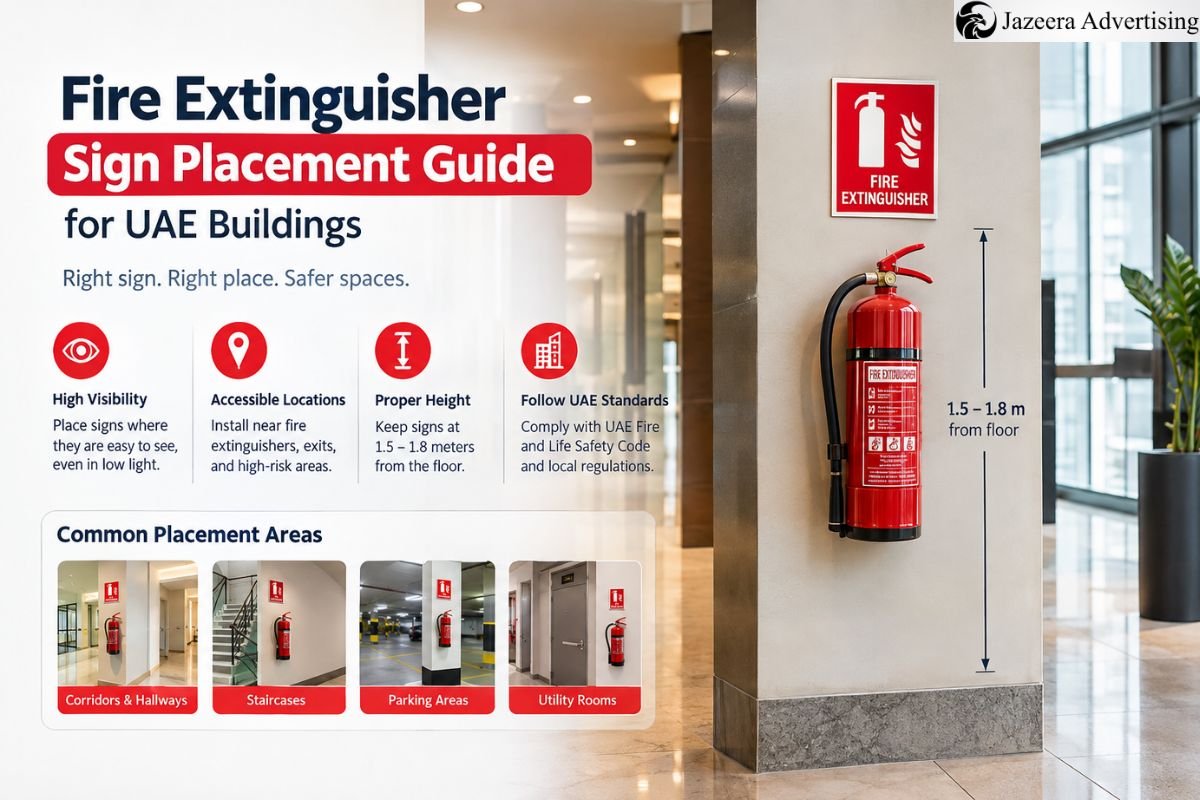
In case a fire starts and there is no way of finding out where the fire extinguisher is located, the sign fails its purpose. Fire extinguisher signs should be placed above eye level to be easily visible from every point in the room and indicate the extinguisher, which is fixed at a height no greater than 5 feet.
However, this is checked by Civil Defense inspectors in Dubai whenever they conduct inspections, and it is one of the most common issues raised during inspections. Proper placement of signs from the beginning is a way to eliminate the need for re-inspection and to guarantee the efficiency of signage.
Key takeaways
- It is advisable that all fire extinguisher notices can be viewed from at least 50 feet away without any hindrances.
- NFPA offers specific measurements for fire extinguisher mounting heights depending on the size and available space in the area.
- Photoluminescent signs make it easy to read the information in staircases, basements, and whenever there’s a blackout.
- At Dubai construction sites, temporary fire extinguisher signs should be clearly visible regardless of the presence of scaffolding and other equipment.
Why does placement matter more than people assume?
For most individuals, fire extinguisher signage merely represents a basic upkeep obligation. However, such signage fulfills a critical role. According to NFPA 10, the presence of appropriate fire extinguisher signage may help to ensure that the needed extinguishers can be found, as they can be blocked behind furniture, inventory, appliances, and columns.
The signage should be determined in advance of furnishing the space. In many cases, signage that has already been installed when cabinetry, lighting, ceilings, and other elements are already complete has ruined the location for proper signage.
Moreover, signage that is poorly placed could lead to compliance issues. For example, violations of OSHA regulations in the U.S. can lead a company to face fines, while in Dubai, penalties due to violations of signage requirements may be imposed by the Civil Defense Department. A wrongly placed or missing sign may be the first thing to be picked up by inspectors.
What does the fire code actually require?
NFPA 10 sets the baseline that most UAE fire consultants still reference alongside the UAE Fire and Life Safety Code. Here’s what applies on the ground:
- Mounting height: Extinguishers under 40 lbs. should be mounted no higher than five feet above the ground. Heavier models may go only a maximum of 3.5 feet. Maintain at least 4 inches of clearance between the bottom of the extinguisher unit and the floor.
- Travel distance: In places with ordinary Class A hazards of fire, such places as offices and shops, one should not have to walk more than 75 feet to the extinguisher. This distance is reduced to 50 feet in places that have Class B hazards and to 30 feet in business premises with Class K hazards.
- Sign visibility: In certain cases, when the fire extinguisher is placed in a place where visibility is limited by shelving, machines, or even walls, the presence of a sign becomes obligatory. The sign in this case must be placed according to NFPA 170 and have the shape of a red square with the picture of a fire extinguisher on it.
- Low-level signage in the UAE: a detail a lot of Dubai fit-outs miss. Civil Defence guidance calls for supplementary signs mounted low, roughly 150mm to 455mm above the floor, on top of the standard high-mounted sign. The logic is straightforward: in a smoke-filled corridor, people crawl, and a sign at eye level six feet up is useless to someone on their hands and knees.
None of this is complicated once you know it. It’s the kind of detail that gets missed when signage is treated as decoration rather than a life-safety system.
Picking the right sign material for the space
When deciding on materials, one must first consider the environment, and only then its visual appeal.
- Photoluminescent signs absorb light around them and radiate it for many hours after the power goes off; hence, they are essential for staircases, basements, and other escape routes for the duration of an emergency evacuation, because there is no certainty that backup lighting will exist for long enough. Dubai Civil Defence has made stricter demands about this kind of sign.
- Signs of rigid acrylic or aluminum composite fit various indoor environments such as office buildings, trade centers, and reception areas where the main consideration is sign longevity rather than emergency lighting features.
- Vinyl or adhesive signs are more economical and perform reasonably well in light traffic areas, as long as they are replaced as they wear out.. UV exposure in Dubai is aggressive enough that outdoor vinyl signage can lose legibility within a year or two if it’s not rated for it.
Furthermore, this is where working with an established safety signage supplier in UAE actually pays off, rather than ordering generic signs online and hoping they meet code. A supplier who’s been through Civil Defence approvals repeatedly knows which material passes inspection in which environment, and that saves a round of rework nobody wants.
Where do construction sites get this wrong?
Construction site safety signage in Dubai has its own failure pattern, different from a finished office building. Sites change daily. Scaffolding goes up, pallets shift, temporary walls get added and removed. A sign that was perfectly visible on Monday can be blocked by Thursday.
The mistakes I see most often on active sites:
- Signs mounted on temporary structures that get relocated without anyone moving the sign with them
- Extinguishers placed near the site office but nowhere near the actual work zones where welding, cutting, or electrical work is happening
- Faded or dust-covered signage that hasn’t been checked since installation, sometimes for months
- No low-level or supplementary signage at all, since site managers assume the main sign is enough
Therefore, a construction site needs a signage plan that gets revisited every time the layout shifts, not a one-time installation at the start of the project. It’s one of the more overlooked parts of site safety management, and it’s often the first thing flagged when Civil Defence does a surprise walkthrough mid-build.
Sign types compared
| Sign Type | Best For | Visibility in Power Outage | Typical Lifespan |
| Photoluminescent | Stairwells, basements, escape routes | Yes, glows for hours | 10+ years |
| Illuminated (electric) | High-traffic corridors, large floor plates | Yes, needs backup power | 5-8 years |
| Rigid acrylic/ACP | Offices, retail, reception areas | No | 8-10 years |
| Adhesive vinyl | Low-traffic storage, temporary areas | No | 1-3 years (UV exposure) |
Working with a signage supplier who understands compliance
Not every signage vendor understands fire code, even when they’re perfectly capable of producing a good-looking sign. There’s a real difference between a general indoor signage company in Dubai that handles wayfinding and branding, and one that also knows the specific pictogram sizing, mounting height rules, and photoluminescent certification requirements Civil Defence checks for.
Jazeera Advertising has handled enough fire and safety signage projects across Dubai fit-outs to know where inspectors focus their attention. A sign that’s technically correct on paper but printed at the wrong contrast ratio, or mounted six inches too high, can still fail an inspection. Jazeera Advertising’s approach tends to start with the fire consultant’s layout drawings rather than guessing placement after the fact, which cuts down on the back-and-forth that usually happens when signage gets ordered separately from the fire safety plan.
If you’re weighing options for the best safety signage board in Dubai for an upcoming project, ask any potential supplier directly whether they’ve handled Civil Defence-approved installations before, and whether they can show examples. Professional Advertising is one of the names that comes up consistently in that conversation, largely because the signage holds up to inspection rather than just looking right on delivery day.
Final word
The placement of fire extinguishers is not something to install after a fit-out. It’s part of the same planning that determines where the extinguisher should be mounted, and it should receive the same attention when mounting height, visibility, and the material that it is mounted on are taken into account.
Be sure to obtain layout drawings from your fire consultant well in advance, consult your indoor signage company in Dubai before installation, and review the plan whenever there are changes to the space, particularly on active construction sites. Before you put a layout into practice, it’s a good idea to speak to a team that’s had the experience of walking projects through Civil Defence and knows what to expect along the way, such as Jazeera Advertising.
Frequently asked questions
Tall enough to avoid obstructions and to be seen from approximately 50 feet. That can be, a lot of the time, at or near the height of the ceiling in a warehouse with high racks.
No. The extinguisher is in compliance with NFPA 10’s 3.5 to 5-foot rule. If the sign needs to be positioned higher for visibility over shelving or crowds, then it can be installed at that height.
Not everywhere. They must be installed in escape routes, stairwells, and basements where lighting could not be guaranteed in the event of a power failure.
Only 75 feet for ordinary hazards, 50 feet for flammable liquid areas, and only 30 feet in commercial kitchens in the immediate vicinity of cooking equipment.
Not really. For outdoor signage, it is crucial that the materials used are UV-resistant, as the sun can pose a threat to vinyl or acrylic.
Dubai Civil Defence checks fire extinguisher signage compliance during fit-out approvals and at periodic audits. If it is not complied with, a fine may be incurred, or sometimes the inspection may be failed.
To supplement, Civil Defence suggests additional signs be fixed from 150mm to 455mm above the floor, as people will crawl under the smoke sheets during evacuation.
In addition to monthly and annual checks of the extinguishers. Check for fading, physical damage, or obstruction caused by furniture, stock, or equipment moved.
There are no changes to the rules, but more regular placement reviews are required, as the scaffolding and temporary structures are constantly changing layout.
Not always, and it’s good to verify. Find out if any potential supplier has experience in working with Civil Defence fire safety signage, and not just branding.

Digital Compliance Boards: Future of Industrial Safety
Safety Signage Cost Guide for Businesses