- September 21, 2026
- by Jazeeraadv
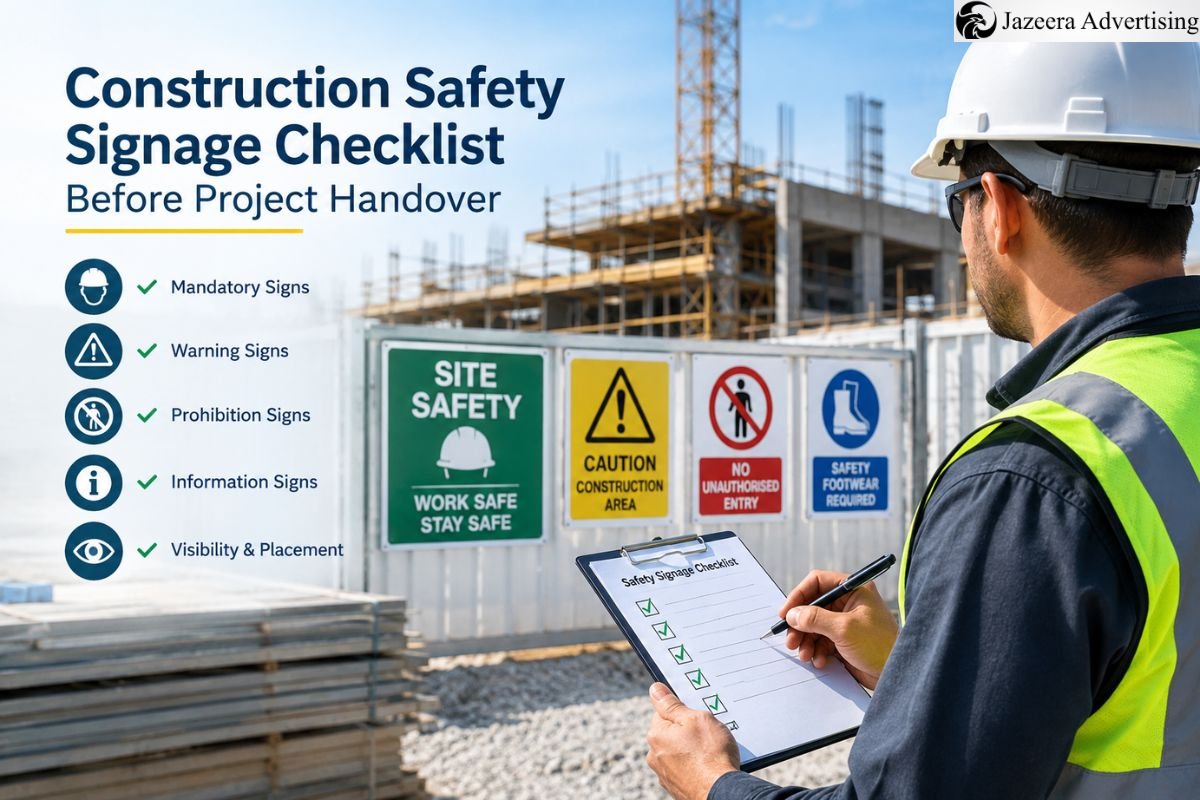
Construction Safety Signage Checklist Before Project Handover
Table of Contents
- Key takeaways
- What counts as “complete” signage before handover?
- The core checklist
- Fire and emergency signage
- PPE and mandatory action signs
- Site perimeter and public-facing signs
- Choosing the right boards and materials
- Common mistakes contractors make
- Working with a signage supplier vs. doing it in-house
- Bottom line
- Frequently asked questions
A construction site can only be handed over once each and every hazard has been marked correctly. These hazards include items such as fire points, PPE zones, restricted areas, warnings for working at height, ID boards, etc. Failure to do so is one of the reasons for which inspectors from Dubai Municipality mark sites during their final inspections, but this can easily be avoided through effective planning and following a checklist.
This is not just about obtaining the permit; it is also essential to make those who will be responsible for the facility aware of the hazards.
Key takeaways
- Handover signage is not construction-phase signage. Some boards stay, some come down, and a few need swapping out entirely.
- Dubai Municipality’s Technical Guideline on Safety Signs at Work (DM-HSD-GU99-SSW2) follows the ANSI Z535 standard, and that’s what inspectors are checking against.
- Fire, evacuation, and mandatory PPE signs get checked first. There’s no negotiating on these.
- If the signs on site don’t match what’s listed in the HSE file, that’s a red flag that will delay approval.
What counts as “complete” signage before handover?
Contractors mix up two different things: signage installed during construction, and signage that’s actually complete for handover. They’re not the same. During active construction, a lot of what’s up is temporary. Barricades near an excavation. “Hard hat area” boards near scaffolding. Warning tape around wet concrete. Most of that comes down once work in that particular zone finishes.
What has to remain, or get installed fresh, is the permanent layer. The signs a building occupant or facility team will be relying on for years, not weeks. Fire safety signage, emergency exit routes, electrical hazard warnings near panel rooms, anything tied to the building’s occupancy certificate.
Therefore, a decent way to test this: walk the site as you’ve never seen it before. Would you know where the fire extinguisher is? Would you know which door not to open in a fire? If not, the signage still has gaps.
The core checklist
Most Dubai-based consultants and HSE officers are looking for the same things during a pre-handover walkthrough.
- Fire and emergency signage: exit signs, assembly point boards, fire extinguisher location markers, hose reel signs
- Mandatory PPE signs: at plant room, workshop, or any entrance where hard hats, gloves, or eye protection are still required
- Prohibition signs: no smoking, no unauthorized entry, no naked flames near gas lines
- Warning signs: electrical hazard, slippery surface, low headroom, confined space
- Directional and informational signs: floor numbers, exit routes, first aid stations
- Site identification board: required for the construction period, and often kept around briefly after handover for reference during snagging
- Multilingual signs, wherever the workforce or occupants come from a mix of nationalities, which is close to the norm across the UAE
Not every project needs every item on this list. A villa handover doesn’t look like a warehouse handover. Scale the checklist to what the building’s actually used for instead of copying a generic template wholesale.
Fire and emergency signage
This gets the most scrutiny, and it should. Dubai Civil Defence and Dubai Municipality both hold contractors accountable for evacuation routes being unmistakable.
- Exit signs are illuminated or photoluminescent where the fire strategy calls for it
- Assembly point signage is visible from outside the building, not hidden behind a hedge
- Extinguisher and hose reel signs are mounted at a consistent, readable height
- Nothing new (furniture, a false ceiling, late-stage finishing work) is blocking a sign that used to be visible
Here’s a trap a lot of contractors fall into: fire signage goes up early in the project, then finishing works cover it or move it out of sightline. A false ceiling goes in, a partition shifts a few feet, and suddenly the exit sign that used to be obvious from the corridor isn’t. Run the signage walkthrough after finishing work, not before.
PPE and mandatory action signs
Areas that stay operational after handover- server rooms, generator rooms, plant rooms, rooftop mechanical spaces- need mandatory action signs to stay put permanently. Usually the blue circular format under ANSI Z535 and ISO 7010: helmet required, ear protection required, no entry without authorization.
Furthermore, one detail that gets missed: the sign’s language needs to match whoever’s actually going to read it. On a site with a mostly South Asian maintenance crew, English-only instructions leave real gaps in understanding. Bilingual or trilingual signage (English-Hindi-Urdu combinations show up often on UAE sites) closes a lot of that gap.
Site perimeter and public-facing signs
Handover doesn’t always mean the hoarding and barricades come down right away, especially on mixed-use sites where the plot next door is still mid-construction. Where perimeter signage is staying up:
- Street- or walkway-facing warnings need to stay legible and undamaged
- Contractor contact details need to be current, not a subcontractor who left the project months ago
- Anything referencing the Dubai Municipality permit number should match the current project phase
Once the building’s fully handed over and the perimeter is being cleared, this is also when temporary construction site safety signage in Dubai comes down for good, replaced by permanent occupancy signage: parking rules, visitor instructions, building directories.
Choosing the right boards and materials
Dubai’s climate is brutal on cheap signage. Months of direct sun fade printed vinyl fast, and humidity near the coast warps lower-grade substrates.
| Material | Best Use | Durability in Dubai Climate |
| Aluminum composite panel (ACP) | Permanent outdoor signs, site ID boards | High, resists warping and fading |
| Photoluminescent PVC | Emergency exit and evacuation signs | High, glow retention holds up well indoors |
| Reflective vinyl on metal backing | Perimeter and traffic warning signs | Moderate to high, needs periodic replacement |
| Standard paper/vinyl print | Short-term construction phase only | Low, degrades within weeks outdoors |
A lot of projects are spent here and I regret it later. The best safety signage board in Dubai isn’t necessarily the priciest one. It’s the one matched to where it actually sits and how long it needs to hold up. An exit sign in an air-conditioned corridor doesn’t need the same weatherproofing as a warning sign bolted to an exterior wall in direct sun eight months a year.
Jazeera Advertising works with UAE contractors on exactly this kind of matching: figuring out which boards need UV-stable coatings and which can get by on standard indoor-grade printing, based on where the sign is actually going.
Common mistakes contractors make
- Signs are up but not maintained- Faded text, peeling vinyl, a bent board. Technically present, functionally useless.
- Wrong mounting height- Too high or too low kills visibility, especially on emergency signage that needs to register fast.
- Mixed sign styles- Older formats next to new ANSI/ISO-compliant ones on the same site just confuses people.
- Signage doesn’t get updated after design changes- A relocated fire exit or a repositioned electrical panel needs a sign that reflects that, not one still pointing at where things used to be.
- Signage as a last-minute task- Ordering boards a week out usually means settling for whatever’s already in stock, not what actually fits the space.
However, that last one is probably the single biggest cause of delayed handovers. Custom-sized boards and multilingual printing both need lead time. Wait until the final week, and you’re stuck with whatever a safety signage supplier in UAE happens to have sitting on the shelf.
Working with a signage supplier vs. doing it in-house
Some contracting companies keep basic stock in-house: standard prohibition and warning signs that don’t need customizing. Fine for generic requirements. Where it falls apart:
- Custom site ID boards with project-specific details, permit number, contractor name, timeline
- Multilingual signage that needs a real translation, not something run through Google Translate
- Bulk orders where sizing, color, and mounting hardware need to stay consistent across dozens of signs
Moreover, a signage supplier in the UAE with construction experience usually already has templates aligned to Dubai Municipality’s format, which cuts down the back-and-forth during approval. Worth asking directly whether their designs follow the current DM-HSD-GU99-SSW2 guidelines rather than an older template. Standards get revised, and printing to an outdated one just means paying to reprint later.
For projects spanning several buildings or phases, sticking with the best signage company in Dubai across the whole job keeps things visually and formally consistent, which inspectors tend to notice on the good side during multi-building handovers.
Bottom line
It comes down to one test: does every hazard, exit, and restricted zone on site have a sign that’s visible, accurate, and built to survive Dubai’s climate? Get that right before the final walkthrough, and you skip the last-minute snagging, keep the HSE file matching what’s actually on the walls, and hand the next occupants a site that’s genuinely safe to move into, not just one that looks compliant on paper.
Frequently asked questions
Fire exit and evacuation signage, extinguisher location markers, mandatory PPE signs wherever protection is still required, and whatever’s tied to the occupancy certificate conditions.
Not a strict legal requirement in every case, but strongly worth doing wherever the workforce or occupants aren’t all English speakers. It affects comprehension directly.
Generally no. Temporary signs tied to active work zones should come down once that work’s done and get replaced with permanent occupancy signage where relevant.
Usually the project’s HSE consultant, sometimes Dubai Municipality inspectors too, depending on the building type and permit conditions.
Whenever they’re faded, damaged, or hard to read. No fixed schedule, but an annual visual check catches most problems before they turn into compliance issues.
In specific building types and configurations under the fire and life safety code. A fire consultant can confirm what applies to a given building.
Usually a snag or a delay. The contractor has to fix the mismatch before final sign-off happens.
Most established signage companies do, and it cuts down the coordination time between design approval and getting the signs physically up.
Construction Safety Signage Checklist Before Project Handover

Best Materials for Reception Letter Signage: Acrylic, Stainless Steel or Brass?