- September 11, 2026
- by Jazeeraadv
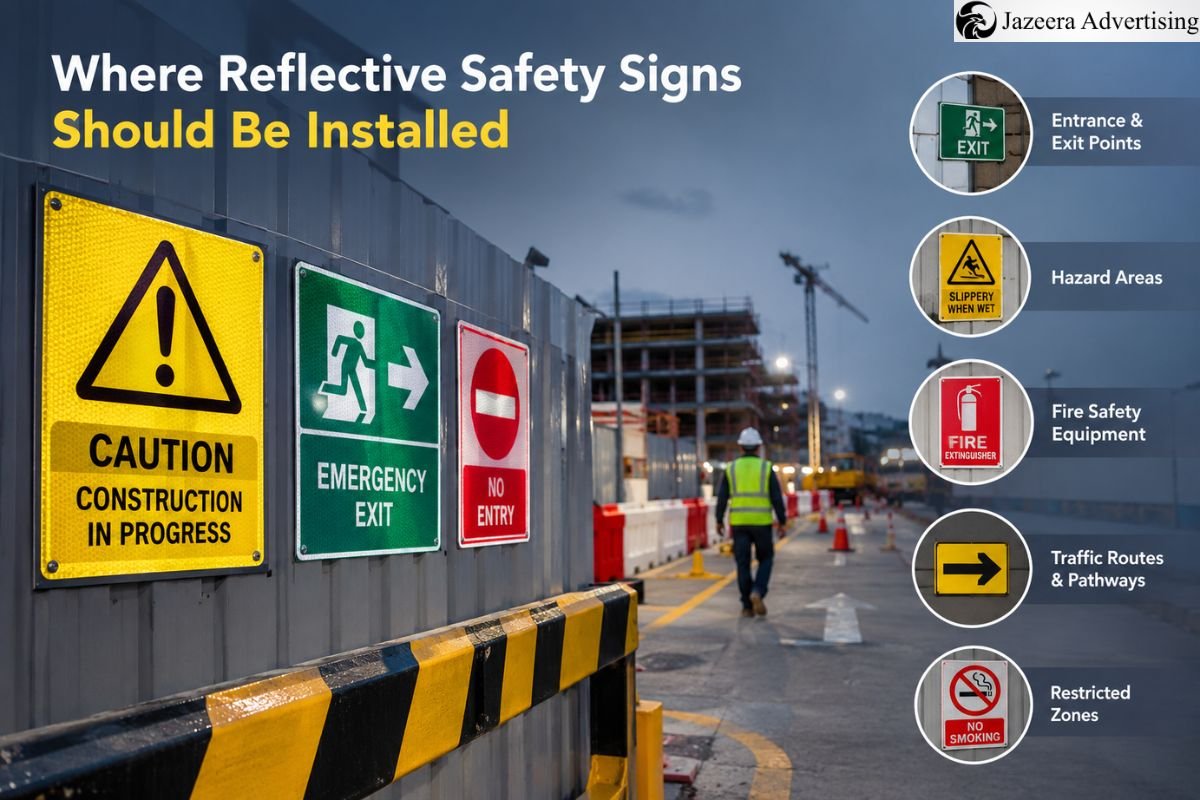
Where Reflective Safety Signs Should Be Installed
Table of Contents
- Key takeaways
- Why does reflective signage placement actually matter?
- Reflective safety sign placement
- Regulations governing signage on UAE work sites
- Choosing the right signage board for your site
- Common placement mistakes that cost companies money
- Comparison: sign type vs. ideal location
- Working with the right signage partner
- Conclusion
- Frequently asked questions
Reflective safety signage must be positioned at every place where individuals and vehicles access danger zones. Such places include site entrances, peripheries of excavations, paths of cranes, turning points for vehicles, and poorly lit places. Pedestrian safety signs must usually be posted at a height of around 1.2-2 meters above the ground. Signs for vehicles must be mounted even higher for them to be clearly visible.
In one year, injuries that resulted from slips and trips contributed to 33% of workplace accidents. Proper signage may considerably reduce injuries on construction and manufacturing sites by as much as 30%. Improper placement of safety boards may increase the chances of fatal accidents and create problems with Municipalities due to inspections. Hence, it is advisable to buy high-quality boards from the best safety signage supplier in Dubai.
Key takeaways
- Reflective signs perform most efficiently when the light beam is directed towards the reflective sign at appropriate angles.
- Dubai Municipality regulations explain the specifications for the shape, color, wording, and location of the sign.
- The effect of safety signs is much more effective when they are effectively positioned, lowering the chances of risks associated with slips, trips, and visibility.
- The type of material used in making the safety signs and the proper placement determine their durability; hence the need to have the best safety signboard.
Why does reflective signage placement actually matter?
An improperly placed reflective road sign does not serve the intended purpose. For instance, the “Deep Excavation” sign when facing a wall becomes ineffective for guiding workers.
The mechanism of reflective signs is based on the capacity to reflect the headlights or flashlights of the vehicle’s back. This means that such road signs have to be placed facing the traffic direction. It is important to remember that, in the case of construction site safety signage in Dubai, one needs to take into consideration not only dust and strong winds but also the direct sunlight in the summer. Therefore, the proper usage of reflective materials is required under the above conditions, as well as mounting the signs at the proper height and angle.
Furthermore, there are also legal issues that should be considered. Dubai Municipality provides regulations on the use, placement, and selection of road safety signs. It should be noted that such regulations have strict requirements regarding the shape, color, etc. The inspectors check whether the safety signs are appropriately located, not only regarding their existence.
Reflective safety sign placement
- Site Entry and Perimeter Points
Every entrance must have a reflective sign that can be read from a moving vehicle before reaching the entrance. Signs along the border must be large and readable when approaching, especially in construction areas close to RTA-regulated roads. This isn’t optional.
- Excavation and Trench Edges
Any drop of over half a meter requires a boundary marker to be visible from both directions day and night. Barrier tape is usually placed alongside it, but the reflective marker is what is really visible during the night.
- Overhead and Crane Zones
Whenever there are overhead loads, the crane’s radius, material hoists, and scaffolding areas must be positioned at the spots where workers would be looking naturally. They should not be hidden behind equipment.
- Vehicle and Machinery Movement Paths
Turning spots, reversing areas, and loading areas need reflective boards at the height of a driver’s eye, facing the direction of movement and not against the wall.
- Confined Space and Restricted Entry Points
Warning signs and permitted areas for confined spaces must be installed at all entry points under the ground and in closed structures at any job site. This applies especially in industrial and utility projects at Jebel Ali and similar places.
- Hazardous Material and Chemical Storage Areas
Sites handling chemicals need dedicated warning signs at storage entrances, along with respiratory protection notices in dust or chemical exposure zones. Reflective versions matter most where storage sits near vehicle or forklift traffic.
- Emergency and First Aid Points
Fire points, muster areas, and first-aid stations need signage visible from a distance in an emergency, which is exactly when lighting tends to be worst.
Regulations governing signage on UAE work sites
Signage in the UAE isn’t governed by one rulebook. It’s layered. A typical audit checks against Dubai Municipality EHS standards, Civil Defence fire codes, federal labour law, ISO 45001, and local building codes all at once, so a contractor who only reads the federal requirement can still fail an emirate-level inspection.
At the federal level, UAE Federal Decree-Law No. 33 of 2021 extends employer obligations around workplace health and safety across the private sector. On the technical side, ISO 7010 sets the international standard for the symbols, colours, and shapes used across all safety sign categories. It’s the framework most safety signage suppliers in UAE businesses design against.
However, Abu Dhabi has gone further than most emirates. The Department of Municipalities and Transport announced that traditional construction signboards must be replaced with QR codes across project sites, effective October 2024, linking to live project information including location, permit type, and a summary of the work underway. Dubai hasn’t mandated this yet, but it’s a sign of where enforcement is heading.
Worth flagging: reflective boards don’t replace fire or transport-related signage rules. Those sit under separate legislation entirely, so one signage plan won’t cover everything.
Choosing the right signage board for your site
Not every job needs the same grade of reflective material. Basic engineering-grade film is fine for internal site notices, but road-facing perimeter boards need high-intensity prismatic grade to stay legible at approach speed.
A good best safety signage board in Dubai provider will ask three things before recommending material:
- Distance the sign needs to be read from
- Whether it faces vehicle traffic or foot traffic
- Expected exposure to sun, sand, and humidity over the sign’s working life
Boards left in direct Gulf sun for years fade unevenly when the film grade is wrong. You end up with a sign that looks fine on paper but has lost half its reflectivity by the second summer.
Common placement mistakes that cost companies money
- Mounting signs too low or too high, outside typical eye level for the intended audience, pedestrian or driver.
- Facing signs away from the actual approach direction, especially at bends or corners.
- Reusing signage from a previous project without checking whether the hazard, wording, or required standard has changed.
- Skipping maintenance checks. Dubai Municipality’s guidelines require damaged or malfunctioning signs to be repaired or replaced immediately, with maintenance records kept.
- Treating one sign as sufficient for a large hazard zone instead of repeating it at every approach point.
Any one of these can earn a non-compliance note during a Building Control or contractor HSE audit.
Comparison: sign type vs. ideal location
| Sign Type | Best Placement | Typical Mounting Height | Priority Zone |
| Perimeter/Entry Warning | Site gates, road-facing boundary | 1.8–2.5m | Vehicle approach |
| Excavation/Trench Marker | Edge of drop, both approach sides | 1.0–1.5m | Pedestrian + vehicle |
| Overhead Hazard | Crane swing radius, hoist areas | Eye level from ground | Pedestrian |
| Confined Space | Entry points to enclosed structures | Door/hatch level | Permit-controlled access |
| Chemical/Hazmat | Storage area entrances | 1.2–1.8m | Vehicle + pedestrian |
| Emergency/Muster Point | Assembly areas, fire points | 2m+ for distance visibility | All personnel |
Working with the right signage partner
A good placement plan only holds up if the boards themselves do. That’s where working with an established best outdoor signage company in Dubai pays off: durability under heat, the correct reflective grade, and wording that matches current Dubai Municipality conventions aren’t things you want to get wrong twice on a live site.
Moreover, Jazeera Advertising has handled signage rollouts across construction and industrial sites where the brief wasn’t just “print a warning sign” but “make sure it’s still readable in three years of sun and sand.” That’s usually what decides whether a site stays compliant or ends up reordering signage every year.
Conclusion
Reflective safety signage isn’t decoration. Placement matters as much as the sign itself: right height, right angle, right zone, checked on a schedule. If you’re setting up a new site or auditing an existing one, sort out the location logic before you order boards, not after.
If you’re planning a signage layout for an upcoming project, Jazeera Advertising can help map hazard zones to the right board type and reflective grade for lasting compliance.
Frequently asked questions
Pedestrian-facing signs typically sit between 1.2–2m; vehicle-facing perimeter boards go higher, often 1.8–2.5m, for visibility from a moving vehicle’s line of sight.
Yes, wherever low-light or nighttime work happens, or where vehicles move through. Requirements vary slightly between Dubai Municipality and Abu Dhabi’s OSHAD frameworks.
Danger signs use white on red for death or serious injury risk, Warning uses black on orange, and Caution uses black on yellow for minor injury risk.
Damaged or faded signs should be replaced immediately per manufacturer guidance, with maintenance records kept. Routine checks are typically monthly on active sites.
No. Large zones need signage repeated at every approach point, since visibility and angle vary across a wide area.
High-intensity prismatic film handles sun and sand exposure better than basic engineering-grade film, especially on road-facing boards left outdoors year-round.
Abu Dhabi has mandated QR-code signboards for project information since October 2024. Dubai hasn’t required this yet for hazard signage specifically.
Dubai Municipality Building Control, Abu Dhabi’s OSHAD, and each project’s own HSE team all run signage audits, alongside MOHRE at the federal level.
Large enough to read at approach speed from a vehicle. Smaller boards work for pedestrian-only internal zones, but road-facing signs need a larger format.
Yes. Properly placed, documented signage shows hazard communication was in place, which supports compliance and can lower liability exposure if an incident occurs.

Best Materials for Reception Letter Signage: Acrylic, Stainless Steel or Brass?

Office Branding Trends Businesses Are Following in 2026