- August 12, 2026
- by Jazeeraadv
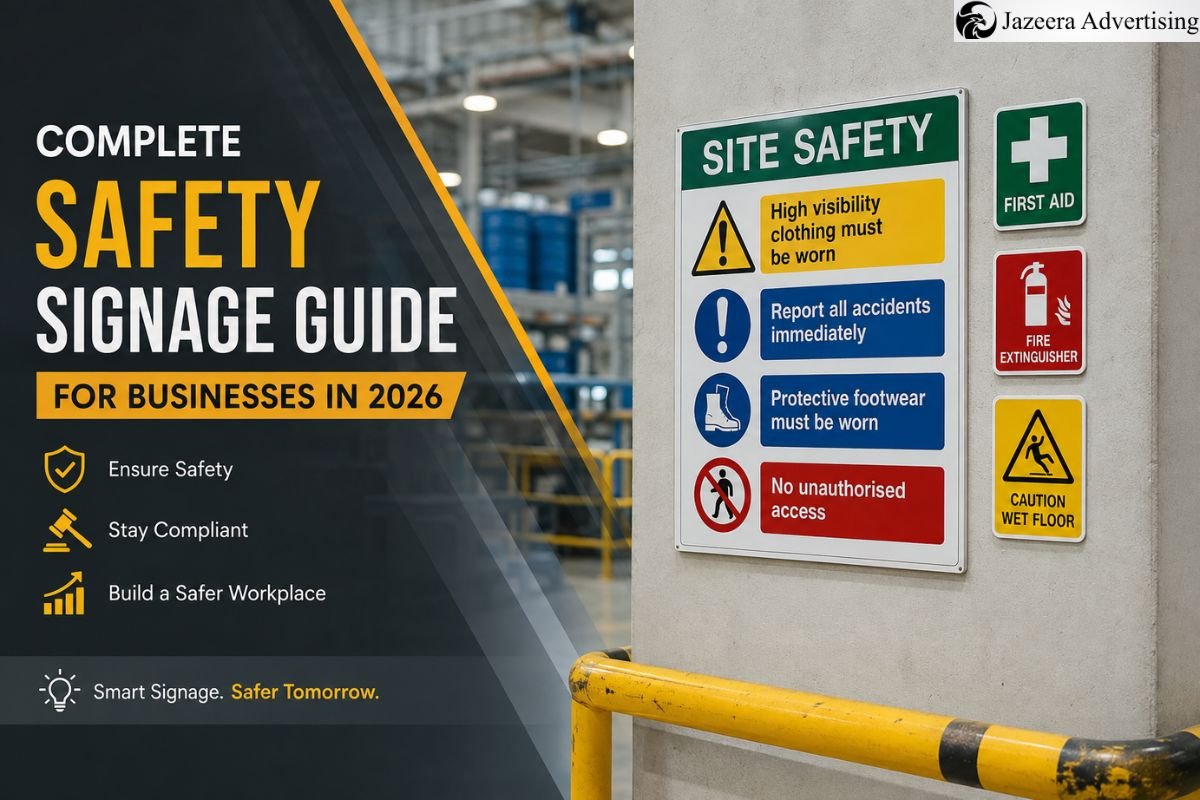
Complete Safety Signage Guide for Businesses in 2026
Table of Contents
- Key takeaways
- Why does safety signage still matter in 2026?
- What makes a safety signage board effective?
- Types of safety signs every business needs
- Construction site safety signage explained
- Materials that hold up in UAE conditions
- Common mistakes businesses make with safety signs
- Choosing the right signage solutions
- Expert insights on compliance and placement
- Final verdict
- Frequently asked questions
Key takeaways
- Dubai laws necessitate the use of standardized safety indicators in all places of work and building construction processes.
- Onsite conditions, signage material, and overview play an essential role in indicating the best safety indicators within the Dubai area.
- Signage for construction sites must be durable enough to be able to survive high temperatures, dust, and ultraviolet radiation.
- You may obtain safety signage from trusted suppliers in the UAE to help you avoid inspection problems and the necessity to change signage.
The owner of a warehouse in Al Quoz talked about his success with safety audits for two years but, eventually, failed an inspection due to many faded signs. Low-quality signage gets easily damaged by the scorching sun in Dubai.
There is much more to installing safety signs in Dubai than just putting them up and not looking back at them anymore. They must remain effective for years after installation. In this practical guide, we explain what safety signs should look like in Dubai, what inspectors check for, and what pitfalls businesses should avoid.
Why does safety signage still matter in 2026?
Dubai Municipality and the Dubai Civil Defence keep tightening enforcement around workplace safety documentation, and signage is usually one of the first things an inspector checks. It isn’t decoration. A missing fire exit sign or an unreadable hazard warning can delay an insurance claim after an incident, and in some cases the liability lands back on the business owner.
Moreover, there’s a practical side to this too, one that gets overlooked fairly often. Construction crews and warehouse teams in the UAE are usually multilingual, so a sign that relies purely on text in one language may not communicate anything at all to a chunk of the workforce. Pictogram-based signage, built around ISO 7010 standards, gets around that without needing a translation.
What makes a safety signage board effective?
A good sign does a few specific things. It’s visible from a distance, it registers in under two seconds, and it still looks sharp a year later. People searching for the best safety signage board in Dubai tend to compare price first, which makes sense, but the boards that fail fastest are almost always the ones bought purely on cost.
Font size, contrast, and reflectivity all matter here. A fire assembly point sign in a dim stairwell needs photoluminescent properties. An outdoor hazard sign needs UV-resistant printing, or it bleaches out by the time summer ends.
Worth checking before ordering:
- Sign height matches the viewing distance (a rough rule is 25mm of letter height per metre of distance)
- Colors follow ISO 7010 conventions: red for prohibition, yellow for caution, green for safe conditions
- The board material suits where it’s going, indoor or outdoor, humid or dry
Types of safety signs every business needs
Most commercial spaces need some mix of the following, and the exact combination depends on the industry.
| Sign Category | Purpose | Common Locations |
| Fire safety signs | Mark exits, extinguishers, assembly points | Corridors, stairwells, parking areas |
| Mandatory signs | Require specific action (wear PPE, etc.) | Workshops, factory floors |
| Prohibition signs | Forbid an action (no smoking, no entry) | Storage rooms, restricted zones |
| Warning signs | Flag a hazard (electrical, chemical) | Utility rooms, labs |
| Informational signs | Guide movement or give instructions | Reception areas, wayfinding |
Retail and office spaces usually get away with a lighter version of this list. Warehouses and factories tend to need nearly every category, often repeated across several zones.
Construction site safety signage explained
Construction sites carry the highest signage density of any commercial environment, which makes sense, since they’re also where most workplace incidents happen. Construction site safety signage in Dubai usually includes crane operation warnings, scaffolding notices, PPE mandates, and site entry restrictions. All of it needs to stay legible through dust, direct sun, and equipment moving around all day.
Furthermore, something contractors get wrong more than you’d expect is sign placement height relative to heavy machinery. Mount it too low and parked equipment blocks it. Mount it too high and workers focused on ground-level tasks walk right past it. Walking the site with the safety officer before finalizing positions catches most of this early.
Bilingual signage, usually English paired with Hindi or Urdu depending on the crew, is standard on most Dubai sites. A large share of on-ground labor communicates primarily in one of those two languages.
Materials that hold up in UAE conditions
Dubai’s climate isn’t kind to cheap materials. Vinyl stickers fade within a year under direct sun. Standard aluminum without proper coating can develop a glare that makes signs unreadable from certain angles. The businesses that aren’t reordering signage every eighteen months are usually the ones that spent a bit more upfront on the right material.
Reasonable options:
- Aluminum composite panels– rigid and corrosion-resistant, good for outdoor and industrial use
- PVC boards– cost-effective for indoor signage with moderate footfall
- Photoluminescent panels– close to essential for fire exit and emergency signage in low-light conditions
- Reflective vinyl on rigid backing– suited to parking areas and low-visibility zones
Common mistakes businesses make with safety signs
A few patterns show up again and again during audits.
- Signs get installed once and never looked at again. Fading, peeling, physical damage- none of it gets noticed until an inspector points it out.
- Generic templates get used even when they don’t match the actual hazard. A “wet floor” sign near a chemical storage area doesn’t tell anyone what’s really at risk there.
- Viewing distance gets ignored. A well-designed sign is useless if the text is too small to read from where people actually stand.
- Bilingual signage gets skipped on sites where it matters most, which leaves part of the workforce effectively unwarned.
Choosing the right signage solutions
Not every signage solutions Dubai provider understands the regulatory side of the job. Some will just print whatever’s requested without flagging a compliance gap. It’s worth asking a potential supplier whether they actually know Dubai Civil Defence code requirements, not just how to run design software.
A supplier worth working with usually:
- Asks about the installation environment before recommending a material
- Points out compliance gaps in an existing layout instead of just taking the order
- Offers custom sizing, since off-the-shelf boards don’t fit every space
Therefore, this is where an established safety signage supplier in UAE, such as Jazeera Advertising, is one example, makes a real difference. They’ve generally already worked through the material and placement problems specific to Dubai’s climate and inspection standards, instead of a business having to learn them the hard way.
Expert insights on compliance and placement
Auditors tend to check three things in order: is the sign present, is it legible, and is it actually positioned where the hazard exists? Businesses that pass consistently treat signage as ongoing facility maintenance rather than a one-time install.
A habit worth adopting: have someone do a quarterly signage walkthrough alongside regular maintenance checks. It takes maybe twenty minutes and catches fading, damage, or blocked visibility before it turns into an inspection problem.
However, one more thing worth knowing. Signage requirements shift slightly whenever Civil Defence updates its guidance. A supplier who stays on top of those changes saves a business from installing signs that were fine last year and aren’t anymore.
Final verdict
Safety signage in Dubai is not only about complying with regulations. It makes it easy for people to identify hazards, know the way to get out, and act appropriately in case of an emergency. Signs should be easily understood, legible, and in proper positions.
The right materials from the beginning will also save on replacement costs. Jazeera Advertising creates and installs signs that are long-lasting and effective for offices, construction sites, and warehouses in Dubai.
Frequently asked questions
Aluminium Composite Panel with UV-resistant printing is the most durable for outdoor applications, as it will not fade and warp under Dubai’s climatic conditions for several years.
Yes. Most of the sites are in English and Hindi/Urdu, as a huge portion of the ground staff is able to communicate in one of those languages.
With the proper material, quality signage can usually be expected to last for 3–5 years outdoors, although it will be noticed more quickly if it’s checked every quarter if it is fading or damaged.
Red means “No” or “Do Not,” yellow means “Caution” or “Be Careful,” green means “Safe” or “Exit,” and blue means “Do” like “Do wear PPE”.
Most Dubai signage companies, including Jazeera Advertising, offer design, printing, and installation services all in one.
The standard height for most indoor signs is eye level (about 1.5-1.7 m). The viewing distance and the equipment height are more important for outdoor and construction signs.
Dubai Civil Defence usually mandates that signage use a special light and colour scheme to keep exits illuminated during an electrical outage, especially in commercial establishments.
Mandatory signs in blue are required to be worn, such as safety equipment. Red prohibition signs: ban an activity, such as not smoking or entering without permission.
Seek one that is familiar with Dubai Civil Defence codes and enquires about your installation conditions, not just printing off what you send.
Yes. In warehouses, there’s a greater need for hazard, PPE, forklift warning signs, etc., whereas in offices, fire and wayfinding signage are generally more applicable.
Digital Compliance Boards: Future of Industrial Safety
Safety Signage Cost Guide for Businesses