- August 4, 2026
- by Jazeeraadv
ISO Safety Signage Standards Explained
Table of Contents
- Key takeaways
- What do ISO safety signage standards actually cover?
- Why does compliance matter more than businesses realize?
- The core elements of ISO 7010 signage
- Colour coding and what each colour means
- Where standards get misapplied on UAE sites?
- Choosing the best safety signage board
- Comparison: compliant vs non-compliant signage
- Common mistakes businesses make
- Expert insights
- Bottom line
- Frequently asked questions
Key takeaways
- ISO 7010 defines the correct safety symbols for a clear understanding of people in different languages across the globe.
- With the right colour, shape, and pictograms, safety signs would conform to ISO regulations.
- Construction projects in Dubai follow ISO regulations as well as Municipality and Civil Defence regulations.
- Safety signs’ materials, visibility, and height play a key role in effective compliance.
ISO safety signage standards solve one specific problem: making sure a warning means the same thing to everyone who sees it, regardless of what language they speak. In the UAE, where a single construction site might have workers from a dozen countries, that’s not theoretical. It’s the difference between a sign people ignore and one that actually stops an incident. ISO 7010 is the important standard for shapes, colours and symbols of all signs with fire exit and chemical hazard signs being relevant examples. Knowing what ISO requires will help in buying quality safety signage boards in Dubai while avoiding high reprinting costs and unmanageable inspections.
What do ISO safety signage standards actually cover?
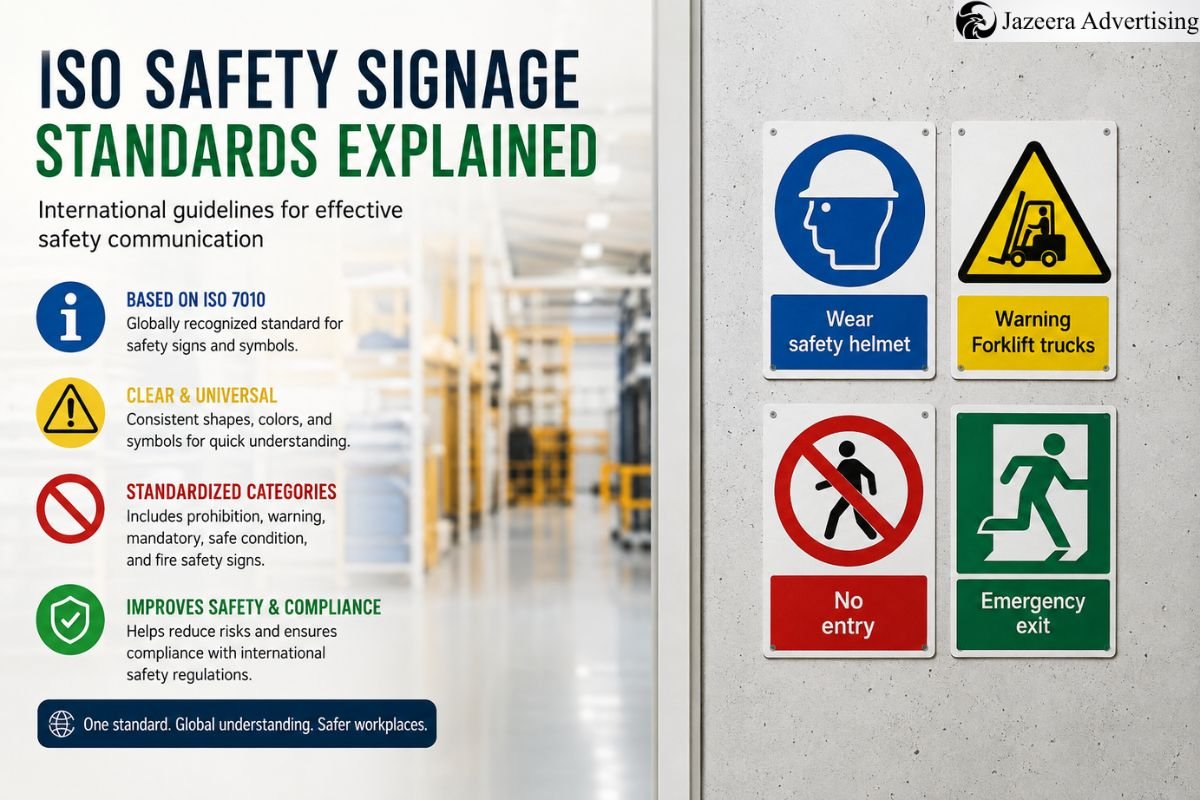
ISO 7010 is the international standard that governs the use of symbols in safety signs. The necessity for the standard arose because signage systems used by countries varied considerably. The “No Smoking” symbol may, for instance, look different in one country compared to another. The standard solves this problem by providing an approved and recognized set of pictograms that can be used universally for different meanings.
This means ISO 7010 does not operate alone. It is used together with ISO 3864, or the standard that helps with pictogram design, in terms of shape, color contrast, and the colors associated with safety. In other words, ISO 3864 is the rulebook for symbols while ISO 7010 lists the symbols to be used and their meanings.
This is important for business people in the UAE because the authorities like Dubai Municipality and the UAE Civil Defence often require enterprises to follow ISO standards when conducting inspections. If symbols do not pass the proportion requirements or if their colors do not match the ISO standards, businesses might fail the inspection even if the symbol can be understood well by humans.
Why does compliance matter more than businesses realize?
Many business executives perceive safety signage merely as an obligation that needs to be fulfilled as per the list. This is not correct. If the signage is not compliant, it is liable for default. In case any incidents happen on the site, failing to comply with ISO requirements would be another issue in an investigation or an insurance claim.
Furthermore, there is a practical aspect of the issue too. People react to the signs which follow some standard visual language quicker. For instance, a red circle with a diagonal line is understood as “prohibited” immediately, even by a person who has never seen this sign before.
The core elements of ISO 7010 signage
Every graphic that corresponds to ISO 7010 is made of shape, color, and pictogram.
- Shape- describes the category even before the icon itself is read. A circle represents the mandatory and prohibited category, the triangle indicates caution, while square or rectangle represents information and emergency instructions.
- Color- supports the message conveyed by shape in the following manner: red indicates prohibition and fire equipment, yellow signifies caution, blue means that there is a need to take action, whereas green shows that an area is safe or indicates emergency exits.
- Pictogram- refers to the particular symbol recognized by the standard. For example, the running man pictogram signifies an emergency exit, while an exclamation point warns of something being of importance.
All of them work together, because a yellow triangle without the correct pictogram inside it is not a valid ISO sign but just a yellow triangle.
Colour coding and what each colour means
| Colour | Meaning | Typical Use |
| Red | Prohibition, fire equipment, danger | No entry, fire extinguisher location |
| Yellow | Warning, caution | Wet floor, overhead hazard |
| Blue | Mandatory action | Wear PPE, hard hat required |
| Green | Safe condition, first aid, exit | Emergency exit, first aid station |
The table looks simple, but the ratio of colour to white background is actually specified under ISO 3864. It’s not left to design preference. A sign printed with too little colour contrast can technically fail compliance even if the pictogram itself is correct.
Where standards get misapplied on UAE sites?
This is where a lot of businesses get tripped up. Dubai’s construction sector moves fast, and signage often gets ordered in bulk without much thought to spec. A few patterns show up repeatedly.
Sites reuse generic signage bought from unrelated regions, where local shape or colour conventions differ slightly from ISO 7010. Others mount signs at heights that make them technically present but practically invisible from a working distance. Some sites mix old signage systems with newer ISO-compliant boards, which just creates visual inconsistency and confuses workers instead of helping them.
Furthermore, construction site safety signage in Dubai also has to deal with sun exposure and dust. Most people don’t think about that until a sign fades within a year and becomes unreadable, which is a compliance failure in itself since illegibility defeats the whole point of the sign.
Choosing the best safety signage board
When you’re evaluating suppliers, design accuracy is only half the equation. Material matters just as much. The weather of Dubai resulting in a hot and humid atmosphere and dust destruction of low quality materials. There is considerable durability of boards composed of ultra violet light resistant acrylic or aluminum.
The best safety signage board in Dubai uses ISO compliant symbols, suitable materials that resist global warming conditions and mounting solutions that are appropriate for a given location.
Thus it is advisable to verify with the supplier if its design manages to adhere to ISO 7010 registered standards or if it uses arbitrary designs instead of officially recognized symbols. Some cheaper signage solutions Dubai use approximate icons that look similar to the standard but aren’t technically registered, and that can cause problems during inspection.
Comparison: compliant vs non-compliant signage
| Factor | ISO-Compliant Signage | Non-Compliant Signage |
| Pictograms | Registered ISO 7010 symbols | Generic or approximate icons |
| Colour ratio | Meets ISO 3864 contrast rules | Inconsistent or low contrast |
| Material | UV-stable, weather-resistant | Standard PVC, fades quickly |
| Inspection outcome | Passes Civil Defence checks | Risk of citation or reorder |
| Worker recognition speed | Fast, consistent | Slower, inconsistent |
Common mistakes businesses make
A few mistakes come up again and again when businesses handle signage without expert input:
- Ordering signs based on size alone, without checking whether the pictogram matches the correct ISO registration.
- Assuming translated text is enough on its own, without the accompanying standardized pictogram.
- Placing signage too far from the hazard it’s warning about, which reduces its practical value even if the design is correct.
- Skipping replacement cycles, so faded or damaged signs stay up because nobody flagged them for reprint.
However, each of these looks minor on its own. Together, they’re the most common reason a site fails an inspection it should have passed easily.
Expert insights
Safety signage should not be left unattended; it needs to be inspected regularly. Check signs at least twice a year to ensure that they are clean, legible, undamaged, and clearly installed. Maintaining on-site replacement safety signage helps to minimize delays in replacing damaged signs.
By working with the same safety signage supplier in UAE for all your signage needs, you can ensure consistency throughout the workplace. Variations in colours, symbols and designs, which may occur if signs are purchased from various suppliers, can lead to confusion and pose a potential risk of not being compliant with safety standards.
Bottom Line
When you know the basics, ISO safety signage standards are easy to follow. The correct use of colour, shape, and approved pictograms aids in effective and consistent safety communication. The majority of compliance problems occur due to poor materials, wrong symbols, or signs that are not regularly checked.
Always select a Best safety signage board in Dubai that is familiar with the ISO 7010 standards as well as the needs of the Dubai Civil Defence. Jazeera Advertising can assist you in setting up appropriate, durable, and understandable safety signs for the workplace, which will enhance workplace safety and minimize the chance of non-compliance with safety standards.
Frequently asked questions
It is the internationally adopted standard that sets the meaning of registered safety symbols, so a hazard sign will have the same meaning anywhere, in any language.
ISO standards are frequently mentioned by Dubai Municipality and Civil Defence during inspections; therefore, it is practically required that you be compliant even if they don’t explicitly state the standard.
Prohibition, warning, mandatory action and safe conditions/exit (red, yellow, blue and green).
For most outdoor signage in the UAE, the signs ought to be checked twice a year and replaced if the fading or damage causes the words to become illegible.
In the hot, humid, and dusty climate of Dubai, UV-stabilized acrylic or aluminium composite is usually more durable than traditional PVC.
No. No text alone is sufficient to comply with ISO. Any translated text should be accompanied by pictograms to remain compliant.
The use of generic or approximate icons rather than those registered as ISO 7010 symbols that may not pass inspection even though they appear to be correct.
Inquire if their design process uses registered symbols from ISO 7010, and if materials are rated for the UAE climate.
Yes. Even if the hazard is correctly signed but placed too far away from the hazard or too low in visibility, it would not be considered compliant.
Check for ISO pictograms that are correct, waterproof, and compatible with existing mountings at your installation location or project.

Digital Compliance Boards: Future of Industrial Safety
Safety Signage Cost Guide for Businesses