- July 21, 2026
- by Jazeeraadv
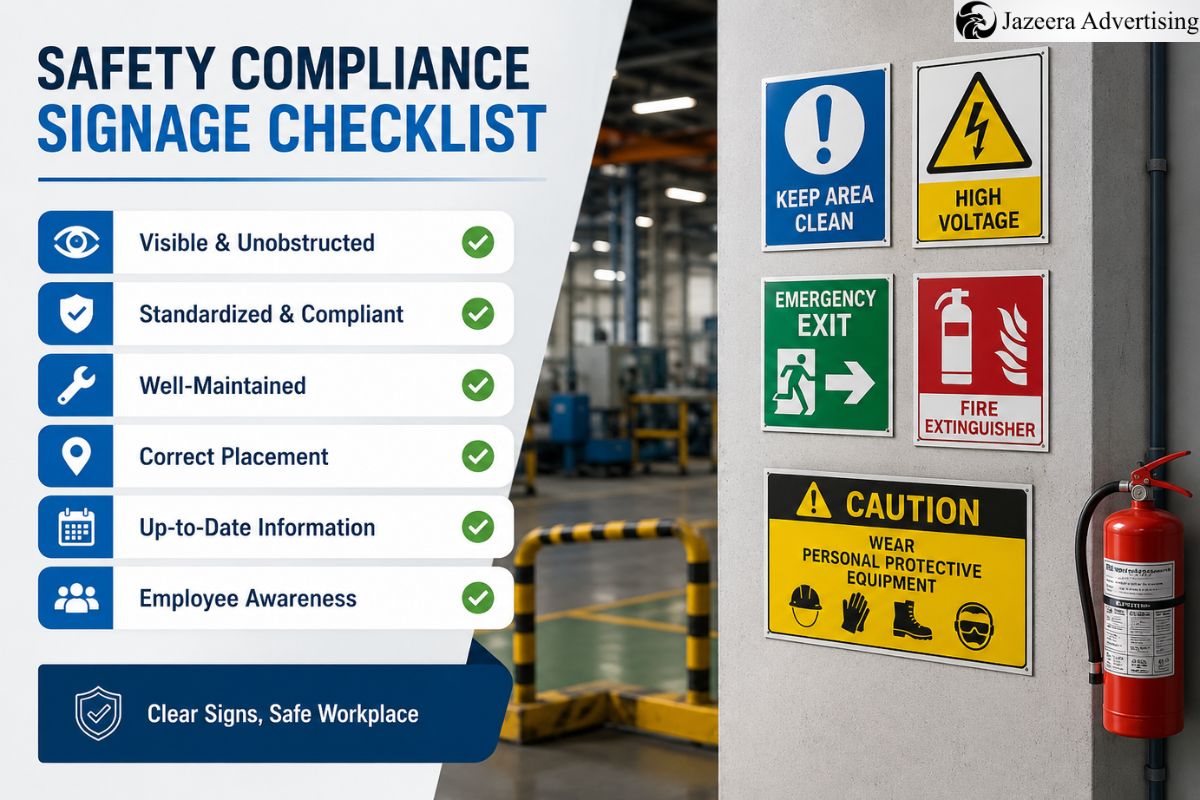
Safety Compliance Signage Checklist for Factories
Table of Contents
- Key Takeaways
- Why does factory safety signage matter?
- Types of signs every factory needs
- Compliance rules you should know
- Comparison table: sign types and uses
- Choosing the right signage partner
- Common mistakes to avoid
- Bottom line
- Frequently asked questions
Key Takeaways
- Dubai factories have to follow specific signage rules, and skipping this can mean fines or worse.
- A good mix of warning, mandatory, and emergency signs actually cuts down on accidents.
- A local supplier who knows UAE compliance saves you a lot of back and forth later.
- Checking your signage regularly keeps you ready for inspections instead of scrambling before one.
Walk onto any factory floor, and the signs are the first thing you see- Dubai warning labels near the machinery, exit signs above the doors and hazard markers on the storage rooms. None of it is decoration. It is there because missing a warning can lead to serious injuries or even loss of life. If you run a factory in Dubai, you already know how seriously the authorities take this. A safety sign which has become dirty, torn, or obscured should never be overlooked. It’s confusing and leads to more accidents and potential safety violations when they come for an inspection. Periodic inspections and for replacement of worn or damaged signs contribute to a safe and compliant workplace.
However, this guide walks through what a proper factory signage checklist actually looks like. What signs you need, what the rules require, and how to think about picking the best safety signage board in Dubai for your specific setup. Whether you’re building a new facility from scratch or fixing gaps in an old one, this should give you a clear starting point.
Why does factory safety signage matter?
A good sign does its job in about two seconds. No explanation needed, no supervisor required to translate it. That speed is the whole point.
A few reasons this matters more than people give it credit for:
- It stops accidents before they happen. A clearly marked “High Voltage” panel or a “No Entry” sign at the right spot is often the only thing between a worker and a bad decision.
- It shapes how people react in an emergency. When there’s smoke in the room, nobody has time to think. They just follow the exit signs.
- It keeps inspectors off your back. UAE authorities check for this, and a missing sign is an easy thing to flag.
- It tells visitors something about how you run things. Auditors and clients notice a facility that takes safety seriously, and they notice the opposite too.
This isn’t just a factory thing either. Construction site safety signage in Dubai follows the same logic, just with different hazards, since sites change layout almost daily and the signage has to keep up.
Types of signs every factory needs
Different signs do different jobs, and a factory that only has one type is missing coverage somewhere. Here’s the basic breakdown:
- Warning signs- Flag hazards like exposed wiring, chemical storage, or areas with moving machinery.
- Mandatory signs- Tell workers what they need to wear or do, like helmets, gloves, or goggles in certain zones.
- Prohibition signs – Mark what’s not allowed, whether that’s smoking near flammables or using a phone in a restricted area.
- Emergency signs- Point to exits, assembly points, fire extinguishers, and first aid stations.
- Informational signs- Cover the basics, like floor maps or which department is which.
Therefore, miss one of these categories and you’ve got a gap, even if the rest of your signage looks fine.
Compliance rules you should know
UAE regulations line up with international standards for the most part, but there are a few local details worth knowing before you order anything:
- Signs need to be readable from a reasonable distance, including in low light.
- Materials should hold up outdoors, especially with Dubai’s heat and dust.
- Colors follow the usual code: red for danger, yellow for caution, and green for safety info.
- Eye-level placement matters more than people think.
- Multilingual signage is often necessary given how mixed most factory workforces are here.
Furthermore, getting this wrong doesn’t just create a safety risk. It can also complicate insurance claims or slow down a licensing renewal. That’s usually the point where facility managers start looking for a proper safety signage supplier in UAE instead of handling it piecemeal.
Comparison table: sign types and uses
| Sign Type | Purpose | Common Locations |
| Warning Signs | Flags hazards (electric, chemical, heat) | Near machinery, storage rooms |
| Mandatory Signs | Requires PPE or specific actions | Entry points, work zones |
| Prohibition Signs | Restricts unsafe behavior | Near flammable material, smoking zones |
| Emergency Signs | Directs evacuation and emergency response | Exits, staircases, assembly points |
| Informational Signs | Provides general guidance | Reception, corridors, floor maps |
However, treat this as a starting point rather than a final list. Every factory layout is different, and the real answer comes from walking the site and figuring out where the gaps are.
Choosing the right signage partner
Not every signage company understands what a factory floor actually needs. A few things worth checking before you sign anything:
1. Have they worked on industrial sites before?
Retail signage and factory signage are not the same job.
2. Will the materials actually last?
Heat, dust, and constant handling wear signs out fast if they’re cheap.
3. Can they customize the design?
Your layout and your branding aren’t generic, so your signs shouldn’t be either.
4. How fast can they turn things around?
Compliance deadlines don’t move just because production is behind.
5. Do they know UAE regulations well?
This one saves you from redoing work later.
Jazeera Advertising has handled enough industrial and commercial signage projects to know what factories actually need versus what looks good on paper. They work through the whole process, design, production, and installation, so you’re not managing five different vendors for one signage plan.
If you’re looking at signage solutions Dubai businesses can actually depend on long-term, that end-to-end approach is worth asking about.
Before you commit to any vendor, ask to see past work and get them to walk your facility first. It’s a small task that can save a lot of rework down the line.
Common mistakes to avoid
A few patterns show up again and again in factories that fail inspections:
- Signs left up long after they’ve faded. If it’s hard to read, it’s not protecting anyone.
- No consistent placement pattern. Workers should be able to predict where a sign will be, not hunt for it.
- Assuming everyone reads the same language. A single-language sign misses a big part of most factory teams here.
- Too many signs crammed into one wall. Past a certain point, people stop reading any of them.
- No regular check-ins. Signage needs get reviewed after every renovation or layout change, not just once a year.
Fixing these doesn’t take much. It just takes someone actually walking the floor and looking.
Bottom line
Safety signs are not something you just set and forget. As manufacturers grow and evolve, their safety challenges will change as well. It is important to stay up-to-date with safety signs in order to keep the workplace safe and compliant.
Whether you are starting a brand new factory or revamping an old one, make sure to take a moment to assess your workplace and determine if any of your safety signs are missing, broken, or outdated. Additionally, if you’d rather not handle it alone, the best safety signage board in Dubai from Jazeera Advertising can take you through the whole process, from figuring out what you need to getting it installed properly.
Ready to sort out your factory’s signage? Get in touch and build a plan that actually holds up.
Frequently asked questions
Seek out signs made from tough material, easy-to-read symbols, and colors in compliance with UAE regulations, tailored for industrial use as opposed to standard retail signs.
Inspect signs every six months and replace any discolored, damaged, or otherwise unreadable ones. Don’t take a wait-and-see attitude until a scheduled inspection.
They aren’t strictly mandatory, but they are highly recommended because the majority of factory workers are multilingual and pictures are helpful in overcoming language barriers.
Aluminum, PVC, and acrylic coated with protective lacquer are the best options because they are resistant to Dubai’s strong rays from the sun and exposure to dust and humidity and won’t degrade within a year.
Yes, construction site safety signage in Dubai changes constantly, just as site hazards also change with time.
Find out their experience in specific industrial projects, realistic timelines, and real level of knowledge of UAE regulations.
Yes, companies provide custom size, wording, and position based on real hazard factors instead of one-size-fits-all solutions.
Fines, delays with getting permits, and in severe cases even temporary operations shut down.

Best Materials for Reception Letter Signage: Acrylic, Stainless Steel or Brass?

Office Branding Trends Businesses Are Following in 2026