- November 26, 2026
- by Jazeeraadv
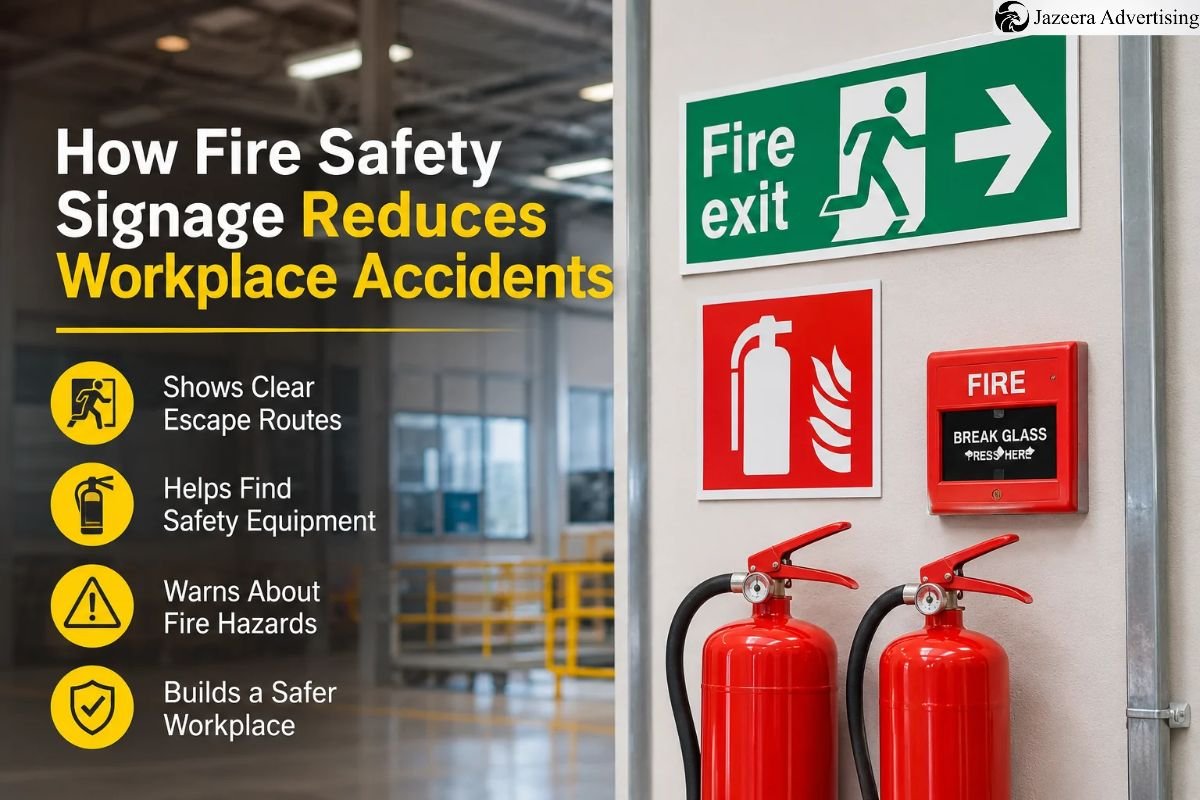
How Fire Safety Signage Reduces Workplace Accidents
Table of Contents
- Key takeaways
- What is fire safety signage and why does it matter?
- How does fire safety signage prevent workplace accidents?
- Which fire safety signs does every workplace need?
- Where should fire safety signs be placed?
- Construction site safety signage: what is different?
- How to choose a reliable safety signage supplier?
- Choosing the best safety signage board for your site
- Common mistakes to avoid
- Bottom line
- Frequently asked questions
The implementation of fire safety signage reduces accidents in the workplace since it guides people on where to identify hazards and how to avoid them or vacate a building during emergencies. By using proper signage, one can eliminate confusion, and quicken the evacuation process as well as keep in mind the rules that one otherwise would forget.
In the bustling city of Dubai with its industry and construction environment, proper signs can mark the boundary between a close call and serious injury. The following guide seeks to explain how signs work, which types of signs must be present in each workplace, and how to find a proper supplier.
Key takeaways
- Safe evacuation signage ensures quick evacuation in case of emergency.
- Signs also help to keep people safe from everyday hazards; they alert people to keep exits clear and adhere to safety guidelines.
- Placement, durability, and standard design are just as important as where a sign is placed.
- Choose a supplier with high-quality materials, knowledge of local regulations, and installation support.
What is fire safety signage and why does it matter?
Fire safety signage is a series of standardized signs that convey fire-related information at a single glance. These signs indicate where to go for fire exits, where to find fire extinguishers, assembly areas, alarm call points, and what not to do during a fire, like smoking or using elevators. They are based on shapes, colours, and symbols that people can pick out of the crowd, and can be used when someone is stressed, doesn’t know the layout of a building, or can’t read a long set of instructions.
Most workplace accidents are not preventable. They occur when a hazard is not detected, when a route is unknown, or when one thinks that a route is safe. Signage helps fill in those spaces. Transforms safety rules into “rules that show up” and rules that are in effect 24 x 7 without requiring a supervisor to repeat them.
However, civil defence requirements and building regulations are the major influences on fire safety expectations in the UAE. The best safety signage board in Dubai is a very important aspect of any business, and when it’s taken seriously, it conveys a message of caring for employees, visitors, and contractors. They also help to minimize inspection risks that might result in fines, forced shutdowns, or rework costs.
Types of fire safety signs
There are some basic types of fire safety signs, each serving a certain purpose:
- Emergency exit signs indicate the closest available safe way out of the building.
- Signs for fire equipment are used to identify extinguishers, hose reels, and fire blankets so that they can be quickly located.
- There are signs in the assembly area to guide people to a safe meeting location outside the building.
- Alarm and call point signs will be used to show where a fire alarm can be activated.
- Any signs that prohibit people from doing something are present, like the prohibition signs on smoking, open flame, and exit blockage.
All of the categories reinforce one another. An exit sign is far more valuable when it points to an obvious assembly point, and an extinguisher sign is most valuable when it is placed next to an obvious warning for the presence of flammable materials.
How does fire safety signage prevent workplace accidents?
Signage offers two primary ways of reducing accidents. Firstly, it assists individuals in behaving appropriately in an emergency. Secondly, it helps to avoid situations that can be dangerous in the first place. Both of these are important effects, and a good safety plan will include signage for each.
- Faster Evacuation During Emergencies
It is easy to see, during a fire, that people may not be able to see as far as they would in normal conditions, due to the smoke. Staff may be in a panic, and visitors are likely to be lost too. In these situations, individuals depend on glowing, conspicuous, and clearly marked signs for the closest exit. Photoluminescent and illuminated signs are visible in the event of a power outage, making them an essential requirement in large buildings where lighting may be affected by a power outage.
The evacuation speed is related to the speed at which individuals choose to evacuate. If signs are set at decision points like corridor intersections, staircases, and room doorways, people will spend less time searching. The shorter it takes to make a decision, the more quickly people will evacuate and the less the crowd will crowd, fall, or delay in leaving.
- Prevents Accidents Before They Happen
Signage is not only for emergencies. Common hazards like open electrical panels, materials in corridors, or blocked fire doors can be life-threatening. Prohibition and warning signs help to remind people to keep these areas clear and follow safe practices. If you see the same sign every day, it becomes a habit. Staff start to see what is amiss and report issues before they get bigger.
Signage also helps facilitate training. Symbols and messages need to be consistent on site for induction programs and toolbox talks to be effective. Learning the visual language of safety is fast and easy, and contractors who visit occasionally will still pick up the basic elements.
Which fire safety signs does every workplace need?
While the risk in each workplace is unique, most companies will require essential signs. The following table lists some common sign types, their function, and common locations.
| Sign Type | Main Purpose | Typical Location | Priority Level |
| Emergency exit | Shows the safest route out | Above exits and along corridors | Essential |
| Fire extinguisher | Marks equipment for quick access | Wall-mounted near equipment | Essential |
| Assembly point | Directs staff to a safe meeting area | Outside exits and parking zones | High |
| Fire alarm call point | Identifies where to raise an alarm | Next to exits and stairwells | Essential |
| No smoking / no open flames | Prevents ignition risks | Entrances, storage, and loading areas | High |
| Flammable materials warning | Alerts staff to combustible stock | Storage rooms and chemical areas | High |
| Fire door keep closed | Protects escape routes from smoke | On or beside fire doors | High |
Essential signs should be in place prior to occupancy of a building. Therefore, high-priority signs should be added as soon as a risk is identified. A periodic audit is helpful to ensure the list remains current after changes in layout, equipment, or tenants.
Mandatory, prohibition, warning, and safe condition signs
Fire safety signs are frequently classified together according to the type of instruction they convey. Mandatory signs indicate what actions shall be taken by people, e.g., wear protective clothing or use a certain door. Prohibition signs convey a message of what not to do. Warning signs raise awareness of dangers that might not be apparent. Safe condition signs are typically green and indicate a safe path or where safety equipment can be found.
The selection of the right category is important, as each will have a different visual style. Red circles and Blue circles are generally used to signify prohibitions and required activities; yellow triangles would be used for warnings, and Green squares for safe activities. These styles may be combined or used in unofficial designs, which may confuse at an important time.
Where should fire safety signs be placed?
If people can’t see a sign when they need it, then it doesn’t work. It is important that placement is as crucial as design itself. One of the most frequent causes of signage not working during inspections and in real emergencies is poorly located signage.
Placement guidelines
A good placement will adhere to certain practical guidelines:
- Locate exit signs over doorways and at every change in direction in a corridor.
- Place extinguisher signs at eye level where the extinguisher can be seen from a distance.
- Do not stack items, decorations, plants, or shelving on signs.
- Include uniform heights throughout a structure so that people can determine where to view them.
- Keep lights on for illuminated signs during outages, as needed, with backup power.
- Ensure signs are easily legible to people who will be viewing them at a distance.
One other useful tip is to take a stroll through the building as if you were a new visitor. At the main entrance, ask if it’s easy to see where to go at each corner. When searching for a sign, the sign is likely to be in the wrong location or too small.
Construction site safety signage: what is different?
There are other challenges at construction sites. The layouts are constantly changing weekly; workers are from various contractors, and hazards include heavy machinery, working at height, hot works, and temporary power. This makes the construction site safety signage in Dubai far more flexible and durable than that in a permanent office and will need to be changed more often as well.
Installing temporary signs may be necessary at sites where the signage must be relocated or replaced as work is completed. Weather is also a factor. Colors can fade, and adhesives can lose strength due to Dubai’s hot climate, intense sun, and sometimes dust storms. Signs constructed of UV-resistant materials, with protective laminates, will stand up to the weather and will still be legible throughout the course of the project.
Common hazards on Dubai job sites
There are various signs which are typically used on construction sites for:
- Cranes and excavators are surrounded by restricted areas.
- Hard hats, eye protection and high level of visibility are required.
- Working at height and fall protection areas:
- Electrical hazards and live cable warnings.
- Hot Work: Zones where hot work is carried out and fire extinguisher locations.
- The assembly locations for site-wide evacuation.
- Site rules, speed limits for vehicles, and pedestrian routes
Moreover, all these hazards pose a genuine risk of injury to the person. Provide clear signage at entry gates, haul roads, and high-hazard work areas to provide information to workers and visitors before entering a hazardous area. Many accidents occur on the site because people don’t know what is happening, which is why it’s particularly important to have signs at the gate.
How to choose a reliable safety signage supplier?
Not all signs are equal. The signs can fade, peel, and become prone to losing reflectivity in a matter of months, while using signs that don’t meet specifications can cause inspection issues. Partnering with a reliable safety signage supplier in UAE safeguards your investment and your personnel.
Quality and materials checklist
When considering suppliers, check the materials and manufacturing standards of their products. Keep in mind the following:
- Substrate type, such as aluminum composite, rigid PVC, or stainless steel, suited to indoor or outdoor use
- Effect on printability and durability of the ink, especially against UV exposure
- Exit signs and emergency signs are made using photoluminescent or illuminated materials.
- Adhesive or fixing systems that stay secure in heat and humidity
- Check colors, size, and finish before ordering, as samples are available.
- The warranty period and replacement policy are provided.
A reputable supplier will be able to communicate this information effectively, will be able to suggest materials that will suit your requirements, and help you not to over- or under-specify.
Compliance with UAE requirements
Signage must match the guidance of Dubai Civil Defence and relevant UAE Standards. Inquire during the tender process with potential suppliers how they are staying up to date with these needs and if they can supply documentation for your project. Suppliers that are aware of the local rules are able to help prevent defects of design, delays in approvals, and retrofits that will cost more than if the design was done right the first time.
Additionally, see how the supplier will manage the installation. Some companies will only sell signs, and others will provide site surveys, plans for sign placement, and professional fitting. If the site is busy, one supplier able to design, supply, and install in one process can save a huge amount of time.
Choosing the best safety signage board for your site
Choices of products depend on age, location, budget and risk tolerance. A small office might only require a handful of exit and extinguisher signs, while a factory could require hundreds of signs for various chemicals, machinery and emergency exits. The aim is to have the level of signage and quantity of signs equivalent to the hazards you are dealing with, not purchase a package of signs.
The first step is to create a map of your building or site. Mark exits, equipment, assembly points, and hazard areas. Then, do a comparison of your map with the signs you already have. Find missing Signs, broken signs, or Signs that are not in alignment with the layout. This exercise will frequently show that there are too many signs in some places, and no signs in others.
If you are ready to purchase, request a written quotation, which should include each sign, the size of each sign, material, and fixings. A clear quotation is easier to compare suppliers and ascertain that nothing critical is missing. Jazeera Advertising offers safety signage solutions to businesses throughout Dubai & UAE, and can be installed in indoor, outdoor, and site settings. They can look at your layout and suggest the types of signs that would work well in your workplace.
Furthermore, to get a better understanding of what a professional signage company can offer, you can take a look at the best signage company in Dubai and see the type of safety and advertising products they provide.
Common mistakes to avoid
Even the best safety teams can make mistakes in signage. These are some common pitfalls that can hinder your results in no time at all:
- Signs that are improperly located, either too high or too low, or blocked from sight.
- Staff make use of non-standard colours or symbols that are not understood
- Exit signs are not maintained when energized; so, during power outages, exit signs are not illuminated.
- Signs installed without changing the site plan and evacuation drawings.
- Allowing the use of old, out-of-color, or worn signs
- Employing only English in the workplace among workers with multiple languages
- Assuming visitors and contractors understand signs without any induction
Many of these issues are addressed by using regular inspections. Regularly walking the premises and having a checklist while making sure that any damaged signage is replaced promptly keeps your signage effective. Having a named individual to oversee the signage also ensures problems are not forgotten.
Bottom line
Fire safety signs are an easy and cheap way to prevent accidents at workplaces. Silently it operates behind us to guide people during an emergency and remind them about hazards while they are at work. Benefits are best achieved by having a uniform signage system that is properly positioned, well-maintained, and regularly updated to reflect any changes within an organization.
If you run an office, a warehouse, or a construction company, then begin by conducting an on-site inspection to identify your key indicators before working with suppliers that understand both quality standards and local needs. Consistent attention to signs creates an environment that promotes awareness of safety at all times. Businesses located within Dubai and throughout the United Arab Emirates have access to this information, which helps them stay safe from harm while also ensuring regulatory adherence for their activities.
Frequently asked questions
Fire safety signage makes it fast and easy to find exits and equipment, minimizing panic, confusion, and injuries in case of emergency or during normal fire hazards.
Signs should be inspected at least once a month and following any layout changes, damage, or maintenance. Illuminated signs must be tested periodically to ensure that they operate when the power goes out.
Search for materials that are durable, meet local building codes, have samples, warranties, and installation assistance. This can be particularly helpful, as a supplier who understands the climate and regulations in Dubai will be especially valuable.
Look for a provider that has experience, quality materials, local compliance expertise, and installation services. Jazeera Advertising provides safety signage in Dubai and throughout the UAE.
How Fire Safety Signage Reduces Workplace Accidents

15 Modern Shop Front Board Design Trends Businesses Are Using in 2026