- November 24, 2026
- by Jazeeraadv
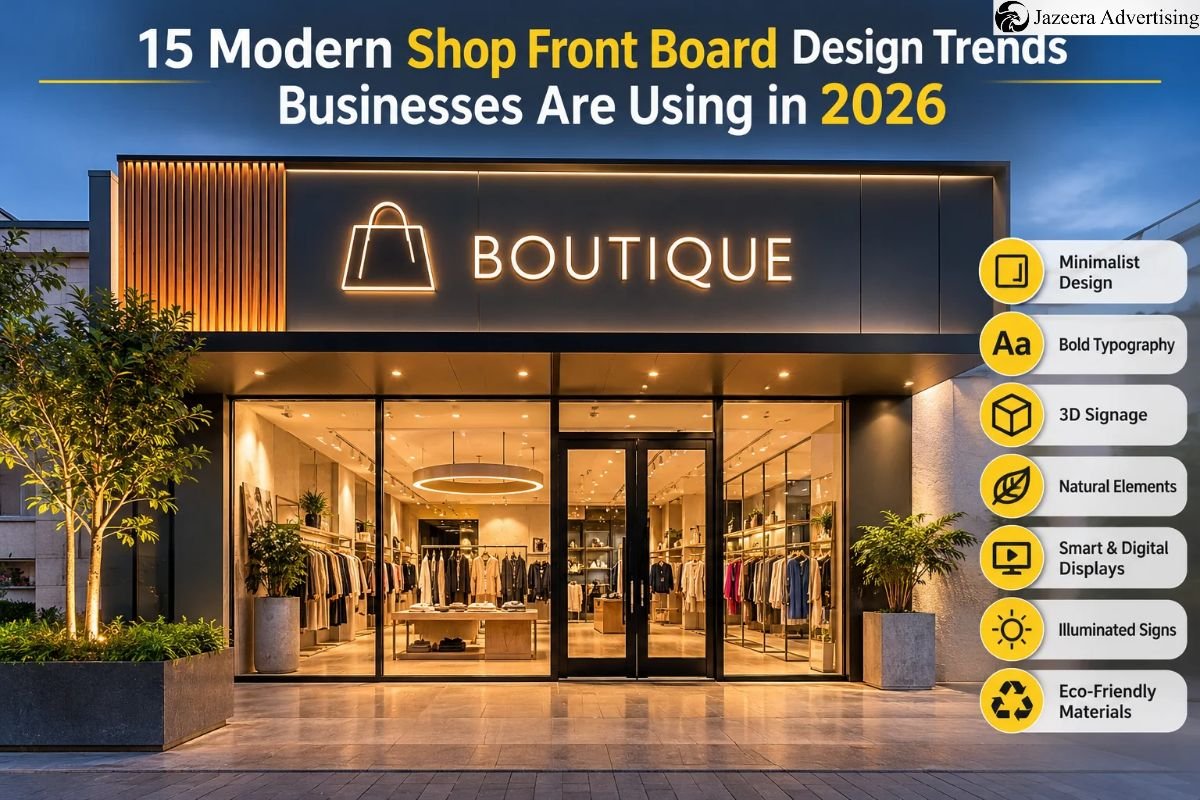
15 Modern Shop Front Board Design Trends Businesses Are Using in 2026
Table of Contents
- Key takeaways
- What makes a shop front board effective in 2026?
- How do modern boards compare to traditional designs?
- 15 modern shop front board design trends for 2026
- How do you choose a reliable signage partner in Dubai?
- Wrapping up
- Frequently asked questions
The current business storefront in 2026 is far beyond just a name written on a wall. It is a quick visual means that communicates to the audience what products are being sold, what kind of attitude a business has, and if it is worth paying a visit. The most effective designs feature sharp fonts, layered materials, functional lighting, and bold traffic colors. In the bustling shopping streets of Dubai, companies move away from overly cluttered panels to simple professional boards.
In this guide, there will be described the 15 trends that will influence the storefronts this season and also the reasons why each of them is effective and how to find a reliable partner to bring those ideas into life. If you are searching for the best signage company in Dubai, the checklist below will help you compare options with confidence.
Key takeaways
- Contemporary storefront designs can thrive through a focus on easy readability, simple fonts, and even colors.
- Acrylic displays sum up dimensions and textures, whilst LED and smart lighting improve visibility after dark.
- Neon signs and other embellishments therefore provide secondary details highlighting the primary message.
- In terms of the lifetime value, look out for a weather-proof finish, a good guarantee, and a provider backed by substantial local experience.
What makes a shop front board effective in 2026?
A well-designed shop front board must be visible from across the street, immediately convey your brand, and be effective in light and dark conditions. High contrast, a limited colour scale and clear hierarchy of a logo. Good materials and lighting also ensure it will remain sharp through the years.
The first few seconds that a shopper spends deciding whether to enter a store are a crucial part of their shopping experience, and every design aspect on the exterior of a store can make a difference. Designers work with several basic principles that always yield results:
- Readability from a distance, so that people can read from the other side of the road or from a moving vehicle.
- Logo, colours and fonts that align with your other marketing – brand recognition.
- Using visual balance, avoid filling the space; give room for breathing around the message.
- A night performance with lighting that provides clarity once dark and doesn’t overpower.
The board has to collaborate with the building as well. A sign that doesn’t respect the façade’s architecture appears as if it was added as an afterthought, whereas one that fits in with the frame looks like a deliberate choice. This means that many businesses now take a site survey first to determine the size, shape, and material to use.
Therefore, evaluating the sight line from the roads and footpaths in the vicinity is often a better position than first proposed. Those measurements are also used to see if one board or multiple smaller boards are required to lead customers towards the entrance.
How do modern boards compare to traditional designs?
Unlike older boards, modern boards are actually different in just about every way one can imagine, from the typefaces used to the way they are lit. The table below summarises the most important differences.
| Feature | Traditional Boards | Modern Boards (2026) |
| Typography | Ornate, multiple fonts | Clean sans-serif, few words |
| Materials | Heavy painted metal or plain plastic | Layered acrylic, aluminium, glass, and wood-look panels |
| Lighting | Fluorescent or older neon tubes | Efficient LED modules, often smart-controlled |
| Colour palette | Many colours competing | Limited, high-contrast colour blocks |
| Visual clutter | Dense text and multiple slogans | Single message with generous spacing |
| Maintenance | Frequent repainting and tube replacement | Long-life LEDs and weather-resistant finishes |
| Customisation | Fixed, costly to change | Modular panels and programmable displays |
Traditional boards were created and meant to be viewed and filled. Contemporary boards are meant to be comprehended easily. They’re simple, purposefully so, because the less they have, the more quickly they’ll be read, and the more quickly they’re read, the more customers they’ll be able to identify. But simplicity doesn’t equate to dullness. Modern designs use depth, texture, and adding light to create interest without depending upon text.
Upgrading regularly can result in more than just an improved look. Modular construction provides energy savings, which lower running costs, and can be used to promote without replacing the entire board. Furthermore, a new storefront design can also help attract customers to the business, as it will make the store look more modern and professional.
15 modern shop front board design trends for 2026
These are some of the current design trends that designers and business owners are opting for. Each can be used in a small café, in a fashion boutique, or in a large showroom.
1. Minimalist Typography and Clean Sans-Serif Lettering
Minimalist typography is a common trend in today’s retail store design. A clean, spacious sans-serif typography style is being used to increase the ease of reading the pavement and by passing traffic. The brand name is presented clearly with fewer words, bigger lettering, and simple shapes to give a clear demonstration without competing elements. This style works well in minimalist interiors, luxury boutiques, and professional office environments.
Sometimes companies will use a big headline with a small tagline so that their customers understand what they’re getting within the first second. The design is simple and has fewer frills, so it doesn’t get dated and can be adapted with the change of brand image.
2. Backlit LED Channel Letters
The backlit channel letter is still a popular size. Every letter is formed as a three-dimensional figure and has a closed back panel, behind which the light is diffused evenly. This provides a crisp after-dark appearance that allows the name to be seen the rest of the way down the street.
However, the current LED modules perform cooler and consume fewer resources than the older neon and fluorescent types of modules; they also last for many years with very little maintenance. The ideal choice is to pick a light colour that will match the color of your facade and to refrain from too intense settings, which could reflect glare to other buildings.
3. Layered Acrylic Lettering With Depth
Acrylic layering has become a common technique for adding dimension without too many structures. Acrylic letters or logos are cut out and layered with very small gaps between each piece to create a subtle shadowing effect. The finish is high quality, and it has a nice tactile feel when held close. Acrylic is lightweight, resistant to weather conditions, and comes in a variety of finishes, including matte, gloss, and mirrored.
This is one of the methods that many brands apply in their boutiques, dental offices, and coffee shops. For any acrylic signage design in Dubai, the question that comes to mind is how the layers are attached. The secure fixings and proper spacing will determine how the sign will remain crisp over time.
4. Custom Neon Accents for Brand Personality
Neon is far beyond the nightclub and retro dining environs. Modern companies take advantage of it as a select accent, giving personality to their contemporary facade. One neon bar under a logo, or a small neon icon near the entrance, can be successful in getting attention without overpowering the overall design.
Therefore, custom-bent glass tubing is available, and LED neon alternatives can be bent as well and have a comparable glow, but are more durable and cost less to run. In the case of neon, be sure to hire a team of custom neon signs makers in Dubai with the proper knowledge and expertise regarding electrical safety, transformer placement, and wiring norms. Limit the size of the neon piece; make sure it doesn’t overshadow the primary message.
5. Warm Wood-Look Panels Combined With Metal
Natural textures are coming back to the front of stores. The aluminium panels with wood finish, the timber-effect finishes and brushed metal frames provide a warm and inviting atmosphere appropriate for cafés, bakeries and lifestyle retailers. The combination of organic forms and contrasting sharp metal edges creates a balance and luxuriousness to the facade.
Additionally, other materials with a modern wood appearance are also more resistant than actual wood in the intense sun and heat of Dubai. Often, designers will reserve the wood-look section of the design for behind the lettering, thereby keeping the letters readable. When the inside is made of a similar material, for example, this duo is great for creating a seamless brand experience from street to store.
6. Slim-Profile Illuminated Light Boxes
Light boxes are transforming into thinner and lighter versions of themselves. The cabinets have been developed in a way that uses LED technology only on the edges, which means that they occupy less space. The prints are evenly illuminated; therefore, they appear colorful, and all the shades are consistent. The displays are easy to replace and install when it is needed.
A big number of shops are applying them for seasonal campaigns along with the permanent brand display. The design is such that it allows an easy mounting flush system whereby it seems like it is an entire system, not just an addition. Be sure to check that the printing material of the light box is UV-resistant in order not to fade too quickly.
7. Bold Colour Blocking
The easiest technique to be noticed on a busy street is bold colour blocking. Designers create bold patterns of two or three bright colours instead of mixing many shades. It might be the most suitable solution for companies with a strong character, such as gyms, children’s shops, food trucks, etc.
It should be remembered that the contrast between colour and text is important since colour does not make your message visible by itself. It is better to check your colour palette in daylight and at night before making a final decision. A consistent colour system across the signboard, windows, and door graphics helps customers connect the storefront with your brand instantly.
8. Smart Lighting and Programmable Displays
Smart lighting enables a board to vary its color, brightness, and animation during the day. Retailers can turn off the light during quiet hours, turn it on for promotion, and remotely schedule them. This allows for flexibility, conserving energy and maintaining the storefront’s relevance. Programmable LED displays are particularly beneficial for restaurants that offer lunch and dinner promotions, or stores with frequent sales days.
Other companies favor more gradual changes, as they believe they look charming without drawing attention. By collaborating with the best LED Sign board makers in Dubai, the possibility of installing controllers, power supplies, and wiring incorrectly and requiring repairs or replacement is reduced.
9. Frosted and Textured Glass Finishes
This ‘frosted’ glass effect is no longer new on office doors or showroom partitions, but is now being seen on shop fronts as a stylish background. Sandblasted or etched textures scatter light gently and obscure information that might otherwise be seen behind the window. Frosted surface printed vinyl can provide logos that are subtle and refined.
Textured glass is also somewhat private and is an excellent choice for clinics, spas, and boutiques that wish to maintain the customer experience. Installation should be done according to engineering guidance for wind load and safety, as glass is heavy and fragile. Use frosted for looks and a backlit name to make the sign easy to read.
10. Eco-Friendly and Recyclable Materials
Across the sign industry, sustainability is influencing material selections. Aluminium is requested as a recyclable material, energy-efficient LED lighting is requested, and low-VOC paints are becoming a standard request. A lot of companies like to have the designs modular so that they can replace just one board panel rather than changing the entire board.
However, responsible suppliers also describe what happens to materials when they reach the end of their life. But sustainability is not at the expense of quality either. If a less expensive board is installed but needs to be replaced in a couple of years, it is not as valuable as a properly constructed eco-friendly board that will last many years. Request a material list and a warranty from your provider before you order to make a fair comparison.
11. Monochrome Black and White Boards
Monochrome boards (black, white, or charcoal) are a classic favorite. They fit with virtually any architectural style and can coordinate window displays and product photography. A black background with white or metallic lettering is used for good contrast and a subtle, modern appearance.
Monochrome palettes also help to prevent a board from appearing out-of-date after a couple of years. Designers add texture to make it appear non-flat, with brushed metal, matte finishes, or subtle shadow lines. Use a generous size lettering style and maintain a good proportion to the changes between letters so that when a person passes the shop, the name is visible.
12. Projecting Three-Dimensional Blade Signs
The signs, known as blade signs, stick out from the building at right angles and are visible from both approaches. Today’s models are made of light materials and have slim profiles, with a logo or symbol that usually symbolizes the company. They are particularly useful in pedestrianized zones where you don’t have cars driving through but people walking along the street.
Moreover, as blade signs face outwards, they need to be designed for structural support and need to meet local regulations for clearance height and projection distance. A sign that is designed in a way that will create a balance with the main fascia board, and that will help to lead customers to the entrance.
13. Integrated Logo and Architecture Designs
With integrated design, the signboard becomes a part of the building. Lettering is used to match lines on windows, cornice features, and entrance frames to make the sign look intentional. This will give the street a cleaner appearance and eliminate all the clutter that comes with multiple add-on panels. The role of architects and designers can be engaged early in the process, thus aiding in proportions and lighting placement.
Integrated concepts also lead to consistency throughout an entire multi-tenant building while allowing each tenant to be unique. Do a measured drawing of the façade first and then make decisions on sizes.
14. Digital Hybrid Boards
Digital hybrid boards are boards where a brand panel is fixed behind the screen and where a smaller screen is used for promotions, opening hours, or updates in the menu. The digital portion keeps the message fresh, and the fixed part ensures the storefront is recognizable. Screens should be sufficiently bright for daylight viewing and should automatically reduce their brightness at night to avoid glare.
There should be one message per slide, and there should be no ambiguity in the timing. There are certain systems, like in pharmacies, restaurants, and retail chains, where the offers change often, which makes hybrid systems more useful. Check that the screen is weatherproof and has good power and network connectivity prior to installation.
15. Weather-Resistant Finishes for Dubai’s Climate
In Dubai, finishes are essential which are resistant to heat, moisture, dust and strong sun. The colour and shape of boards are maintained for years with a powder-coated aluminium frame, UV-stable vinyl and sealed LED modules. Drainage, ventilation and corrosion protection are also taken into account by designers, particularly if the area is close to the coast where salt air can cause faster deterioration.
It will last a lot longer if the sign is cleaned and inspected on a regular basis. A permanent finish is not just a finishing touch; it ensures the appearance of your brand remains consistent and fulfils its job. Inquire about the coatings and warranties that are provided for outdoor use with suppliers.
How do you choose a reliable signage partner in Dubai?
Look for a company that provides design, licensed manufacturing, clear costs, and real-world projects in this area. Request samples of portfolios, ensure they provide Dubai permits, and verify their warranty and maintenance. A dependable partner will also clearly explain the material options before you commit.
Choosing a provider is among the most significant choices to be able to make with regard to your storefront. Before you make comparisons, you are essentially searching for the best signage company that is suitable for your brand, budget, and building. Here are some things to keep in mind before entering into a contract:
- Design expertise, so there is a one-stop shop for concepts, drawings, and mockups.
- Exposure to your building type, be it a mall unit, a stand-alone shop, or a multi-storey office.
- Clear permit support, including guidance on approvals and compliance with local regulations.
- Clear-cut quotations for materials, lighting, installation, and maintenance.
- Warranties and after-sales service, such as maintenance, replacement, and periodic inspections.
Request references and recent pictures of projects from all candidates. If possible, go to a couple of installers and see how they did the job, as lighting quality and craftsmanship can be better assessed in person. Additionally, ask for a mockup or digital image of the board installed on your actual facade to reduce surprises during installation.
The best signage company in Dubai, such as Jazeera Advertising, whose services you can check out, can help you explore possibilities and align the plan with your goals and budget. In this regard, a good partner will become more than just a vendor and will seem like a member of your team. Make sure to pay attention to the way they address your questions, since communication during the design phase can help ensure smooth installation.
Wrapping up
The shopfront signage of 2026 is all about being clear, unique, and sophisticated in style. Whether you use slender fonts or acrylic layers, you have one goal in common: to get passers-by to stop and walk in. Good lighting systems, high-quality materials, and designs that are in line with the architecture can ensure that your signage will be effective for a long time.
If you are developing a new storefront, use this guide as a checklist, pay extra attention to the quotes received from different suppliers, and remember that a good design starts with a well-considered brief. To add some originality, it is possible to cooperate with custom neon sign manufacturers from Dubai.
Frequently asked questions
Backlit LED letters on minimalistic boards are popular due to their clarity and good nighttime visibility.
Prices depend on dimensions, materials used for construction and illumination; therefore, obtain an itemized price list from various suppliers prior to making your choice.
Usually yes. Verify current requirements from relevant Dubai authorities or your signage provider before starting on fabrication.
Energy-efficient LED lights are bright and durable. The best LED sign board manufacturers in Dubai are available for recommendation.
15 Modern Shop Front Board Design Trends Businesses Are Using in 2026

How to Increase the Lifespan of Outdoor Advertising Hoardings