- November 21, 2026
- by Jazeeraadv
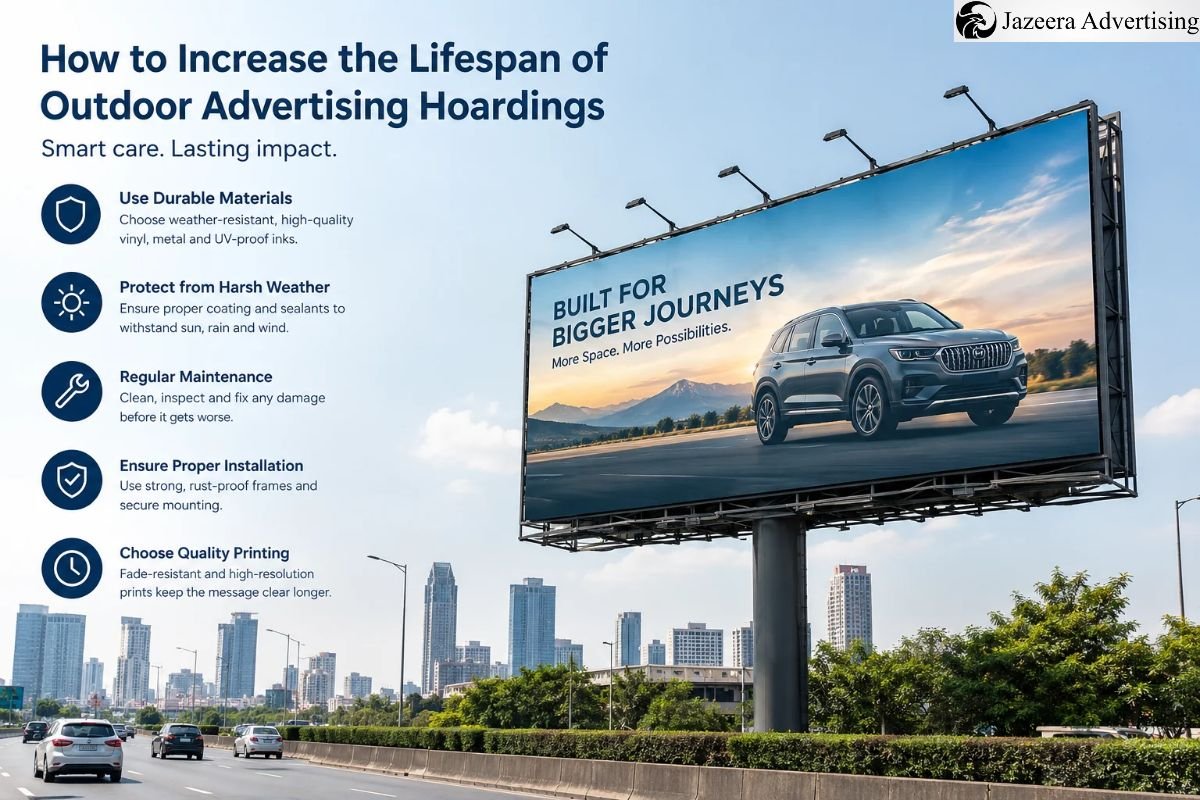
How to Increase the Lifespan of Outdoor Advertising Hoardings
Table of Contents
- Key takeaways
- How long does an outdoor advertising hoarding last?
- Why do hoardings wear out early?
- How can material choice extend hoarding life?
- Which installation practices protect hoardings?
- What maintenance routine keeps hoardings looking new?
- How does Dubai’s climate affect hoardings?
- How do you choose the right signage partner?
- Bottom line
- Frequently asked questions
To enhance the longevity of outdoor advertising boards, concentrate on four areas: use of strong frame materials, proper structural installation, scheduled maintenance, and proper printing technology resistant to extreme weather. A suitably built hoarding can remain bright and strong for years, whereas an improperly maintained hoarding is likely to suffer difficulties like peeling or fading within months. In this guide, each variable will be clarified for firms to make sure their investment remains fruitful.
If you want to find the best outdoor signage company in Dubai, professionals at Jazeera Advertising have had the chance to observe successful samples and those that did not work. The advice below reflects those practical lessons, so that property owners, marketers, and facility managers can use it immediately.
Key takeaways
- UV-resistant printing materials and a galvanized and aluminum frame provide longevity to a product.
- Correct foundation, even tension, and proper drainage are effective at preventing many of these problems from occurring.
- Regular monthly inspections and quick repairs help maintain the good condition of buildings and printing equipment.
- An understanding of Dubai’s weather conditions by a contractor would help them to design, install, and maintain durable signage.
How long does an outdoor advertising hoarding last?
Outdoor advertising hoardings usually last for about 3-7 years based on their frames, print materials, and surroundings. Hoardings are well maintained in Dubai, but it can be expensive to maintain; on the other hand, poorly maintained ones will have a shorter lifespan.
The lifespan isn’t an exact figure. The quality of a building depends upon its construction process as well as maintenance procedures post-installation. Think of a hoarding as a system in which the frame, the printed skin, the fixings, and the surface finish all have to work together. If one component fails early, the others usually follow.
Typical lifespan by component
Notice that different components of a hoarding age at varying rates. Below is a general guide to the longevity that you can typically expect:
| Component | Typical Lifespan | Main Risk |
| Galvanised steel or aluminium frame | 7 to 10 years | Corrosion at joints |
| Standard vinyl or flex banner | 1 to 3 years | UV fading and tearing |
| Heavy-duty PVC or reinforced mesh | 3 to 5 years | Sun cracking and surface wear |
| Bolts, brackets, and anchors | 2 to 5 years | Loosening and rust |
| Plywood or MDF backing | 2 to 4 years | Moisture swelling and warping |
The first part that breaks is typically the print on the skin. It’s much cheaper to replace a banner than it is to rebuild a frame; over the long haul, planning these two areas separately can save you a lot of money. Many owners also wait until they see something wrong structurally before addressing it. Before installing your billboard structure, it is a good idea to examine the following basic components of your structure to identify their weaknesses early on, and the best signage company in Dubai can be helpful.
Why do hoardings wear out early?
There are a number of forces at work against hoarding on a day-to-day basis, and most of these are not intermittent. Early failures are typically caused by one or more of the following reasons:
- The breakdown of inks, plastics, and coatings due to exposure to sun and heat.
- Repeated stress to the frame and fixings due to wind loading,
- Installing the structure poorly, making it unbalanced from the get-go.
- Small problems that grow into large, expensive issues due to delayed maintenance.
However, if you know what these causes are, you can more easily avoid them. These can all be planned for instead of just hoping for.
Sun, heat, and UV damage
Printed hoardings are most vulnerable to ultraviolet radiation. The pigments in the ink and the plastic fibres in the banner tend to fade over time after absorbing UV light. The outcome is that the color fades, it gets brittle and cracks along folds and edges.
Additionally, add heat to the mix. Lifting at the corners of laminates occurs as a result of repeated expansion and contraction of seams. In hot climates, a UV stability outdoor print guide will be helpful when comparing the different types of inks and laminates to see how they withstand high levels of sunshine.
Wind load and structural stress
Wind is one thing that is underestimated. A large hoarding can act like a sail, and even a moderate gale can generate a considerable force through the frame. If the panel is not well tensioned or anchored, it flaps, and the fixings and the print material are both affected.
After months of flapping, tiny holes develop in the areas where the eyelets rub against the frame. These holes then open up again in the next storm. Therefore, a banner that’s meant to last for three years may fail the first season if it’s not created to suit the windy conditions in that area.
Neglect and small problems
The biggest problems usually start as small problems that go uncorrected. If the bolt is loose, it causes vibrations, which in turn loosen the adjacent bolt. A small unidentified tear grows into a big flap that catches the wind and tears the panel from its frame.
The solution is a little easier, but it takes discipline. These problems can be identified and fixed at an affordable cost through regular checks. It is better to build the habit than wait for an obvious failure, and it will safeguard the structure as well as the reputation of the advertiser.
How can material choice extend hoarding life?
The life of a hoarding depends upon material choices at design time. It is much better to select the right frame, skin and backing from the outset than to have to replace parts subsequently. Three key areas need to be emphasized:
- The use of frame material, such as galvanised steel and aluminium, outperforms untreated metal in resisting corrosion.
- Printed materials that are laminated, with UV-stable substrates that retain colour.
- Backing and fixings with moisture-resistant boards and stainless hardware, which limit slow deterioration
All the options are connected with each other. This is because a high-quality print on a low-quality frame will not last, and a good frame with a poor banner will look old in a year.
Choosing the right frame
For the majority of hoardings, galvanised steel is a strong and affordable option. If the metal is cut, the cut edges should be treated after cutting to prevent rust, as the zinc coating protects the metal from rust if it is not applied properly. Aluminium is also light and naturally resistant to corrosion, making it suitable for larger panels or coastal locations, where salt air can cause corrosion to occur more quickly.
As important as the material of the frame, the design of the frame matters. Cross bracing takes wind load off the elements equally, and if poorly spaced, it will develop points of stress and crack over time. Request structural plans before accepting any design.
Selecting printing materials
As you consider a campaign, explore billboards & flex printing services in Dubai providers offering different options and inquire about the brand of the UV laminate, ink type, and the length of the warranty. A good provider will be able to let you know how the print is likely to look in local sunlight and will not just give you the lowest price for printing per square metre.
The table below shows a comparison of the most frequently used materials for outdoor printing on hoardings.
| Material | Expected Outdoor Life | Best Use | Relative Cost |
| Standard flex banner | 1 to 2 years | Short campaigns, temporary sites | Low |
| Laminated flex banner | 2 to 3 years | Medium-term promotions | Medium |
| Reinforced PVC | 3 to 5 years | Long-running hoardings | Medium to high |
| Mesh vinyl | 3 to 5 years | Wind-exposed or large-format sites | High |
It is important to note that Mesh vinyl is suitable for windy places. It has perforations that let air flow through it, thus greatly decreasing the wind load. Though the material is more expensive initially, it can keep the environment in which the print can be displayed for a much longer period of time.
Which installation practices protect hoardings?
The quality of the installation affects the ability of a hoarding to withstand stress on the first day. Any high-quality material will not function properly if it is not installed properly. The process of installation is disciplined and goes in a logical order:
- Assess site wind exposure, ground conditions, and access before surveying the site to determine wind erosion potential
- Calculate the size of the foundation according to the frame size and the load requirement of the locality.
- Anchor the frame securely and check that it is level and plumb
- Tension the printed panel evenly and fix it to the frame
- Once the structure is complete, check the results after its first exposure to a strong wind or storm.
Therefore, failure at any point results in potential failure of the entire process. A post-storm inspection is extremely valuable because many installation problems aren’t discovered at the time of their installation and only manifest months later.
Foundation and anchoring
The base is the hidden part of the hoarding, and it could be the most significant part. A frame that is not firmly set in place will push and weave in the wind. The dimensions of the footing for the structure should be determined, and anchor bolts installed to the proper depth based on the height and area of the structure.
The soil conditions are also important. Sandy ground is different from compacted clay, and sites close to the coast may also require extra corrosion protection for buried components. Request a drawing from your installer of the foundation specification so that future maintenance crews will know what was installed.
Panel tension and drainage
The panel has to have the right tension, so as not to flap about, but tense enough not to risk damaging eyelets. A uniformly tense panel prevents localised damage, while correct spacing of eyelets distributes any load evenly across the frame. Regular checks for tension during the first week can prevent issues from arising from this stage.
The drainage system is likely to be as important as the tension. If rainwater gathers in any place behind or on top of the printed panel, this will create weight and create the right conditions for mould to start developing. Small drainage gaps or a slight slope of the surface will provide for proper drainage of water, thus keeping both the print and the frame in better condition.
What maintenance routine keeps hoardings looking new?
The best way to make any hoarding last longer is to perform regular maintenance. The idea is to catch the little buggers before they get big and fix them before they multiply. Most sites can be managed with a basic schedule and well-defined work assignments.
A number of brands have agreed to work with branding and signage companies in Dubai that provide maintenance contracts, which have the ability to keep sites under check periodically and minimize the risk of unexpected failures. Regardless of whether you have your maintenance team in-house or have it outsourced to a third party, the general services are the same.
- Monthly and quarterly inspections
Most problems can be detected with monthly visual examinations. Check for loose eyelets, worn or golden print, rusted areas on the frame, and sagging. Record the date and the condition of each item to be able to find trends over time.
Quarterly inspections should be more thorough. Inspect for anchor movement, test anchors, inspect welds and joints, and inspect bolt torque and foundation for movement. A log of the simple kind is useful in planning for the replacement of a component before it is lost entirely.
- Cleaning without causing damage
The dust, bird droppings, and grime that collect in a print diminish its color and can hold moisture against the print, which is harmful. While cleaning will help, the wrong cleaning method can do more harm than the dirt. Use gentle brushes, mild soap, and lots of clean water. Don’t use abrasive pads, high-pressure jets when close to laminates, or harsh solvents, as they can damage laminates and reduce seam strength.
Avoid drying and streaking by cleaning during cooler parts of the day. Ensure the surface is dry before the next wind event, as trapped moisture is a frequent cause of mould and delamination.
- Repairing small damage early
In the case of small tears, loose corners, and missing eyelets, they should be mended as soon as they are found. A patch that’s put on in a few days will be quite inexpensive, as opposed to having to replace an entire panel if it is left on for months. Have spare eyelets, repair tape, and matching print offcuts to hand for quick repairs.
Moreover, if the structure has problems like cracked welds or corroded brackets, hire a professional tech. While temporary fixes may provide some relief, they are always accompanied by a permanent fix.
How does Dubai’s climate affect hoardings?
The climate in Dubai is one of the most challenging for outdoor advertising. Hoarding weather conditions change for prolonged periods, with strong sun, high humidity near coastal areas, fine airborne dust, as well as occasional strong wind storms. It’s measurable to design and maintain for these conditions.
Seasonal variation should also be taken into consideration in local planning. Weather in the summer can speed up the effects of the sun (UV damage and material expansion), and weather in the winter and spring months can bring higher wind speeds and occasional rain. Inspection scheduling before and after these time frames can help you to prepare instead of react.
- Heat and UV radiation
The sun is very strong for most of the year in Dubai, and the surface temperature of materials like printed material can reach temperatures much higher than the air temperature. This heat causes the ink to decompose more quickly and makes plastics more brittle. The best protection is to use UV-stable inks and laminates; this should be included in every job contract.
Additionally, orientation also matters. A hoarding that gets all-day sun is likely to be more degraded than one that is shaded from the sun for part of the day. If possible, take into account orientation when selecting sites, and allow for a shorter print life for the most exposed faces.
- Dust, sand, and humidity
Fine sand and dust gradually settle on the printed surface and gradually wear away over time, especially in windy weather. Humidity is another hurdle at the coast, and it invites corrosion of metal parts and mould on backing boards. Both are slow, but cumulative problems.
Sealed frame joints, galvanised or coated hardware and moisture-resistant backing materials are all included in the protection. Regular cleaning will clear away abrasive particles that cause surface damage, and monitoring drainage will reduce moisture build-up.
- Sudden storms and sandstorms
The most spectacular dangers to hoardings are sudden storms and sandstorms. Strong winds can blow panels off of frames in minutes and can scour print surfaces with sand. The first step in preparing for such events is to have a good structural design and solid anchors.
Therefore, always check the site after major storms, when conditions are safe. Check for missing or misaligned panels, bent structural members, and missing or loose fastenings. It is important to take swift action to prevent further damage and to maintain the advertisement’s presence during repairs.
How do you choose the right signage partner?
How long a hoarding lasts can depend on the right partner. A good provider takes into account local conditions when designing the structure, employing quality materials and assisting the project following installation. When looking for the best solution, consider more than just the price when comparing them, and consider how the company will deal with long-term performance.
Ask the provider how they conduct site surveys, design the structure, and provide a guarantee. If the vendor has no idea about how to perform the calculations of the wind load or what materials are being used, then he or she is not likely to provide a durable outcome. It’s also useful practice to ask about references from projects, so you can get a sense of how previous installations have fared.
What to look for in a vendor?
If you are looking at a business to work with on a new project, see if they have the following traits:
- Documented site survey before any design work is completed
- Structural drawings that take wind load and local regulations into consideration.
- Provide clear material information, such as type of ink and laminate information
- A structural and printing warranty which is in writing.
- The production in-house or fabrication under close supervision.
- After handover, a maintenance plan or service agreement.
These are qualities that indicate that a provider cares about the life cycle of the hoarding rather than just the day it is installed. They also make it simple to compare quotes on an equal basis.
Why does local experience matter?
Local experience is worth it because the conditions in Dubai are specific. A company with experience in a lot of projects throughout the city will know what kind of materials work well, which fixings will corrode quickly, and what seasonal winds impact various sites. That knowledge can’t be easily transmitted from outside the market.
Local teams are more responsive to issues as they occur locally. An electrician nearby will be able to check out an injured board on that day so as not to cause any delays for your project. Businesses relying upon visibility have high-speed needs which are important for their success.
Bottom line
Making the outdoor advertising hoardings last longer involves three key factors: using appropriate materials, installing the hoarding correctly, and regular maintenance of the structures. Each stage supports the others, with any error at any stage resulting in reduced efficiency of the hoarding. For example, even when planning for outdoor advertising in Dubai, one has to consider the impact of sun, wind, and dust on the hoarding.
Whether planning for your next outdoor campaign or maintaining an existing site, the support of the best outdoor signage company in Dubai can help you achieve success in your efforts. Jazeera Advertising offers professional advice that can be for you to ensure proper performance of your advertising hoarding.
Frequently asked questions
Hoarding lasts for about three to seven years due to its material composition, construction standards, and maintenance frequency.
Sun exposure on printed items and loose or corroded fasteners are responsible for most of these failures, which can be made worse due to a lack of timely repairs.
Yes. Select UV-resistant laminated flex or reinforced PVC, as it is more durable than regular printing material due to its resistance to sunlight in Dubai.
Find an authorized company that does site surveys, has clear warranty terms, produces products internally before installing them on-site, and provides service and maintenance post-installation.

How to Increase the Lifespan of Outdoor Advertising Hoardings

Top Indoor Branding Signage Ideas to Enhance Customer Experience