- November 19, 2026
- by Jazeeraadv
Top Indoor Branding Signage Ideas to Enhance Customer Experience
Table of Contents
- Key takeaways
- What makes indoor branding signage effective?
- Creative reception signage ideas
- Wayfinding signs that guide visitors
- Digital and interactive signage options
- Materials and finishes for Dubai interiors
- Office branding ideas for corporate spaces
- Common mistakes to avoid
- How to choose the right signage partner?
- Final thoughts
- Frequently asked questions
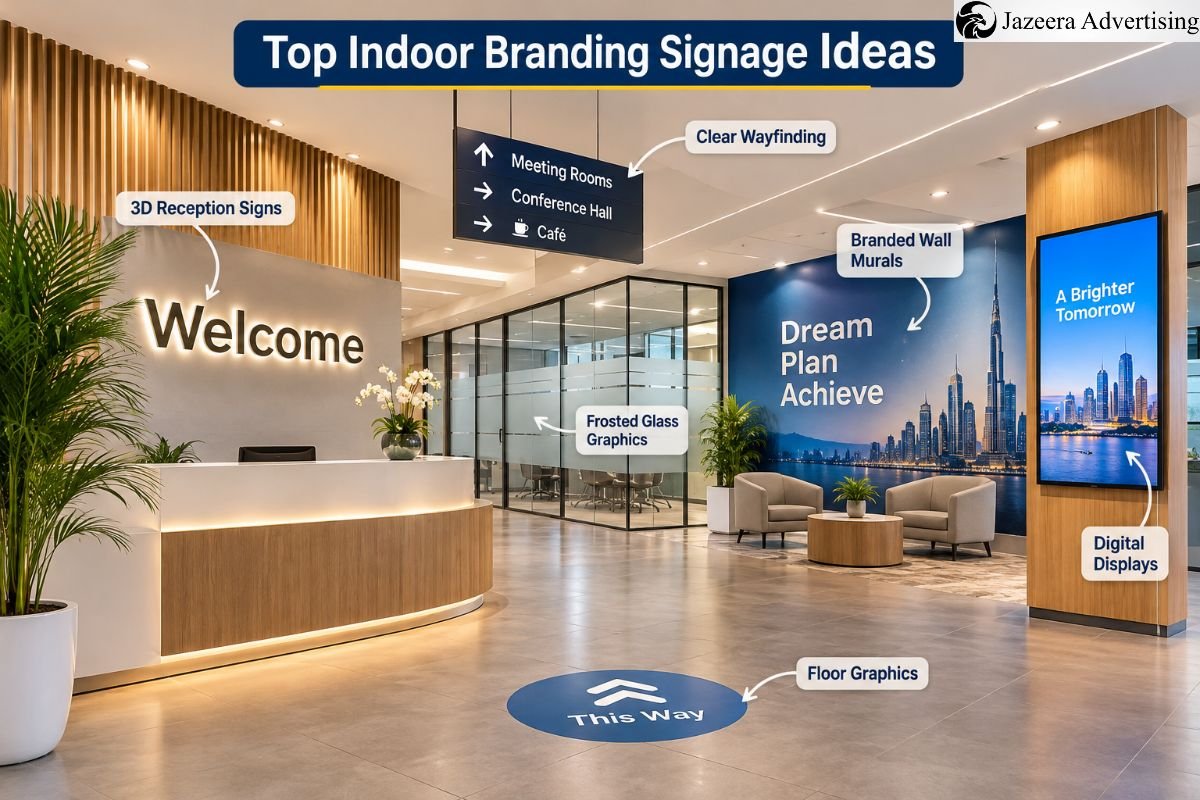
Indoor branding signage conveys an organization’s image, guides customers through their journey, and leaves a memorable impact. Popular options include illuminated wall logos, 3D letters, backlit panels, information screens, and reception area signage. Good signage enhances customers’ experience through better navigation of a space and establishing trust in brands. An experienced indoor signage firm based in Dubai will assist companies in choosing appropriate design options, materials, as well as installation services. The article discusses good interior signage designs for office buildings, shops, hospitals, and hotels, as well as some useful advice on selecting appropriate signs to use at these places of business within Dubai.
Key takeaways
- Lighted logo walls, 3D lettering and lighted panels make a great initial statement at reception and in public areas.
- Wayfinding signs remove the confusion, decrease staff interruptions, and make each customer visit easier.
- Information remains up to date on digital screens and touchscreen directories, and helps to manage today’s fast and efficient customer service.
- Look for materials that will withstand the heat and humidity of Dubai and hire a partner who has successfully completed indoor installations.
What makes indoor branding signage effective?
The reason why indoor signage works is because it reaches the right person at the right time. It’s not just about decoration. Good signs communicate, project the brand image and ease the way through an environment. Knowing exactly where to go and feeling welcomed along the way enhances the overall visitor experience.
Why does indoor signage matter for customer experience?
Think about the last time you visited an unfamiliar clinic or office. When the door was unfamiliar, you were likely hesitant, glanced around, or asked a staff member for assistance. Even if it’s a minor moment of confusion, it adds stress. Clear signage takes that hesitation away and allows one to concentrate on why they came.
However, space perception is influenced by the space atmosphere as well. Lighting and colour are warm, materials used are of good quality which indicates care and attention to detail. Those attributes are frequently conveyed to the business itself before the first word is spoken, so signage can impact trust.
How does signage support brand recognition?
Repetition builds recognition. The consistent use of the same logo, colour scheme and font on the reception wall, meeting room door, washroom sign and printed brochure makes the brand familiar. It becomes familiar to the users over time and can be easily recognised even outside of the building.
Consistency is more important than complexity. The simple, effective sign system typically does a much better job than a complex array of competing messages. Use your core brand elements several times, but not all over the place.
Creative reception signage ideas
Visitors make their first impression at the reception area, so it must be the most carefully designed section. Signage must be large enough to be read from the entrance door and elegant enough for the interior. The following are ideas that are suitable for many business types.
- Illuminated Logo Walls
An illuminated logo wall is a wall panel that is lit with a soft glow in front of a company logo. This is one of the most easily identified indoor branding ideas, as it establishes a focal point instantly. Lighting can be linear LED-backed to create a more glowing look or edge-lit for a sleeker, floating appearance.
Logo walls work best if the rest of the room is kept empty. Do not place them in direct sunlight from windows, as this will wash out the colour, and ensure that the logo is easily visible from several metres away. A cleverly positioned logo wall can be a place to take photos, providing the brand with free social media publicity.
- 3D Letter Signage
Dimensional letters can be used to give depth and texture to a wall. They may be attached to the surface or set into a backing panel, and they are different in their light catchment during the day. This gives the image such a premium look that flat printing can’t match.
The material used will affect the outcome. The set comes in polished stainless steel for a sleek modern look or brushed stainless steel for a more subdued look. Acrylic letters can be lit from behind to create a ‘halo effect’ that is ideal for the night-time environment, like a hotel lobby.
- Backlit Panels for Brand Stories
Artwork, icons, or short messages are shown on a translucent surface from the inside, giving the panels a backlighting effect. They are appropriate for corridors, waiting rooms, and meeting rooms where you need to share a value or a service but don’t want to overpower the space. The panels disperse the light, making them easy to view in lower lighting conditions.
One idea should be assigned to each panel. Be careful not to have too many words and images that the visitor walking by has a few seconds to digest. A number of panels could also be used to rotate content so that a corridor is interesting on repeat visits.
Wayfinding signs that guide visitors
Wayfinding is a method of guiding a person through a building, with no confusion. Good wayfinding is paramount in large offices, shopping centres, and medical facilities. It cuts down on staff interruptions, decreases waiting times, and provides visitors with a feeling of control over their travel.
- Directional Signs at Decision Points
Use directional signs at any place where visitors have to choose a direction of travel at junctions in corridors, lift lobbies, and entrances to stairs. Signs must clearly indicate the destination and include an arrow or icon readily discernible at a single glance. When signs are placed at the same height at the same level throughout the building, it is easier for people to learn the system.
Use simple language. The names of departments should correspond to the names of what people are looking for at reception. Use the same name for a room as your clinic calls it; for instance, if your clinic refers to a room as “Consultation 3,” you give your direction sign and door with that name.
- Room and Department Identification Plates
Small but important cues: Door plates and room labels. They reiterate the fact that the visitor is in the right place and help him or her get his bearings. Space can also be made more accessible by adding tactile or braille elements, making it more accessible to a wider range of people.
Apply the one plate design throughout the building. The same font, size, and mounting style will create a sense of order; only the text will vary from room to room. That consistency is an indication of the attention to detail that customers are aware of, even if they don’t say so.
Digital and interactive signage options
Digital screens are more flexible than traditional, static signage. Content can be remotely updated, scheduled to different times of the day, and adjusted for special events. Digital signage is frequently the most convenient option for businesses that will be disseminating evolving content.
- Digital Display Screens
Digital signage is suitable for waiting rooms, retail entrances, and lobbies. They can display live services, promotions, announcements, and wait times. The fact that the content is dynamic helps to make a space feel up-to-date, which makes it feel more active and modern.
Additionally, placement matters. Place displays at the head height of the seated visitor and don’t place them in front of windows. Use large text that can be read from a decent distance away, and don’t have too many points on each content loop to avoid visual noise.
- Touchscreen Directories
An interactive directory allows users to find people, departments, and floors by entering their names and getting directions from there. Their purpose is to lower the number of questions that receptionists have to answer and provide visitors with some degree of autonomy. A touch screen kiosk is particularly helpful for big complexes with lots of people or departments.
Select a device that is designed to withstand heavy usage and has plans for regular software upgrades. Broken or obsolete kiosks are more damaging to customer loyalty than an absence of a kiosk altogether; therefore, they should be included in initial budgets for maintenance purposes.
Materials and finishes for Dubai interiors
The material used for signs is important because it determines their appearance, durability, and performance within an environment. The heat, air conditioning cycle, and occasional dust may affect the condition of indoor signs over time. Taking into account these issues during manufacturing will prevent expensive repairs later on.
- Acrylic, Metal, and Wood Compared
Acrylic is an excellent choice for interior branding purposes. Lightweight, available in many colors, and easy to cut into precise shapes. With back or edge lighting, this gives off an attractive light, which is perfect for reception walls and feature panels. Acrylic signage in Dubai is popular among designers’ projects as it allows them to layer colored sheets or combine clear and frosted finishes for depth.
Every material is different; therefore, the best option should be selected based on where it will be used and what message needs to be conveyed. This is a summary of all available choices from this table.
| Material | Best Use | Appearance | Indoor Durability | Maintenance |
| Acrylic | Backlit panels, feature walls, logo displays | Smooth, vivid, glowing | High when shielded from direct sun | Soft cloth cleaning |
| Stainless steel | Dimensional letters, reception logos | Polished, contemporary | Very high | Occasional polishing |
| Brushed aluminium | Wayfinding signs, door plates | Clean, understated | High | Low |
| Wood | Warm lobbies, boutique spaces | Natural, textured | Moderate, needs sealing | Periodic finish care |
| Frosted glass or film | Office partitions, privacy signs | Refined, light-filled | High | Regular cleaning |
A soft cloth and non-abrasive product should be used to clean acrylic to avoid scratching. Avoid direct sunlight, as it may yellow with time. This is most important in close proximity to large windows and glass doors.
- Protecting Signs From Heat and Humidity
Most indoor areas are comfortable, and temperature variations near doors and moisture in older buildings can still impact materials. If the wood is not sealed correctly, it can warp, and adhesives may weaken when wet. Discuss the finishes and fixings for the appropriate location with your supplier.
Backlighting also helps to avoid overheating and increase the life of LEDs and material behind the panels. Designing these elements at that time is much more cost-effective than correcting them after installation.
Office branding ideas for corporate spaces
Offices are where clients, partners, and job candidates spend time with a company. Office branding can be considered a reflection of company values and assist in daily operations. The concepts listed below apply to a variety of corporate environments, including multi-story headquarters or small businesses.
- Boardroom and Meeting Room Signs
Signage in meeting rooms can be crucial to facilitating important decisions, which is why it should look the part. A brushed metal nameplate, a subtle wall graphic, or a backlit panel with the room name can help reinforce professionalism. Try to keep the design simple so that the room appears to be a space for work.
- Team Zones and Culture Walls
Culture walls honor the individuals that make up the brand. They may have displayed milestones, values, community involvement, or photos of the team. These displays convey the company’s personality to the visitors, and to the employees, they add to their sense of pride in the workplace.
Furthermore, turn content regularly to keep the wall current. When a culture wall has the same message for the past three years, it can begin to feel like a piece of furniture, not a sign of an active organisation.
- Department and Floor Identification
The use of floor and department signage guides employees and guests through large office spaces. Colour code or number systems that are easily remembered and stay consistent with the building’s directory. Clear signage on the floor minimises the loss of visitors and disruption to staff.
Common mistakes to avoid
Signage initiatives, while well-intentioned, can fall short of expectations. When you know what the most frequently made mistakes are, you won’t make them yourself.
- Too many messages in the space, making each sign more difficult to read.
- Signs at varying heights or locations, compelling visitors to find information.
- Writing in small letter sizes or low-contrast colours that cannot be read from a distance.
- Avoiding lighting conditions, including glare from a window or poorly lit corridors without lighting.
- Selecting materials without taking into account the high temperatures, humidity, and dust in Dubai.
- Avoiding digital screen, backlit panel, and touchscreen maintenance plans.
Many businesses also look to save money by picking the lowest bid without having to check out the quality. Some of the branding and signage companies in Dubai provide very low costs, but the lowest price quote may also mask fairly low-quality materials, poor installation, or the absence of warranties. Before you make your choice, cross-reference the quotes you’ve received to find out what they include.
How to choose the right signage partner?
Just as much as the right design, it’s important to choose the right supplier. Find an indoor signage company in Dubai to look into their completed works, to discuss their material choices in detail, and to provide a coordinated approach for design, material preparation, and installation. Inquire if they’ve worked in an atmosphere like the one you’re in; a hospital, a showroom, and a corporate office all require different things.
To access the top provider, you should consider the following:
A good provider will have several strengths that are easy to confirm:
- A portfolio of completed indoor projects of similar nature
- Clear explanations of materials, types of lighting, and their advantages and disadvantages
- Maintaining quality with in-house or well-managed fabrication.
- Installation teams with ceiling experience installing on walls and glass surfaces.
- After-sales service and repair, and written warranties
Before requesting quotations, it’s helpful to take a look at samples of the quality of design that Jazeera Advertising provides on their website.
Questions to ask before you sign
Make a short list of questions to compare providers fairly:
- When will the design be approved, manufactured, and installed?
- What materials are suggested for my area and why?
- What maintenance needs to be done after installation?
- Are design changes, delivery, and permit assistance included in the quotation?
- Do you have references from companies that have similar requirements?
These are questions that any honest answer to them will come up with much more information than a glossy brochure will. A quality provider will help them understand and understand them.
Final thoughts
Branding signage is among the most economical methods of influencing customers’ experience with your business, and it can be used indoors. From a logo wall to a small door plate, each sign tells a cohesive story about your brand. When they are designed with the visitor’s journey in mind, they help lower friction and increase the return rates and likelihood of recall.
In Dubai, office branding is a concept that can be applied to any office space, from small to large, private to public, or even as a whole project. When it comes to office branding in Dubai, the first question you should ask is what the customer needs. Work with a partner who is knowledgeable of local conditions, and select materials that will last.
Frequently asked questions
Indoor brand signage comprises logo walls, dimensional letters, backlit panels and wayfinding signage that display the brand within a building.
Most indoor signs will last several years when they are made of quality materials and cleaned regularly. They may have a shorter shelf life if exposed to direct sunlight and humidity.
Incorporate high contrast colors, large readable text, tactile lettering and standard positioning. This in turn will enable all visitors to move around with confidence and independence.
The cost of indoor signage varies depending on the materials used, the sign size, lighting options, and installation factors. To make a comparison, ask multiple vendors for detailed pricing.
Top Indoor Branding Signage Ideas to Enhance Customer Experience
How Much Does Billboard Advertising Cost in 2026?