- October 15, 2026
- by Jazeeraadv
New Fire Safety Signage Trends for Industrial Facilities
Table of Contents
- Key takeaways
- Why does fire safety signage matter more in industrial facilities?
- What are the latest fire safety signage trends?
- How should facilities choose their fire safety signage?
- Where should fire safety signs be placed?
- Which sign materials hold up in UAE conditions?
- How do you keep fire safety signs effective over time?
- What does the future hold for industrial fire safety signage?
- Bottom line
- Frequently asked questions
Industrial businesses in the UAE are exposed to a unique combination of hazards caused by fire. High temperature variations, large open spaces, chemicals in stock, heavy machinery, and shifts change regularly. Hence the importance of having proper signage in place. In case of fire, people always check the signs first, and their design is as important as the fire protection used. The blog will introduce the latest trends in fire protection signage and indicate how you can benefit from establishing relationships with a UAE safety signage supplier.
Key takeaways
- Use photoluminescent indicators to lead secure evacuations during power failures.
- Pick obvious and standard icons for expedient danger identification in industrial plants.
- Use digital signage for real-time monitoring of emergencies and modification of safety procedures.
- Use resilient materials and hazard-oriented placement fit for the harsh conditions of the UAE.
Why does fire safety signage matter more in industrial facilities?
Industrial buildings are significantly bigger and more intricate than offices. Smoke can fill a large warehouse before it’s too late for a worker to reach the nearest fire exit. Conditions can deteriorate very quickly, and residents tend to go back to their familiar routes rather than the emergency one.
At those times, signage serves as a silent guide! It indicates where exits are, the directions to go, where fire equipment is located, and where to assemble for a headcount. There’s no hesitation when there are clear signs, and often hesitation is the biggest time waster.
Signage is seen as an integral component of safety design by standards bodies. The ISO 7010 safety sign standards define which colours, shapes, and symbols are recognisable to people, and there are additional rules for each type of building for local fire safety requirements. If a facility exceeds minimum requirements, it will be more effective in a drill since staff are familiar with what to look for.
What are the latest fire safety signage trends?
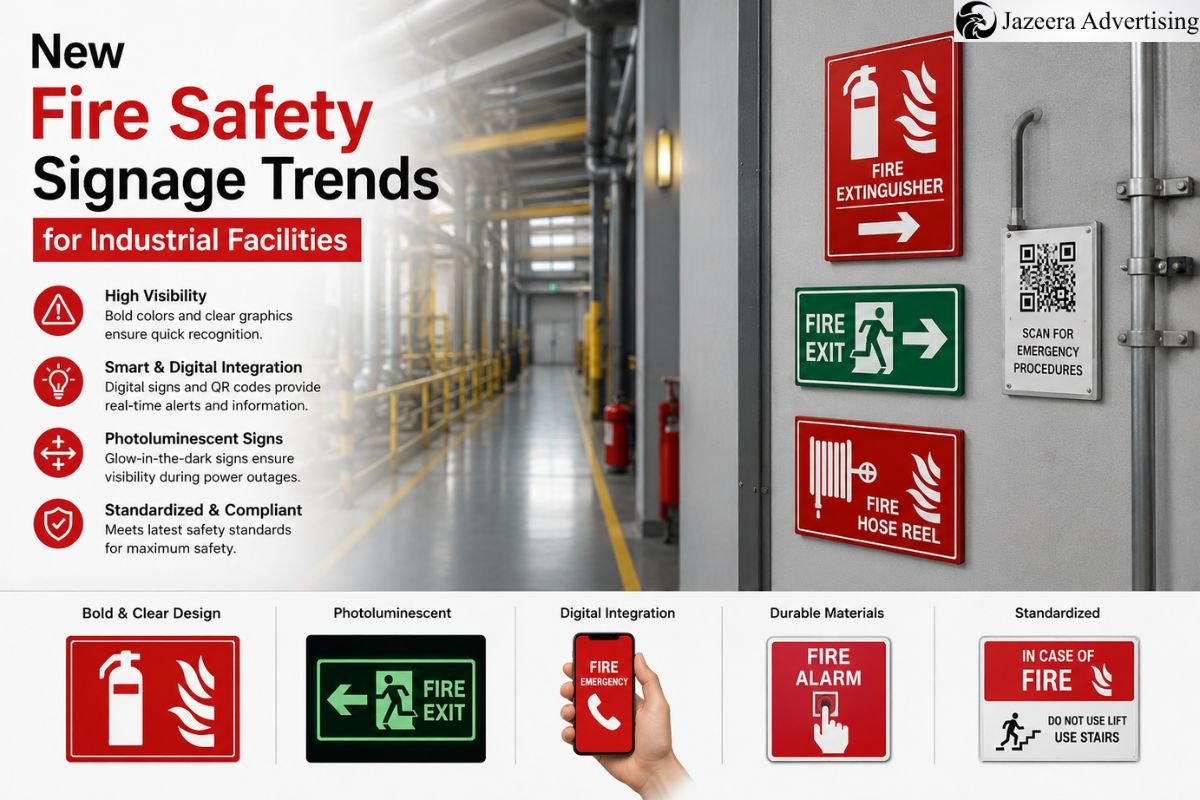
Some of the most significant developments in industrial fire safety signage are photoluminescent signs, real-time digital signs, multilingual signage featuring standardised symbols, and materials designed to resist heat and dust. They each address a shortcoming in existing sign systems, including the failure of signs to endure in smoke and the incomprehensibility of messages by workers in their own language.
- Photoluminescent Exit and Path Markings
Photoluminescent signs and floor strips activate under normal lighting and glow in the event of a power outage or smoke obscuring the sign. Low-level floor markings can help people navigate closer to the ground, which is usually less cloudy than a ceiling, in the event of heavy smoke.
A large number of facilities now combine these markings with exit signage that is illuminated by electricity. A failure of one does not mean that a route is left unmarked, because the other system supports the other. Photoluminescent materials also require a sufficient amount of “charging light” to function, so they are not intended to be used in places where they are in darkness for extended periods.
- Real-Time Digital Signage
Digital displays allow managers to put out a message with a single click. A plant may make the evacuation route visible for a particular zone, change to an alert during the evacuation drill, or present a closure notice if the section is closed. Some systems interface with the alarm panel, and the screen changes immediately after the alarm is triggered.
Planned strategies are required for the digital units. They should be battery-powered or back-powered by a generator, and the information they contain should be easy to read in one glance. An over-texted screen can slow people down rather than speed them up.
- Standardised Symbols for Multilingual Teams
UAE industrial labor forces tend to be multi-national. Some workers can read English or Arabic fairly easily, some can read symbols more quickly than words. Confusion among language groups is minimized with the use of standard pictograms, and bilingual text in Arabic and English continues to be widely used throughout the region.
If possible, select symbols in accordance with the ISO conventions. The same meanings can be recognized without using translation by workers from various countries; a new worker learns the system more rapidly during induction.
How should facilities choose their fire safety signage?
The selection process should not start with the product catalogue; it should start with a risk assessment. Inspect each zone and record the fire loads, occupants, equipment, and escape routes. Your signs will be based on those findings, and not a template.
A practical process looks like this:
- Draw a diagram of the layout of a current floor plan showing all the exits, escape routes, and assembly points.
- Use flagging in flammable, electrical panel, and high-heat areas.
- Verify sign size, sign height, and sign colour with relevant standards.
- Check visibility from a distance by standing at the maximum position in each zone.
- Make frequent inspections and cleaning appointments.
When seeking a quote, don’t stop at the price. Inquire about the methods used by each supplier to test materials against heat and UV exposure, whether they will estimate your location prior to making recommendations, and how fast they can replace damaged signs. The results that come back from your search may be towards the best signage company in Dubai, but the proper one is the one that understands your facility and not only tells you what it is doing, but also why.
Where should fire safety signs be placed?
The placement will determine if a sign is visible before it is needed. Signs should be placed at places where people naturally have to make a decision, such as a junction, doorway, and intersections of corridors. Signage will be at the same height throughout the site, which will enable staff to locate it without any need to think.
- Entrances, Exits, and Assembly Points
Each exit should have a sign accessible from the approach, and not just directly in front of the door. Signs at assembly points should be large enough to be seen from the outside of the assembly area, and should have arrows indicating the direction along which to assemble.
- Hazard Zones and Equipment Areas
Signs should be used to identify fire extinguishers, hose reels, electrical panels and chemical storage areas and to record the restrictions. Ensure that signs are not blocked by stock, pallets or machinery as this is a common issue identified in site audits.
On active builds, placement is as important as it is on the classic. Construction site safety signage in Dubai must be reviewed regularly since work sites are on the move and new buildings are being erected. A sign that was correct one month ago could indicate a route that is now closed.
Which sign materials hold up in UAE conditions?
Materials are important because of the high exposure to intense sun and dust in UAE sites, and salt-laden air in some coastal regions. As the sign fades, warps, or peels, its value can diminish rapidly. The following table outlines some of the more common options.
| Material | Typical Use | Strengths | Considerations |
| Aluminium composite panel | Indoor and outdoor zone signs | Rigid, lightweight, good weather resistance | Edges need sealing in damp areas |
| Rigid PVC | Interior directional and information signs | Affordable and easy to print on | Can yellow under strong UV without protection |
| Stainless steel | Hazard and equipment identification | Durable and handles knocks and washdowns | Higher cost and heavier to mount |
| Photoluminescent film or panel | Exit and path markings | Stays visible when power fails | Needs adequate charging light and regular checks |
The selection of the best safety signage board in Dubai should be based on the conditions rather than the brand. A yard open to the sun will have different specifications from an air-conditioned assembly hall. Inquire with your supplier about the performance of each material under your particular exposure.
How do you keep fire safety signs effective over time?
Signage cannot be viewed as a one-off installation. Conditions change as layout alterations take place, stock is sold, and staff members are turned over.
A simple maintenance process keeps the system efficient:
- Clean the signs and examine them for fading, cracks, or edges peeling at least once every month.
- Verify photoluminescent markings after a power failure to ensure that they glow.
- Provide an update to the signs and site maps whenever layout changes occur, equipment purchases take place, or route modifications have been made.
Maintain a sign register of installations, inspections, and replacements. The register also allows teams to identify trends, like that one exit sign being harder to read than the others. For official guidance, look into OSHA’s guidelines on workplace signs as well as fire codes from NFPA. Ensure to confirm the requirements with Dubai Civil Defence, since approvals vary based on the emirate and type of building.
What does the future hold for industrial fire safety signage?
Upcoming trends are likely to shape the future of industrial signage. Sensor-activated signs will be able to react to smoke or gas readings and change their messages accordingly. Moreover, connected systems will allow facility managers to check the operational condition of the sign remotely, thus notifying them of any problems before inspection.
At the same time, materials are also becoming advanced. Manufacturers keep improving photoluminescent formulations and weather-resistant finishes, thus making signs more durable in hot and dusty conditions. However, technology can only help carry out proper planning; an expensive sign installed incorrectly will not fulfill its function.
Bottom line
The effectiveness of fire safety signage in industrial environments is directly proportional to effective design, sturdy construction, and upkeep. Start with an assessment of risk, select the right signage that works for the environment, and arrange the signage correctly so it reaches the workers.
An experienced safety signage supplier in UAE could walk you through the practical aspects of choosing appropriate signage for your facility. There are a lot of things to consider when choosing an adequate supplier of signs in Dubai, including surveys of your facility, recommendations on the materials to use, and after-sales service. In other words, the most effective safety signage in Dubai becomes effective only after proper placement. At the same time, safety signs in Dubai must be adjusted to the changing shape of construction sites and risks that arise there.
Jazeera Advertising might assist you in coming up with signage solutions that would guarantee safety in your workplace.
Frequently asked questions
The main difference is that photoluminescent fire exit signs absorb ambient light and turn on in case of a power outage, unlike electrically powered signs, which constantly depend on power. Many industrial places utilize both types of fire exit indicators to back up each other.
Fire signs should be checked at least once a month for cleaning, malfunction, and visibility. They need to be tested right after a power failure. Any changes in layout or installation of new equipment should initiate the testing process of fire signs.
Aluminum composite panels are an established material for outdoor applications due to their sturdiness and resistance to environmental conditions. Their edges should be sealed in humid places, while all outdoor signage should also undergo testing for fading from the sun’s rays, since sunlight can be quite fierce in the area.
Yes, the digital displays should have a battery or generator backup, which will make sure that people will see the evacuation notices when the power fails. Their text should also be short enough to be comprehensible at a glance, since too advanced layout might be a barrier in the hour of emergency.

Emergency Exit Signs for Warehouses and Factories

Reception Signage Design Mistakes That Hurt Brand Perception