- August 24, 2026
- by Jazeeraadv
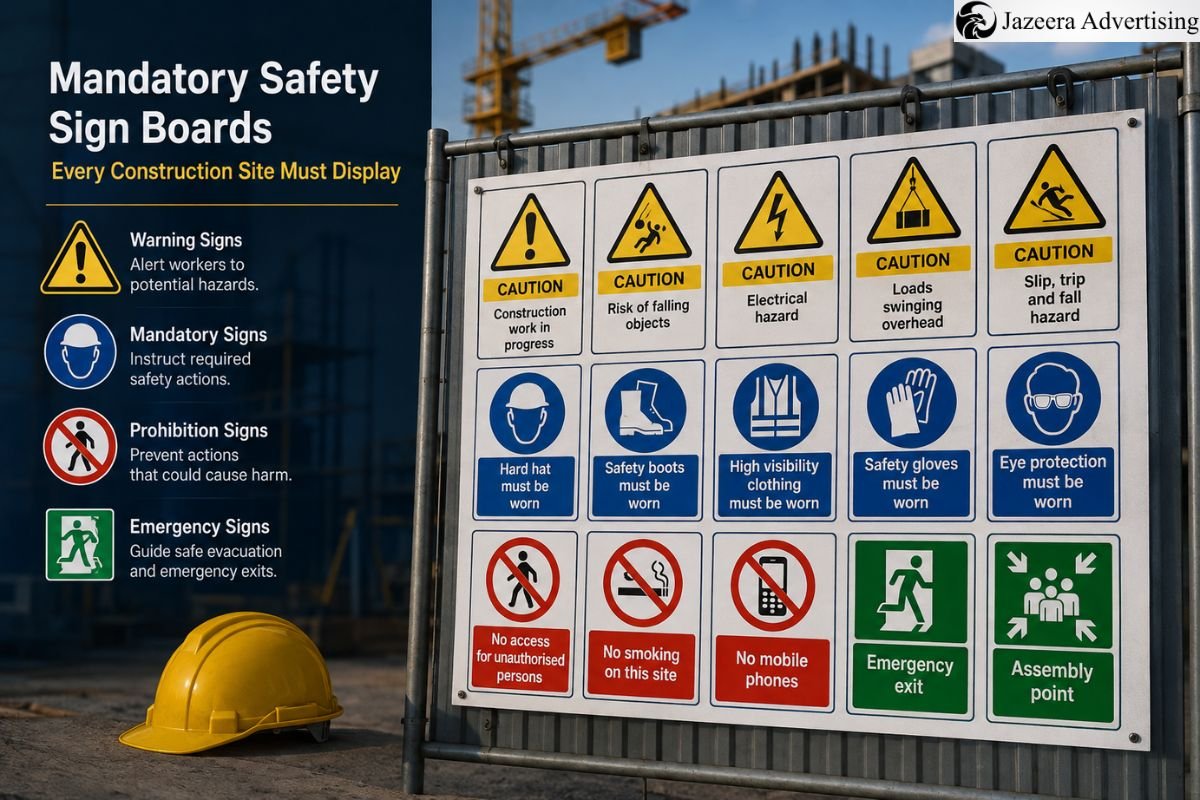
Mandatory Safety Sign Boards Every Construction Site Must Display
Table of Contents
- Key takeaways
- Why is safety signage optional on site?
- The legal framework behind site signage
- Mandatory sign categories every site needs
- Where signs fail even when they’re present?
- Choosing the best safety signage board
- Comparing sign materials for UAE job sites
- Common mistakes contractors make
- Working with a safety signage supplier
- Bottom line
- Frequently asked questions
As per the safety sign guidelines specified by Dubai Municipality and UAE Federal Decree-Law No. 33 of 2021, construction sites in Dubai are required to display ISO 7010-compliant safety signs indicating hazards, mandatory personal protective equipment, prohibitions, means of escape and first aid.
This means that signs for hard hats, visibility jackets and hard-to-read signs have to be installed for fall hazard and excavation warnings, no-smoking and restricted access signs, fire alarm and assembly point signs are to be put up including multilingual instruction for the non-Arabic-speaking and non-English speaking labor force. This is not merely a formality. The fact that 37% of accidents causing lost time can be attributed to falls means that the inspectors will not make a distinction between a missing sign and one that is not legible.
Key takeaways
- Dubai Municipality sets requirements when it comes to size, colour, wording, and position of safety signage.
- Safety signage comes in five categories: prohibition, mandatory, warning, emergency, and fire.
- Defective, diminished, or absent signage may pose compliance problems during inspection.
- Professional signmaking companies guarantee compliance with Dubai signage specifications from the outset.
Why is safety signage optional on site?
Most construction professionals are aware that the existence of safety signage is a must. It catches them off guard once they realize how much conscience a single sign possesses when a bad accident happens. Should someone get injured and it turns out that the relevant sign was missing or unreadable or in a language the injured worker knows nothing about, this information ceases to be a technicality and becomes important in the case of liability.
People may not fully understand just how big a problem this is. The International Labour Organization estimates that there are 2.2 million work-related killings each year. However, there are around 270 million work-related injuries every year, according to the organization. Studies in Al Ain show that lifting loads and falls are two major aspects of lost-time injuries; the two account for 75% of all injuries. In Dubai, about 38% of deaths were linked to lack of supervision in study.
The role of the signage is pretty clear: it cannot take the place of training or personal protective equipment. Signage can serve as a sign of caution that you should remember at times when the training fades away when you are in the middle of a shift.
The legal framework behind site signage
In Dubai, the construction site safety signs obey a number of regulations rather than a single rule, and having knowledge of the applicable regulations is what keeps a site clear of difficulties.
When it comes to the federal aspect of the matter, the UAE Federal Decree Law No. 33 of 2021, which deals with labour relations, obligates every employer to reduce risk of danger, occupational illness, and ignition hazards and to communicate those hazards properly and openly. However, it does not clarify what format or hue the signage must take as it defines the duty that is subsequently elaborated in detail.
In terms of policy, Dubai Municipality’s Technical Guideline for Safety Signs at Work is the document that effectively controls shape, colour, symbol, wording, and placement for construction projects throughout Dubai. Additionally, it also states that employers should have maintenance records for signboards, retrain employees in meanings of signs at least once a year, and keep such training records for up to five years in case of a DM inspection.
Globally, there are a lot of signs that refer to ISO 7010. It is because the meaning of the red circle with a diagonal line is “prohibited” in every country in the world. A person who has never been to the UAE can understand the signs from the first day on the job, which is vital considering that the workers here come from other countries.
Mandatory sign categories every site needs
DM’s guideline groups signs by function rather than treating them as one long list. Here’s what typically applies on an active site:
- Prohibition signs- Red circle, diagonal line, white background. No smoking, no unauthorised entry, no naked flames near fuel storage.
- Mandatory action signs- Blue circle, white symbol. Hard hat required, high-visibility vest required, hearing protection required near piling rigs or generators.
- Warning signs- Yellow triangle, black border and symbol. Overhead crane operation, excavation edges, electrical hazards, moving vehicles, working at height.
- Emergency and escape signs- Green rectangle, white symbol. Fire exit direction, assembly point location, first aid station.
- Fire equipment signs- Red rectangle, white symbol. Fire extinguisher location, fire hose reel, fire alarm call point.
Therefore, a mid-sized residential building near an industrial zone like Jebel Ali needs more than this base set: hazardous substance warnings near material storage, respiratory protection notices in dusty zones, confined space entry permits at manholes or below-grade structures. Sites next to public roads also need RTA-approved perimeter warning signs, sized to be readable at vehicle approach speed rather than walking pace.
Where signs fail even when they’re present?
This is the part contractors tend to underestimate. A site can have every required sign in place at handover and still fail an inspection six months later, simply because signs degrade and sites change shape.
Dubai’s climate is hard on outdoor signage. UV exposure fades colour-coded signs within months if the material isn’t rated for it, and a faded warning sign that’s still physically there doesn’t meet DM’s legibility requirement. Sand and dust building up on low-mounted signs is another failure point that routine walkthroughs miss more often than they should.
Additionally, site layouts also shift constantly during active construction. A scaffold that goes up in week three can block a fire exit sign that was perfectly visible in week one. A new excavation trench can open in an area that had no warning sign because nothing hazardous was there when the signage plan was first drawn up. A static, install-once approach doesn’t hold up against a site that looks different every month.
Choosing the best safety signage board
Not every signboard vendor knows DM’s technical requirements in real depth, and that gap tends to surface during inspections, not before. When you’re evaluating the best safety signage board in Dubai for a given site, a few things matter more than the price per unit.
Material durability under direct sun and heat is the first filter. UV-stable vinyl or powder-coated aluminium holds its colour far longer than basic printed acrylic outdoors. Second is correct sizing and mounting height under DM’s placement rules, since a sign with the right content but the wrong mounting height can still draw an inspection note. Third is multilingual capability.
With a workforce drawn heavily from India, Nepal, Pakistan, and Bangladesh, a sign carrying only Arabic and English text misses a large share of the people it’s supposed to protect. Pictogram-heavy designs built around ISO 7010 solve most of this, since the symbol carries the meaning regardless of what language the worker reads.
Comparing sign materials for UAE job sites
| Material | Outdoor Lifespan (UAE climate) | Best For | Cost Level |
| Rigid PVC/foam board | 6–12 months | Short-term projects, temporary zones | Low |
| Powder-coated aluminium | 3–5 years | Long-term fixed hazard signs, entrances | Medium |
| Reflective vinyl on aluminium | 3–5 years | Night-visible zones, vehicle routes | Medium-High |
| Photoluminescent signage | 5+ years | Emergency exits, escape routes | Medium-High |
| Digital/LED signboards | Ongoing (electronics-dependent) | High-traffic entrances, site status boards | High |
For most active sites, a mix beats committing to one material across the board: aluminium for fixed structural warnings, photoluminescent for escape routes and stairwells, cheaper board for zones that keep shifting as the project moves.
Common mistakes contractors make
- Buying signs once and forgetting maintenance- DM’s guideline calls for ongoing checks, not a single installation. A yearly signage audit, timed alongside the mandatory annual safety refresher, catches most fading and damage before an inspector does.
- Treating signage as English-only- A sign nobody on site can read isn’t doing its job, whatever the letter of the law technically requires it to say.
- Under-signing temporary hazards- Excavations, scaffolding zones, and material storage areas move around throughout a project, and signage plans often lag behind the physical site.
- Mixing non-standard colours or symbols- Custom signs that skip ISO 7010 conventions can confuse workers used to reading the standard shapes, even if the custom version is technically legible on its own.
Working with a safety signage supplier
Getting signage right isn’t really a design exercise. It’s a compliance exercise that happens to need good design to pull off. A safety signage supplier in UAE that knows DM-HSD-GU99-SSW2 in real depth can flag placement and content issues before signs go up, not after an inspector finds them.
Jazeera Advertising has fabricated signage for construction and industrial sites across Dubai, working directly with contractors to match sign specifications to DM’s technical requirements rather than pulling from a generic template. That includes UV-stable materials suited to outdoor exposure, correctly sized mandatory and warning signs, and multilingual layouts built around the workforce actually on site.
For contractors comparing signage solutions Dubai options, the real difference usually comes down to whether the supplier treats the DM guideline as the starting brief or as something to catch up on later.
Bottom line
Construction site safety signage in Dubai is more than just a prerequisite for the manager process. It actually ensures safety of workers all the way through the project. Safety signs should be legible, robust, and appropriate for the UAE weather. They should also accommodate workers and be adjusted according to the changing projects.
If your signage plan hasn’t been modified since it was drawn up, means that it might be outdated. Jazeera Advertising helps companies create signage tailored to their needs which comply with Dubai Municipality requirements.
Frequently asked questions
With the Dubai Municipality’s technical guideline minimum: signs for mandatory PPE, hazard and fall warning, prohibition, fire marking, emergency exit and assembly point.
Between the inspections, Dubai Municipality’s Building Control Section is responsible for running site inspections, and contractor HSE teams are tasked with ensuring compliance.
While languages are not specified by DM, the signs must be understood by those present, so typically a mixture of symbols and Arabic, english and workers’ native languages.
DM’s guideline dictates that damaged, faded signs must be replaced immediately, staff must be retrained on sign meanings annually, and maintenance records must be kept.
Under direct sun, printed board will typically last a few years less than powder-coated aluminium or UV-stable reflective vinyl.
Yes. Most UAE safety sign suppliers, such as Jazeera Advertising, design, manufacture, and install safety signs all in one go.
Fines, project delays and failure to pass inspection are all consequences of missing or illegible signage, and it plays a role in liability when it is associated with an incident.
It’s not an independent UAE regulation but DM’s technical guideline, and local sign fabricators are designing off the ISO 7010 symbols.

Emergency Exit Signs for Warehouses and Factories

Reception Signage Design Mistakes That Hurt Brand Perception