- August 20, 2026
- by Jazeeraadv
Reflective Caution Signs: Why Visibility Matters at Night
Table of Contents
- Key takeaways
- Why does nighttime visibility change everything?
- How does retroreflective sheeting actually work?
- Where does reflective signage matter most in Dubai?
- Choosing the best safety signage board
- Common mistakes businesses make with signage
- Reflective vs standard signage: A quick comparison
- Working with a trusted signage solutions partner
- Bottom line
- Frequently asked questions
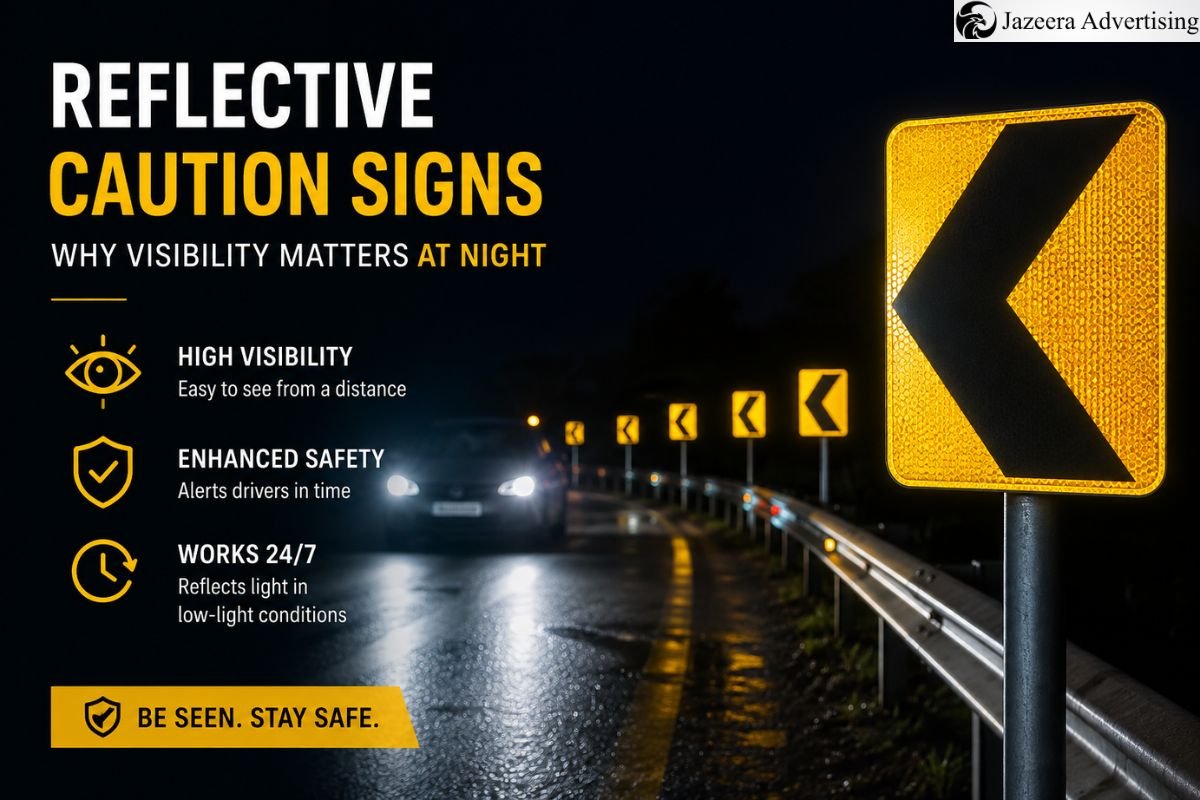
Reflective caution signs feature retroreflective sheeting that allows them to reflect light straight into the driver’s eyes, which explains why they are perceived so well in the dark, a factor that cannot be achieved by any painted or printed board. According to statistics from the US Federal Highway Administration, roughly 50% of all traffic fatalities occur in the dark, although only about a quarter of trips happen after dark.
However, this difference is due to visibility, that’s all. When it comes to construction sites, warehouses, and busy roads in the UAE, this means that there is no question about choosing the best safety signs in Dubai. It is a matter of safety. As soon as it gets dark, any board that does not have appropriate reflection-grade sheeting is no longer properly visible, no matter how good it looks in a computer program.
Key takeaways
- Even though driving hours have decreased, nighttime car crash deaths are rising, signaling visibility issues.
- The effectiveness of reflective signs relies on the quality of the sheeting, mounting angle, and longevity of signs.
- Due to the construction sites and rapid pace of vehicles in Dubai, the importance of reflective signage cannot be overemphasized.
- A reliable supplier of safety signs in the UAE provides engineering-grade reflective signs made of strong materials
Why does nighttime visibility change everything?
Human eyes have evolved to excel during daylight. However, as ambient light decreases, people’s capability to perceive distance, interpret written messages, and discern forms against a dark ground dips quickly before most would even acknowledge that it is difficult to see anything. For a driver approaching an instruction sign at a speed of 80 km/h, there is only about 2-3 seconds to identify the sign, read the instructions, and take action. If no light reflects off the sign, it may as well not exist.
Moreover, the issue is not related only to highways. Many commercial yards, borders of warehouses, and building sites receive trucks beyond sunset, and people walking around these sites are exposed to many more risks than a driver behind a windshield. Pedestrian deaths tend to follow the same trend as the number of car accidents; the night hours contain a disproportionate number of fatalities compared to the pedestrian traffic that happens at night.
How does retroreflective sheeting actually work?
Reflective signs do not shine or have a light source inside them. Retroreflective coating is what is used, which consists of reflective coating with extremely small glass beads or prism-like lenses placed on the surface so that the light from the environment is caught (mostly from car headlights) and reflected to its source without being dispersed like regular paint.
That is what brings about the difference between one sign that can only be indistinctly seen and one that can stand out visibly from a distance of up to 50 meters. Different varieties of reflective sheeting are used:
- Engineer-grade sheeting- It provides regular reflectivity, a short lifespan, and is suitable for indoor signs with little traffic
- High-intensity grade sheeting- This is designed for better brightness and will suit road marking applications
- Diamond-grade sheeting-This is the best performing one and is applied in situations where the response distance is crucial, like construction areas on highways
In daylight, two boards may appear the same, but they can perform entirely differently under the headlights during the nighttime. This is why it’s essential to source it from a genuine safety signage supplier in UAE rather than the supplier who gives you the best value. The cost and performance lie in the base material rather than the printing.
Where does reflective signage matter most in Dubai?
Dubai’s growth means active construction sites, industrial expansion, and dense traffic corridors often sitting on the same stretch of road. A few places where reflective signage isn’t really optional:
- Active construction perimeters, where barriers, diversions, and crane zones need to register instantly for drivers and site visitors after dark
- Industrial and logistics yards, where forklifts, trucks, and staff share tight space under limited lighting
- Parking structures and basements, where reflective boards make up for artificial lighting that’s rarely as bright as daylight
- Public road frontages, where business signage doubling as a hazard warning still has to meet municipal visibility expectations
Therefore, construction site safety signage in Dubai carries extra weight here because contractors are legally on the hook for worker and public safety on-site, and inspectors do check whether warning boards stay legible after dark, not just during a daytime walkthrough.
Choosing the best safety signage board
- Picking the right board comes down to matching sheeting grade, size, and placement to the actual risk on-site, not just the budget line. A few practical filters before ordering:
- Match the grade to the speed of traffic nearby. A quiet internal walkway doesn’t need diamond-grade sheeting. A road-facing construction barrier does.
- Check UV and weather resistance separately from reflectivity. Dubai’s sun degrades cheap laminates fast, and a board that’s stopped reflecting properly after eight months of heat isn’t saving anyone money; it’s just a sign-shaped liability.
- Confirm the mounting height and angle actually match how vehicles or workers approach the sign. Reflective sheeting is directional. A board mounted at the wrong angle loses much of its benefit even with premium material underneath.
Moreover, businesses searching for the best safety signage board in Dubai are usually better off comparing suppliers on material spec sheets than on photos, since reflectivity performance genuinely can’t be judged from a daytime picture.
Common mistakes businesses make with signage
A few patterns keep showing up on sites that later deal with visibility complaints or near-misses:
- Buying printed vinyl boards and assuming bright colors do the same job as actual reflective sheeting
- Installing signs at a height or angle where headlights never hit the reflective surface directly
- Reusing weathered boards past their reflectivity lifespan because the print still looks fine
- Placing warning signs too close to the hazard instead of far enough back to give drivers real reaction time
- Treating signage as a one-time purchase instead of something that needs periodic inspection
None of these are expensive fixes once someone catches them. The problem is they usually go unnoticed until an incident forces the review.
Reflective vs standard signage: A quick comparison
| Factor | Standard Printed Signage | Reflective Safety Signage |
| Night visibility | Poor, relies on ambient light | Strong, actively bounces headlight beams |
| Typical lifespan (UAE climate) | 1 to 2 years before fading | 3 to 5 years with proper-grade sheeting |
| Best suited for | Indoor, low-risk, daytime-only areas | Roads, construction zones, industrial yards |
| Compliance suitability | Often falls short at site inspections | Meets standard site safety expectations |
| Cost over time | Lower upfront, replaced more often | Higher upfront, cheaper in the long run |
Working with a trusted signage solutions partner
Reflective signage costs very little next to a single nighttime incident, but only if it’s specified the first time correctly. That means working with someone who’ll actually talk through sheeting grades, mounting requirements, and site-specific risk, rather than just taking a design file and running it through a printer.
Jazeera Advertising has worked across Dubai’s construction, industrial, and commercial sectors long enough to know that a sign’s daytime appearance tells you almost nothing about how it performs at 11 PM. For businesses comparing signage solutions Dubai, the real test isn’t which supplier has the nicest portfolio. It’s which one asks about your traffic speed, mounting height, and site conditions before recommending a sheeting grade.
If your current boards haven’t been reviewed in a while, or you’re setting up a new site and want this handled correctly from day one, Jazeera Advertising can help specify and produce reflective signage suited to your exact location and risk profile.
Bottom line
When the sun sets, reflective signage is an important safety feature for drivers to help them negotiate roads and traffic safely. In fact, evidence shows that nighttime is generally when more accidents occur, even if there are fewer cars on the road. For construction projects, manufacturing facilities, or busy roads in Dubai, it is important to choose the correct grade of sheeting and to make sure the angle of installation is appropriate for safety, irrespective of how attractive the actual design may be.
If you haven’t inspected your existing signs for a while, it might be a good time to do so. Jazeera Advertising can help you to choose the signs which will stand out during the night.
Frequently asked questions
1. What makes a sign “reflective” versus just brightly colored?
Reflective signs use retroreflective sheeting with glass beads or prisms that send light straight back to its source. Bright paint just scatters light and won’t perform the same way after dark.
2. How long does reflective sheeting last in Dubai’s climate?
Quality sheeting usually holds up for 3 to 5 years under UAE heat and sun exposure, though placement, angle, and material grade all affect how long it actually lasts in practice.
3. Is reflective signage legally required on construction sites?
Most municipal safety codes expect legible warning signage day and night on active sites, which makes reflective boards a practical necessity rather than an optional upgrade for contractors.
4. What’s the difference between engineer grade and diamond-grade sheeting?
Engineer grade offers basic reflectivity suited to low-traffic areas, while diamond-grade prismatic sheeting delivers stronger, longer-range visibility for highways and high-speed roadways.
5.Can reflective signs fail even if they look fine in daylight?
Yes. Faded laminate, a wrong mounting angle, or degraded sheeting can all cut into nighttime performance without any visible change showing up during a daytime check.
6.Do parking structures need reflective signage too?
Yes, especially basements and ramps where artificial lighting is inconsistent. Reflective boards make up for shadows and dim corners that regular lighting often misses.
7. How do I know which signage supplier to trust for reflectivity claims?
Ask for material specification sheets, not just design samples. A genuine safety signage supplier in UAE should be able to confirm exactly which sheeting grade was used.
8. What’s the biggest visibility mistake businesses make with signage?
Assuming printed vinyl with bright colors performs the same as true reflective sheeting. It doesn’t, and the gap only shows up once it’s actually dark outside.
9. Should reflective signs be placed closer to hazards or further back?
Further back, generally. Drivers need enough distance to see, read, and respond to a warning before they actually reach the hazard point.
10.How often should reflective signage be inspected?
A visual and reflectivity check every 6 to 12 months is reasonable, more often in high-UV or high-traffic areas where wear sets in faster than people expect.

Emergency Exit Signs for Warehouses and Factories

Reception Signage Design Mistakes That Hurt Brand Perception