- August 1, 2026
- by Jazeeraadv
Common Construction Site Safety Signage Mistakes That Lead to Fines
Table of Contents
- Key takeaways
- Why do signage mistakes cost more than you think?
- Mistake 1: Using faded or damaged signs
- Mistake 2: Wrong signage placement
- Mistake 3: Missing multilingual instructions
- Mistake 4: Ignoring municipality-specific requirements
- Mistake 5: Inconsistent signage across zones
- Mistake 6: DIY or non-compliant materials
- How to get construction site safety signage right?
- Working with a reliable signage partner
- Wrapping it up
- Frequently asked questions
Key takeaways
- Construction signs that are worn-out often incur unnecessary inspection costs in Dubai.
- Multilingual construction signs have become important for labour forces diverse in Dubai.
- Establishments regarding construction vary according to the construction project, thus, the utilization of generic signs no longer suits today’s world.
- First safety sign suppliers in UAE save one from costly last-minute issues regarding compliance.
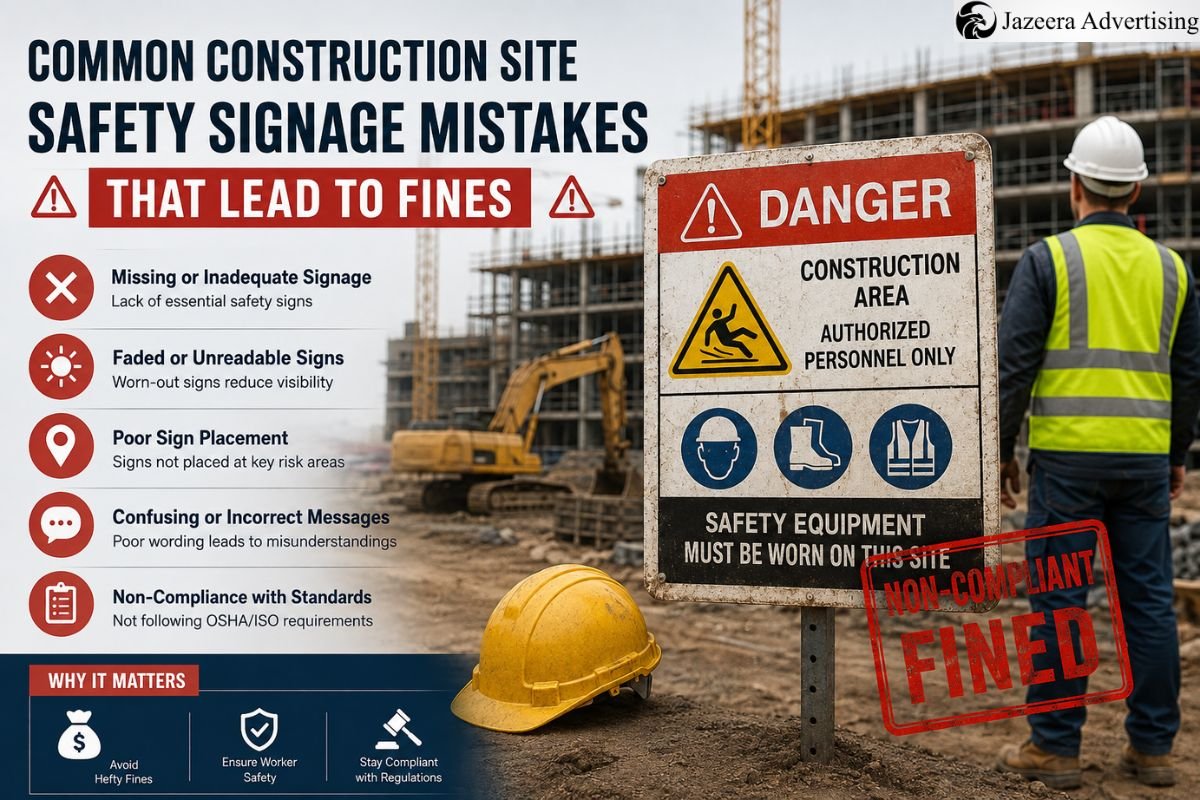
Construction site safety signage in Dubai does more than satisfy an inspector’s checklist. It’s what keeps a worker from walking straight into a hazard he’d otherwise miss. Site visits across the city turn up the same problems on repeat: signs bleached past readability, warnings mounted where no one looks, instructions printed in a language half the crew can’t read.
None of that is minor. Dubai Municipality and Dubai Civil Defence treat signage as a real compliance issue, and getting it wrong usually means fines, stop-work notices, or repeat inspections that push handover dates back. If you manage a site, knowing where signage tends to fail, and why, saves money and prevents injuries.
Here’s a rundown of the mistakes we see most often on Dubai sites, and how to fix each one.
Why do signage mistakes cost more than you think?
A missing hazard sign looks like a paperwork problem until someone gets hurt near unmarked scaffolding or a live electrical panel. Beyond the human cost, Dubai’s regulatory bodies treat signage as core to site safety compliance.
Fines for inadequate signage run from a few thousand dirhams up to considerably more for repeat violations, and in serious cases authorities can stop work entirely until the issue is fixed. On a large project, even a two-day stoppage often costs more than proper signage would have in the first place.
However, there’s an insurance angle too. Some contractors don’t realize that weak signage can complicate a claim after an incident, since insurers may point to it as evidence that basic precautions weren’t taken.
Mistake 1: Using faded or damaged signs
Dubai’s sun is hard on outdoor signage. Standard vinyl or low-grade printed boards start fading within months, and by the time a sign is unreadable, most site managers have long stopped noticing it’s even there.
Why This Happens
Signage goes up once during site setup and then gets forgotten. No one is assigned to check its condition on an ongoing basis, so a board bleached out over eight months just becomes part of the background.
The Fix
Instead of viewing signage inspections as a distinct responsibility, make it a part of your routine safety checkups. Utilize materials resistant to ultraviolet rays that are designed for Gulf weather conditions as opposed to simple indoor sign materials. Although it may be more expensive at first, it pays off in lower replacement costs and fewer fines in the long run.
Mistake 2: Wrong signage placement
A fire extinguisher sign mounted three meters above eye level. A “No Entry” board buried behind stacked materials. These placement errors happen constantly, usually because signage goes up wherever it’s convenient rather than where workers will actually see it.
Common Placement Errors
- Hazard signs placed after the danger zone instead of before it
- Signs blocked by scaffolding, equipment, or stored materials
- Mounting heights too high or too low for average sightlines
- No signage at secondary or temporary access points
The Fix
When you are walking the site, think of how workers actually use the space. Place signage at those locations when important decisions are made: at gates, where hazardous zones begin, along the path to equipment, or at emergency assembly points. The placement must anticipate workers’ movements instead of adding to the design after everything is done.
Mistake 3: Missing multilingual instructions
This is among the most common problems with construction site safety signage in Dubai. Most of the workforce comes from South Asia and more workers can read Hindi or Urdu than English or Arabic.
Using English only may look good on a checklist but fails to do the one thing that is truly important: ensuring that all site workers understand what potential hazards are.
The Fix
Use pictogram signs wherever possible, as visual signs overcome language barriers very quickly. In case text is needed, provide it in Arabic, English, and, depending on your workers, Hindi and Urdu. This small detail may save more accidents than any other improvement in signage.
Mistake 4: Ignoring municipality-specific requirements
Some building contractors believe that one type of signage package will work with any site in the UAE. This is not true. Requirements vary depending on an emirate, municipality regulations, type of the project, as well as whether or not the site is within the jurisdiction of Dubai Civil Defence fire and life-safety signage.
Making the order of general signage without checking new regulations is a good way to fail your inspection.
The Fix
Make sure to get confirmation on the current regulations before making any purchases and work with a signage solutions Dubai supplier who keeps on top of regulatory changes rather than simply using the same designs for every client.
Mistake 5: Inconsistent signage across zones
Complex sites often have multiple contractors and subcontractors working in various areas of a site and each brings its own style of signage. The result of this is that hazard colors, symbols, and formats can be quite different from zone to zone causing confusion for workers moving in these areas.
The Fix
Lock in signage specifications for the whole site before work starts, including color coding, symbol style, and sizing. A single unified system, ideally from one safety signage supplier in UAE, is easier for both workers and inspectors to read at a glance.
Mistake 6: DIY or non-compliant materials
Some sites still rely on hand-painted boards or printed paper taped to a wall. That might get you through a day or two, but it doesn’t meet durability, visibility, or regulatory standards, and it falls apart fast outdoors.
The Fix
Source signage from an established best safety signage board in Dubai provider using reflective, weather-resistant, code-compliant materials. It’s a small line item against overall project cost, but it directly decides whether your site passes inspection.
How to get construction site safety signage right?
Getting this right isn’t complicated. It just means treating signage as ongoing work rather than a one-time install.
- Audit signage needs at the start of every project phase, not just at kickoff
- Match signage type to the actual hazards on site, not a generic template
- Build in multilingual and pictogram elements from day one
- Check condition regularly, alongside other safety inspections
- Keep documentation of placement so you’re ready for inspection
Moreover, sites that manage signage as an ongoing part of safety, rather than something handled once, tend to do noticeably better in municipality inspections.
Working with a reliable signage partner
Getting construction site safety signage in Dubai right usually comes down to who’s supplying it. Jazeera Advertising has worked with contractors across the emirate to design, manufacture, and install signage that holds up under both weather and inspection.
Jazeera Advertising handles the process from initial site assessment through material selection, matching signage to current municipality and Civil Defence requirements instead of shipping out a generic package. For contractors running multiple sites or working against a tight timeline, having one dependable partner like Jazeera Advertising removes a recurring source of risk.
Wrapping it up
Avoidable signage errors can be minimized if people consider signage important, rather than just a formality. Some common harming signage issues that usually lead contractors to fines are: bad quality signs, incorrect position, bad translation and ignoring legal regulations, but these issues can be solved quickly.
Additionally, construction site safety signs in Dubai can help protect the construction team, allowing them to continue working satisfactorily and without the threat of stopping the project.
Are you ready to check your construction site for signage before the inspection? Contact Jazeera Advertising for a compliance overview and a special plan that takes into account the hazards at your construction site.
Frequently asked questions
Safety signs and signage are generally required and follow the guidelines set by Dubai Municipality and Civil Defence which include hazard signs, required PPE signs, fire and emergency signage, restricted access signs, and site information boards.
Review it monthly at least and after any major weather event to ensure that it is not fading, damaged or displaced, before it becomes a compliance problem.
Yes. Considering the variety of the workforce, signage should be in Arabic and English, and in other languages for better communication if possible – pictograms are advisable.
Violations may result in fines or stop-work orders depending on the severity of the violation and may lead to greater penalties and more stringent review on future inspections if it occurs again.
The main contractor is responsible for the whole project but the subcontractors responsible for their own areas would be expected to ensure that they have compliant signage within their zone.
The price depends on the type of material used, the size of the sign and the number of signs required but it’s typically far cheaper to pay a one-time cost for durable and weather proof signage than paying fines or replacing them over and over again.
The materials are also designed to withstand the sun’s rays and high heat, which is essential for outdoor applications in Dubai, and are expected to last significantly longer than the boards used indoors.
Not reliably. Signage varies from municipality to municipality, project to project, hazard to hazard and should not be used off-the-shelf.
Mandatory signs provide instructions for workers like wearing PPE. Warning signs indicate a hazard, such as an electrical hazard or excavation zone.
Audits, a single uniform signage system across zones and a reliable safety signage supplier in UAE are all that it takes to maintain a project compliant from start to finish.
Digital Compliance Boards: Future of Industrial Safety
Safety Signage Cost Guide for Businesses