- February 9, 2026
- by Jazeeraadv
Reception Area Branding: Do’s and Don’ts for Professional Spaces
Table of Contents
- Key Takeaways
- Why does reception area branding matter for professional spaces?
- What are the key do’s of reception area branding?
- What are the common don’ts you should avoid?
- How can the right signage improve brand trust and experience?
- Why professional expertise matters in reception branding?
- Conclusion
- Frequently asked questions
Key Takeaways
- Reception branding builds first impressions that establish trust
- Simplicity and consistency are key to professional environments
- Signage enhances visitor comfort and confidence
- Professional delivery maximizes long-term branding potential
Branding of the reception area creates a first impression, instills trust, and displays business values in seconds. An effective welcome area makes the visitors feel safe and secure. Smart reception branding is not an option anymore; in competitive markets such as reception signage in Dubai, it is a professional requirement.
Why does reception area branding matter for professional spaces?
When a person comes into your office, the reception area is spoken before your employees. It silently conveys your professionalism, culture, and attention to detail. Therefore, proper branding of this space will help in creating expectations early on.
A reception area is not a waiting area only. It is a brand touchpoint. Clients, partners, or job applicants walk in and make their opinions. However, branding provides familiarity and trust, which are directly related to business growth.
Based on experience, professional branding firms have noted that visitors feel more secure when a reception area is well-organized and branded. Such trust tends to give rise to improved dialogues and enhanced relationships.
Additionally, reception branding assists companies:
- Be different in competitive industries.
- Strengthen brand image through visual means.
- Design an experience that is memorable to the visitor.
- Support employee pride and morale.
This is the reason why experienced providers such as Jazeera Advertising are interested in branding strategies that do not clutter the space with design, clarity, and functionality.
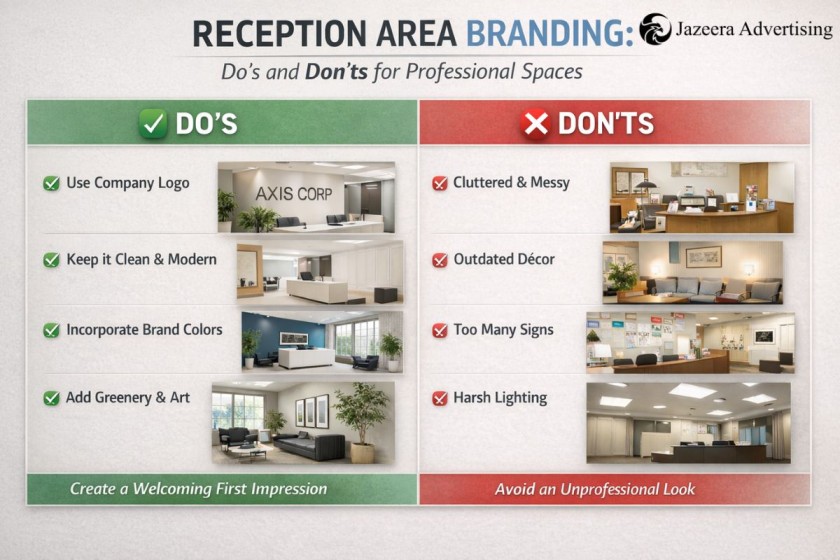
What are the key do’s of reception area branding
- Do you keep branding simple and clear?
In the workplace, simplicity is always the best. A well-organized design with clear branding will make sure that the visitors do not confuse who you are. Therefore, logos, colors, and fonts must correspond to your brand image at all times.
Avoid clutter. Rather, employ targeted branding components that lead to attention in a natural way. Clear graphics make the visitors feel oriented and relaxed.
- Do you use signage that matches the space?
The signage must be appropriate to the size of the reception area, lighting, and style. For example, minimal signage is a good idea in modern offices, whereas creative workplaces may rely on bold graphics.
Scale and location are important in the workplace, such as office reception signage Dubai. Excessive signage can be aggressive, whereas small signage can be ignored.
Good practices include the following:
- Correct logo sizing
- Balanced wall spacing
- Readable writing at a distance.
- Interiors with harmonized colours.
- Do you focus on visitor experience?
The reception branding must never ignore the flow of visitors in the space and their waiting. Moreover, there should be signage at points of entry and direct people in a natural manner.
Comfort also matters. Visitors are respected when branding assists in clarity and calmness. Additionally, a friendly atmosphere will minimize stress, particularly in first-time visitors.
- Do you reflect brand values visually?
Design should reflect your brand values. For example:
- A technology firm might lean towards clean lines and electronic finishes.
- A business organization can adopt plain colors and official fonts.
- An agency can be creative with visuals that are expressive.
This alignment builds trust. Companies that deal with Jazeera Advertising tend to focus on value-based branding in order to achieve authenticity.
What are the common don’ts you should avoid?
- Don’t overload the space with information
The biggest error is the inclusion of excessive text or excessive graphics. Information is valuable, but an excess of it overloads visitors.
Therefore, reception branding must convey only necessities.
Avoid:
- Long mission statements on walls.
- Multiple logos in one view
- Too many color combinations.
However, clarity is always better than complexity.
- Don’t ignore lighting and visibility
The best branding cannot work in case it is poorly lit. Impact can be diminished by dark corners, glare, or shadows. Therefore, signs are to be installed where lighting is favorable.
Good lighting enhances:
- Logo readability
- Material finish
- Overall brand appeal
Moreover, this detail should not be overlooked, and it may make a professional office appear unplanned.
- Don’t use inconsistent branding elements
Uniformity creates awareness. The application of various fonts, colors, or variations of the logos disorients visitors. Additionally, inconsistency undermines brand trust.
Furthermore, there should be professional branding rules. This is the reason why it is important to work with experienced teams.
- Don’t treat reception branding as decoration only
Reception branding is not just a decoration on the wall. It is tactical communication. It is not a good idea to treat it casually.
Rather, the branding process must be strategized and be purposeful in terms of business objectives and expectations.
How can the right signage improve brand trust and experience?
Signage is important in the perception of a business by the visitors. Professional signage is clear and easy to follow. Consequently, visitors become more relaxed and assured.
Reception signage is becoming popular among businesses in markets where branding and signage companies in Dubai in order to build credibility within a short time.
Effective signage:
- Authenticates brand authenticity.
- Guides visitors smoothly
- Improves professional image.
- Supports wayfinding
Moreover, reception signage is included in the brand story. It does not say a word but speaks volumes about reliability.
Based on the experience, firms investing in quality signage usually get positive feedback on the part of clients and partners. This strengthens trust and long-term relationships.
Why professional expertise matters in reception branding?
Reception branding does not just need design skills. It requires space, material, compliance, and brand psychology knowledge.
Therefore, professional experience is an important factor. A professional indoor signage company in Dubai knows the behavior of materials in an indoor environment, the impact of lighting on perception, and how branding works in interiors.
Cooperation with such professionals as Jazeera Advertising guarantees:
- Correct material selection
- True brand representation.
- Prolonged quality of installation.
- Follow the professional standards.
Even though DIY solutions might appear to be cost-effective, they usually do not provide consistency and durability. Professional implementation will save time, effort, and correction expenses in the future.
Conclusion
Branding of reception areas is a strategic investment rather than a design trend. When properly done, it creates trust, enhances visitor experience, and strengthens brand identity. Companies that dwell on transparency, uniformity, and competence get more impressions. The right partner and careful planning of signage would guarantee long-term value, particularly when dealing with a trusted interior signage company in Dubai that knows professional spaces.
Frequently asked questions
It establishes trust, creates good first impressions, and is professional immediately.
Sufficient to convey identity without being cluttered or overloaded with visuals.
Yes, branding must merge with interiors in a harmonious manner.

Best Materials for Reception Letter Signage: Acrylic, Stainless Steel or Brass?

Office Branding Trends Businesses Are Following in 2026